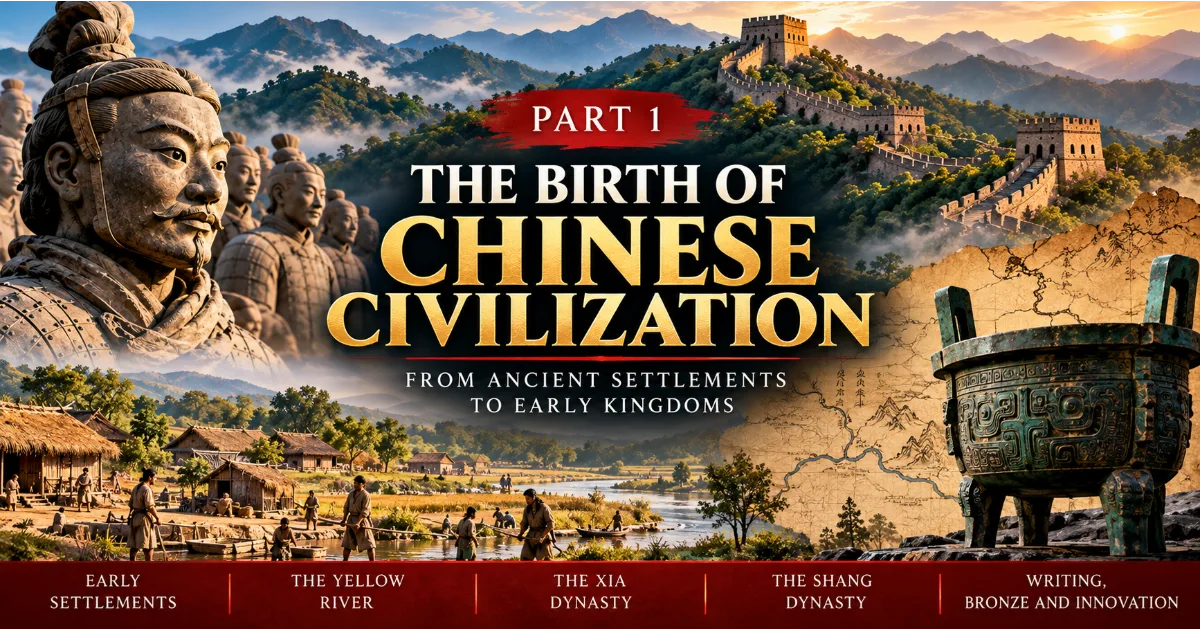
How rivers, farming, ancient communities, and environmental challenges helped shape the foundations of Chinese civilization.
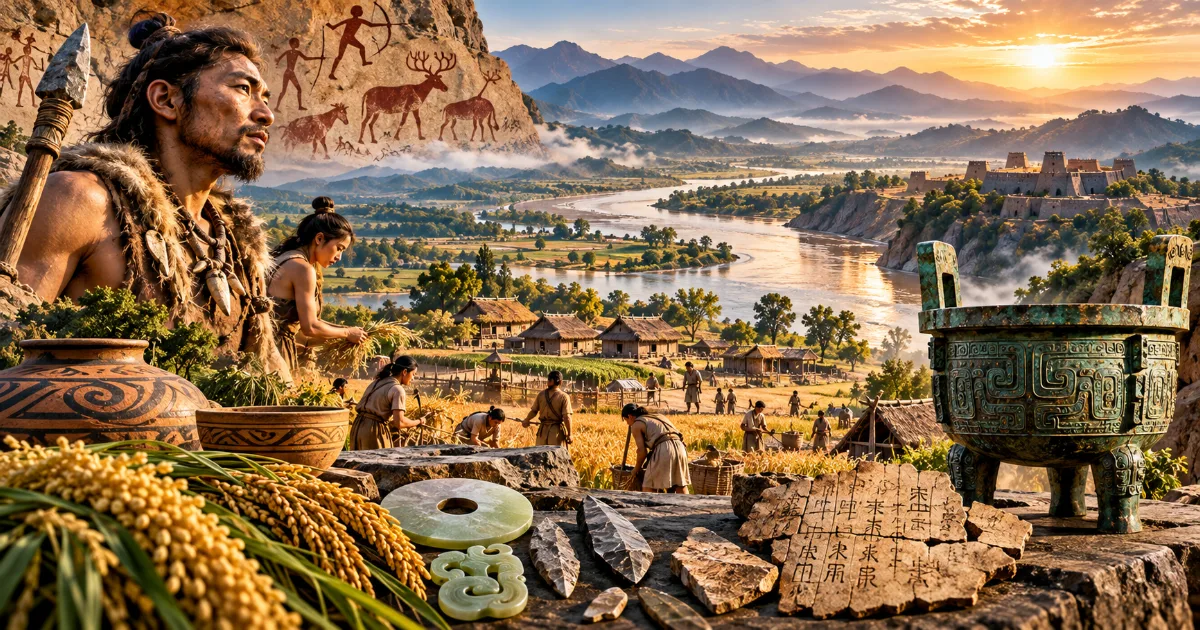
The story of China's agricultural beginnings is a story of people learning to live with the land. Thousands of years before emperors ruled from magnificent palaces, communities across what is now China were discovering how to cultivate crops, store food, build permanent homes, and organize their lives around the changing seasons. Among the geographical features that influenced this transformation, the Yellow River became particularly important. Its waters and surrounding plains supported agricultural communities, while its unpredictable floods created challenges that required adaptation, cooperation, and resilience.
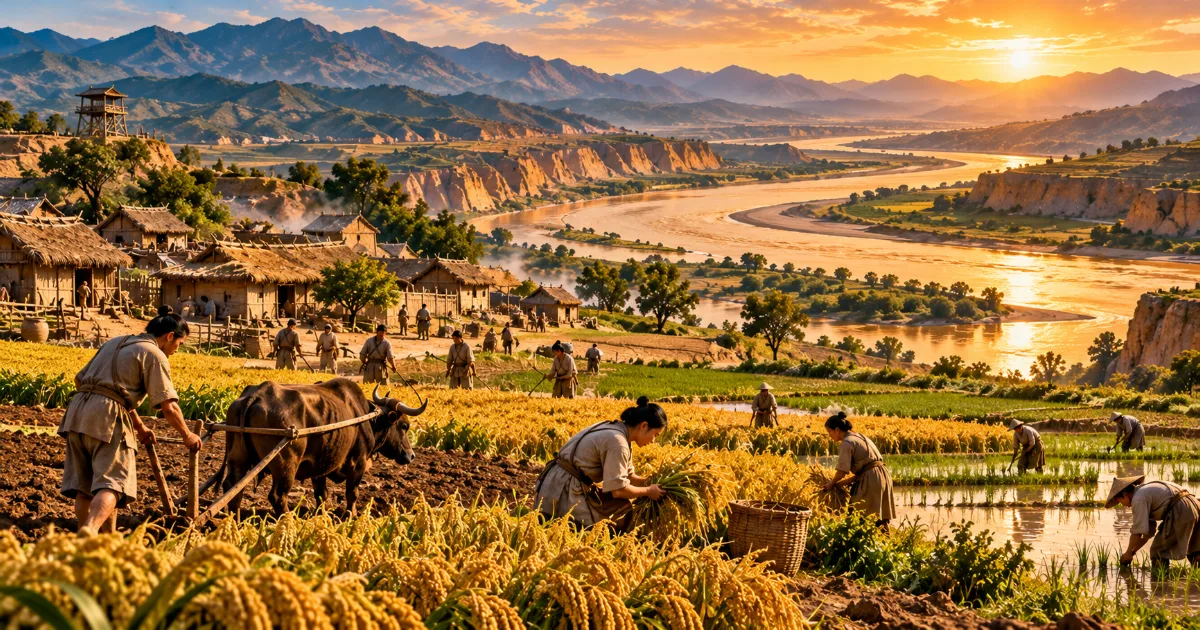
Known in Chinese as the Huang He, the Yellow River flows through northern China and carries large quantities of fine yellowish sediment from the Loess Plateau. This sediment gives the river its distinctive colour and has helped shape the surrounding landscape. Over thousands of years, communities settled near the river and its tributaries, using the available land to cultivate crops and sustain growing populations. These settlements contributed to the development of increasingly complex societies that eventually became part of the broader history of Chinese civilization.
However, the Yellow River was not the only source of China's agricultural development. The Yangtze River basin in southern China supported its own important farming traditions, particularly the cultivation of rice. Communities in other regions also developed distinctive ways of producing food. The emergence of Chinese civilization therefore involved several interconnected agricultural traditions rather than a single river or settlement.
To understand how early China developed, we must explore the relationship between people and their environment. The history of farming reveals how practical knowledge, technological experimentation, community cooperation, and responses to environmental change gradually transformed the lives of ancient people.
1. The Yellow River: A Lifeline in Northern China
The Yellow River begins in the highlands of western China and travels through a vast landscape before reaching the Bohai Sea. Along its course, it passes through mountains, plateaus, valleys, and broad plains. Its tributaries connect different environments, providing water for communities that developed in northern China over thousands of years.
The river's importance came from more than the availability of water. Its surrounding landscapes offered opportunities for agriculture, transportation, fishing, and settlement. In suitable locations, fertile soils supported the cultivation of crops, while nearby grasslands and other environments provided additional resources. Communities could grow crops, collect wild plants, hunt animals, and exchange goods with neighbouring settlements.
The Loess Plateau was especially significant. Loess is a fine sediment deposited primarily by wind over long periods. In many areas, it forms deep layers of soil that can be cultivated relatively easily. The landscape also contains valleys and natural slopes where people could establish settlements and work the land. Although soil quality, rainfall, and local conditions varied, these environments supported the development of early farming communities.
The Yellow River basin was not an empty wilderness waiting for civilization to arrive. It had a long history of human occupation before agriculture became widespread. People gradually developed knowledge of local plants, animals, water sources, and seasonal changes. This accumulated knowledge helped later communities adapt their food production to the environment.
The river also connected different settlements. Although early communities did not possess modern transport systems, waterways and their surrounding routes could facilitate movement between regions. People could exchange tools, pottery, raw materials, and practical knowledge. Such interactions helped agricultural practices develop beyond individual villages.
Over time, the Yellow River basin became one of the important centres of early Chinese civilization. Yet its significance should not obscure the contributions of other regions. China's agricultural history developed through several regional processes, and the Yellow River was one of the major environments in which those processes unfolded.
2. The Yellow River and the Challenge of Floods
The Yellow River offered opportunities for farming, but it could also threaten the communities that depended on it. Its high sediment content has influenced its behaviour for thousands of years. As sediment accumulates in certain sections of the river, the riverbed can rise relative to the surrounding land. Changes in the river's course and the failure of natural or artificial banks can cause destructive flooding.
For ancient farmers, a flood could mean the loss of an entire season's work. Water might cover cultivated fields, destroy houses, damage stored grain, and disrupt the movement of people and animals. If flooding occurred close to harvest time, the consequences could be particularly severe because families might lose both their current food supply and the seeds needed for future planting.
However, flooding did not always produce the same results. Water could also deposit fresh sediment on floodplains, sometimes improving agricultural conditions. The effects depended on the location, the intensity of the flood, the time of year, and the ability of communities to recover.
Early farmers did not have the large engineering projects, forecasting systems, or modern flood-control infrastructure available today. Their responses depended on local knowledge and practical experience. People learned which areas were more vulnerable, where settlements could be established safely, and when seasonal conditions were likely to affect their crops.
Some communities may have chosen elevated ground or natural terraces for their homes, reducing exposure to certain types of flooding. Others adapted their farming practices to local water conditions. The archaeological record can reveal changes in settlement locations and agricultural activity, although the precise reasons for individual decisions are not always clear.
It is important not to assume that the Yellow River immediately produced a single, unified system of water management or a centralized government. Early communities were diverse, and their responses varied according to local circumstances. Large-scale water-control projects became more significant in later historical periods, but the basic challenge of living alongside a powerful river was already part of the experience of northern China's inhabitants.
The relationship between the river and the people who lived near it was therefore complex. It offered water, fertile landscapes, and opportunities for agriculture, but it also demanded caution and adaptation. The river helped shape the conditions in which communities developed, without determining every aspect of their history.
3. Before Farming: How Early Communities Obtained Food
Long before agriculture became an important part of life in northern China, people survived through hunting, fishing, and gathering wild plants. These activities required detailed knowledge of the natural environment. People needed to understand where animals moved, which plants were edible, how seasonal changes affected food availability, and how to make tools for obtaining and preparing resources.
Stone tools played an important role in these activities. Different tools could be used for cutting, scraping, processing animal remains, and performing other practical tasks. Wooden implements and objects made from bone or other organic materials were also useful, although many of them have not survived in the archaeological record.
Wild plants provided an important source of nutrition. People gathered seeds, roots, fruits, and other edible materials when they were available. Communities living near rivers could also make use of fish and other aquatic resources. These varied food sources helped people survive in environments where conditions changed throughout the year.
Hunting and gathering required mobility in many circumstances. Some groups moved between locations as animals migrated or plants became available in different seasons. Others used particular areas repeatedly, returning when local resources were abundant. The precise pattern depended on the environment and the traditions of each community.
Over generations, people developed an intimate understanding of the plants growing around them. They could recognize which species produced useful seeds, which plants were suitable for different purposes, and when certain resources were ready to collect. This knowledge provided an important foundation for the later development of agriculture.
The transition from gathering wild plants to cultivating crops was not a simple decision made at one particular moment. It involved gradual experimentation, changing relationships with the environment, and the development of techniques for encouraging useful plants to grow in managed locations. Some communities continued to rely heavily on wild resources even after farming became more common.
Understanding this earlier way of life is essential because agriculture did not replace an entirely unproductive existence. Hunting and gathering could support sophisticated knowledge, social relationships, and effective strategies for obtaining food. Farming became important through a long process in which communities developed new methods while continuing to use many older practices.
4. The Development of Millet Farming in Northern China
One of the most important agricultural developments in northern China was the cultivation of millet. Several types of millet were well suited to parts of the region because they could grow under conditions that were less favourable for some other crops. Their development as cultivated plants helped support settled agricultural communities.
Archaeological research has identified evidence of millet cultivation in northern China dating back thousands of years. Two important crops were foxtail millet and broomcorn millet. Their relative importance varied across locations and periods, but both contributed to the development of northern China's agricultural traditions.
Millet farming required practical knowledge of soil preparation, planting, seasonal conditions, harvesting, and storage. Farmers had to recognize suitable growing periods and develop ways to protect their harvests from pests, animals, and environmental damage. The seeds could be processed for food and stored for later consumption, making them valuable resources for households.
The availability of cultivated millet supported the development of more permanent settlements in several regions. People could invest time in preparing fields, constructing storage facilities, and maintaining their homes. Reliable food production also helped some communities support larger populations, although harvests remained vulnerable to drought, floods, pests, and other challenges.
Millet cultivation did not mean that early farmers depended on a single crop. They often combined farming with the gathering of wild plants, hunting, animal management, and other activities. This mixture of food sources could reduce dependence on one resource and help communities respond to changing conditions.
The cultivation of millet also contributed to changes in daily routines. Farmers had to coordinate planting and harvesting with seasonal cycles. Grain needed to be dried, processed, and stored, while tools and containers had to be maintained. These activities encouraged the development of practical skills and shared knowledge within households and communities.
As agricultural practices became established, millet farming helped create conditions for increasing social complexity in parts of northern China. It provided a basis for food production that could support craftspeople and other specialists, although such developments occurred unevenly and over long periods.
The story of millet reminds us that agricultural innovation does not always depend on cultivating the crops most familiar to the modern world. Early farmers adapted their choices to the environments in which they lived. Their success depended on finding workable relationships between local conditions, available plants, and human needs.
5. The Yangtze River and the Development of Rice Agriculture
While millet became important in northern China, the Yangtze River basin in the south developed agricultural traditions in which rice played a central role. The region's warmer climate, seasonal rainfall, wetlands, and river systems created conditions suitable for rice cultivation in many locations.
Archaeological evidence indicates that people in parts of southern China began using and managing rice thousands of years ago. The transition from collecting wild rice to cultivating domesticated rice took place gradually. Researchers study ancient rice grains, plant remains, tools, and other archaeological evidence to understand how these practices developed.
Rice farming required particular knowledge of local water conditions. Depending on the location and cultivation method, farmers needed to manage moisture, prepare suitable ground, and time agricultural activities according to seasonal patterns. Early rice cultivation did not always involve the extensive flooded fields associated with later rice agriculture. Farming techniques varied, and the development of more intensive cultivation took place over time.
Communities in the Yangtze basin also developed distinctive forms of settlement and material culture. Archaeological discoveries have revealed houses, pottery, tools, and other objects associated with agricultural life. These remains show that southern communities were developing complex traditions of their own rather than simply copying practices from the north.
Rice and millet agriculture should therefore be understood as complementary parts of a wider history. Different crops supported communities in different environments, and each agricultural tradition contributed to the development of the region in which it flourished. Over time, the movement of people and the exchange of knowledge helped connect these regional histories.
The Yangtze basin's agricultural development also demonstrates why the origins of Chinese civilization cannot be explained through the Yellow River alone. Northern China was a major centre of early settlement and state formation, but southern China made important contributions to the development of agriculture, technology, and cultural traditions.
The history of rice cultivation remains significant because rice eventually became a central food crop across much of China and other parts of Asia. Its development involved long periods of experimentation, selection, and adaptation by generations of farmers. Like millet farming in the north, rice agriculture demonstrates how human communities transformed their environments through accumulated knowledge.
6. How Farming Changed Village Life
Agriculture changed more than the way people obtained food. It influenced where they lived, how they organized their work, what they made, and how they interacted with their neighbours. As some communities began producing crops more regularly, they increasingly invested in settlements that could be occupied for extended periods.
Permanent or long-term settlement made it possible to construct more durable houses and storage facilities. Families could maintain cultivated plots, protect their harvests, and keep tools close to the places where they were needed. Repeated occupation also created opportunities for communities to develop shared spaces and local traditions.
The organisation of labour became especially important. Farming involved several tasks that had to be completed at appropriate times. Fields needed preparation, crops needed planting, and harvests had to be collected before they were damaged by weather or lost through other causes. Some tasks could be performed by individuals, while others benefited from cooperation among household members or neighbouring families.
Food storage was another major development. Grain and other agricultural products could be kept for future use, provided they were properly processed and protected. Stored food helped households manage the interval between harvests and could offer some protection against temporary shortages. Nevertheless, storage could not eliminate the risks created by repeated crop failures or severe environmental events.
Agricultural communities also developed increasingly varied material cultures. Pottery could be used for cooking and storage, while stone tools supported cultivation and food processing. Weaving, construction, and other crafts became important in many settlements. Some craftspeople gradually developed specialised skills, producing objects that were exchanged within or between communities.
The growth of permanent settlements could also change social relationships. Neighbours interacted repeatedly, shared practical knowledge, and established expectations concerning the use of land and resources. Disputes could arise over boundaries, water access, or stored food, making cooperation and conflict resolution important aspects of community life.
These changes did not mean that all early farming villages had the same social structure. Some remained relatively small, while others became larger and more complex. Environmental conditions, population size, and contact with neighbouring communities all influenced their development.
Nevertheless, farming encouraged a different relationship between people and place. Communities increasingly invested labour in particular fields, homes, and storage facilities. Their lives became closely connected to the condition of the land and the success of the agricultural cycle. This relationship helped establish the foundations for more complex forms of economic and social organisation.
7. Population Growth, Surplus Food, and Specialised Work
Agriculture could support population growth by providing a more predictable source of food in suitable conditions. When harvests were successful and food supplies were sufficient, communities could sustain more people than their previous resources might have supported. Over time, larger populations could contribute to the expansion of settlements and the development of new occupations.
However, agricultural production was never completely predictable. Droughts, floods, pests, disease, and other problems could reduce harvests. A community's ability to support a larger population depended on its environment, farming methods, storage practices, and access to alternative resources. The relationship between agriculture and population growth was therefore complex rather than automatic.
Where food production generated a surplus beyond immediate household needs, some people could spend more time on activities other than farming. Potters could improve their techniques, craftspeople could specialise in toolmaking, and builders could develop skills in constructing houses and other structures. People also devoted time to exchange, ritual practices, and the organisation of community activities.
Specialisation could improve the quality and variety of goods available within a settlement. A craftsperson who repeatedly produced pottery, for example, might develop more effective methods of shaping and firing vessels. Knowledge could be refined through practice and passed to other members of the community.
Exchange between settlements became increasingly important in some regions. Communities did not always possess the same raw materials or produce the same goods. Movement between them allowed people to obtain objects and materials that were difficult to find locally. These connections could also spread new techniques, designs, and ideas.
Surplus food could support leaders or individuals who organised collective activities, but it could also create opportunities for unequal access to resources. Those who controlled important goods, storage facilities, or exchange relationships might gain greater influence. In some societies, differences in access to wealth became more visible in burial practices and the possession of rare objects.
These developments helped create conditions in which political authority could become more concentrated. Yet there was no single moment when every agricultural village transformed into a state. Some settlements remained relatively small, while others became influential centres connected to wider networks of communities.
The growth of specialised work illustrates an important principle in the history of civilization. Complex societies depend on many interconnected activities. Farmers produce food, craftspeople create tools and objects, builders construct settlements, and people exchange goods and knowledge. Over time, these relationships can support institutions that extend beyond the household or village.
8. Pottery, Stone Tools, and the Technology of Early Farmers
The development of agriculture was closely connected to advances in material technology. Early farmers needed tools to prepare soil, process crops, construct shelters, and carry out domestic activities. The tools available to them varied according to local resources and the knowledge of individual communities.
Stone tools continued to play an essential role. Implements with sharpened or polished edges could be used for cutting, working wood, and performing certain agricultural tasks. Grinding stones helped process grains and other plant foods, turning harvested crops into materials that could be prepared for consumption. Archaeologists study wear patterns and surviving plant residues to investigate how particular tools were used.
Pottery was another important innovation. Containers made from clay could be shaped into different forms and fired to produce durable objects. Cooking vessels, storage jars, bowls, and other items served practical purposes in daily life. Pottery also preserved evidence of artistic preferences because many communities decorated their vessels with distinctive patterns.
Different archaeological cultures produced different styles of pottery. The painted pottery associated with the Yangshao culture of northern China is one well-known example. Such objects help researchers identify cultural traditions and examine similarities and differences between settlements. However, a particular pottery style does not necessarily mean that every person who used it belonged to one unified political or ethnic group.
The manufacture of textiles and other goods also became important in many communities. Evidence for these activities may include tools, impressions, or surviving fragments, although organic materials often decay. The absence of preserved textiles, wooden objects, or baskets does not necessarily mean that people lacked these technologies.
Over time, technological knowledge spread through learning, observation, migration, and exchange. People adapted techniques to their own circumstances, sometimes improving them or combining them with existing practices. Innovation therefore emerged from the accumulated experience of many generations.
The relationship between technology and agriculture was mutually reinforcing. Better tools could make certain tasks more efficient, while established farming communities could support craftspeople who developed specialised skills. These improvements did not remove the uncertainties of agricultural life, but they expanded the range of activities that communities could undertake.
9. Water Management and Cooperation Between Communities
Water was essential to early agricultural life, but access to it could vary considerably between locations and seasons. Farmers needed sufficient moisture for their crops, while communities also required water for drinking, preparing food, caring for animals, and other activities. These needs encouraged people to develop knowledge of local water sources and seasonal patterns.
In some environments, farmers could rely largely on rainfall and naturally available moisture. In others, the management of water became increasingly important. Communities might use local channels, drainage arrangements, or other practical methods to adapt to their surroundings. The specific techniques varied across regions and periods, and not every early settlement required large irrigation systems.
The Yellow River's flooding history created particular challenges. Communities had to consider the risks associated with living near a changing river while seeking access to fertile land and water. Local decisions about settlement location and agricultural activity could influence how people experienced these risks.
Cooperation could be valuable when tasks affected several households. People might work together to maintain shared resources, prepare land, or respond to environmental difficulties. These activities could strengthen relationships between families and encourage the development of shared rules or expectations.
At the same time, water and fertile land could become sources of disagreement. When resources were limited, communities might compete over access or struggle to protect their own interests. Cooperation and conflict were both possible outcomes of the same environmental pressures.
It is tempting to attribute the rise of the earliest Chinese states entirely to the need for flood control. However, this explanation is too simple. The development of political authority involved many factors, including agricultural production, social hierarchies, warfare, religious practices, exchange networks, and the organisation of labour. Water management may have contributed to cooperation and authority in some contexts, but it was not the sole cause of state formation.
The history of water management is therefore best understood as one part of a larger story. Early communities developed practical ways of responding to their environments, and those responses influenced settlement patterns and social relationships. Over time, some societies acquired the capacity to organise labour and resources on a larger scale, helping establish conditions for more complex political systems.
10. Religion, Ancestors, and the Meaning of the Natural World
For early agricultural communities, the natural world was closely connected to survival. Rainfall, sunlight, seasonal changes, floods, and harvests could determine whether families had sufficient food. Although the precise beliefs of many prehistoric communities remain uncertain, archaeological discoveries provide evidence that ritual practices and ideas about death were important in several early societies.
Burial sites offer some of the clearest clues about these practices. Archaeologists have discovered graves containing pottery, ornaments, tools, and other objects. The arrangement and contents of burials sometimes suggest differences in status or beliefs about the relationship between the living and the dead. However, the exact meanings of these objects cannot always be established.
Agriculture may have influenced how communities understood seasonal cycles and the renewal of life. Farmers depended on recurring patterns of planting, growth, and harvest. Observing these changes required close attention to the natural world, and seasonal activities could become connected to community traditions and ceremonies. Nevertheless, specific religious beliefs varied across regions and cannot be reconstructed fully from agricultural evidence alone.
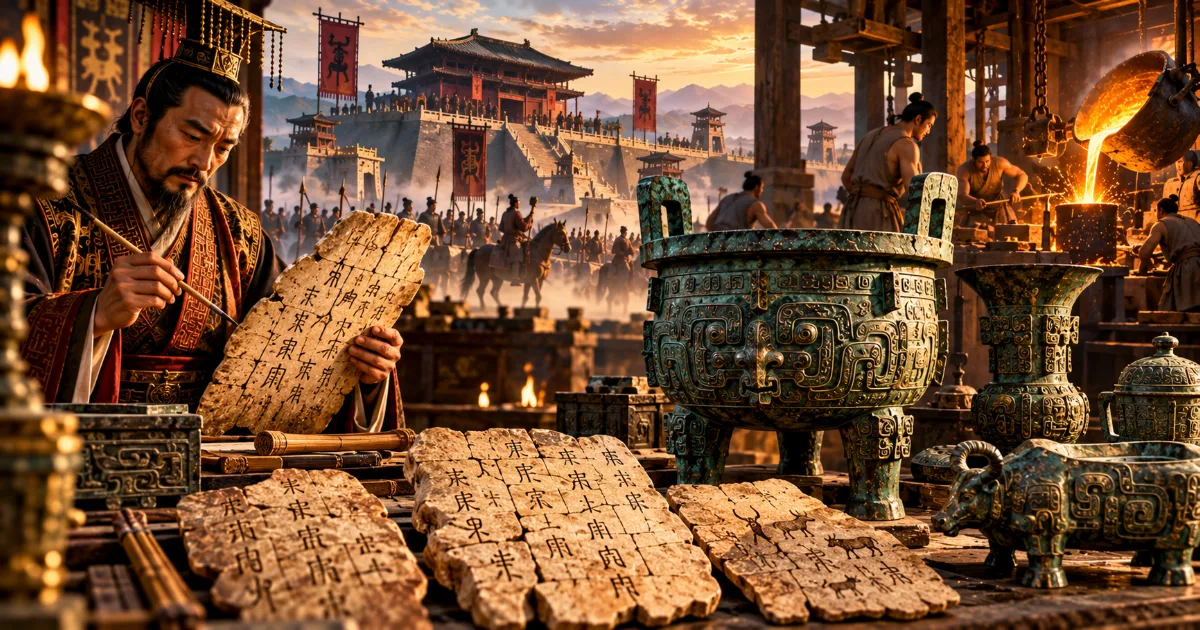
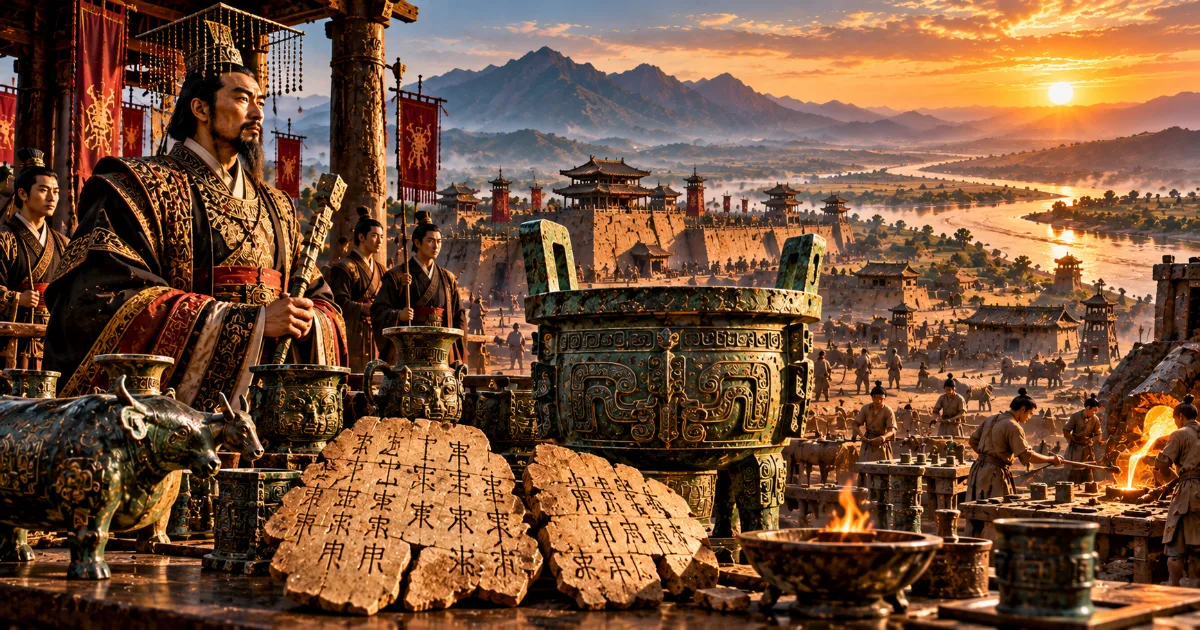
In later periods, particularly during the Shang dynasty, the relationship between ritual practices and political authority becomes much clearer. Shang inscriptions reveal that rulers consulted ancestors and other spiritual powers about warfare, weather, harvests, and royal affairs. These practices connected religious authority with the responsibilities of the ruling elite.
The development of ancestor worship and royal ritual was not simply a direct continuation of one uniform prehistoric religion. Beliefs changed over time, and different communities maintained distinct practices. Even so, the archaeological evidence demonstrates that spiritual life formed an important part of early Chinese societies.
Understanding these beliefs helps us appreciate that agriculture was not merely an economic activity. It influenced how people organised their time, interpreted their surroundings, and understood their place within a community. The natural environment shaped material survival while also providing a setting for the development of cultural and religious traditions.
11. From Farming Villages to the Foundations of Chinese Civilization
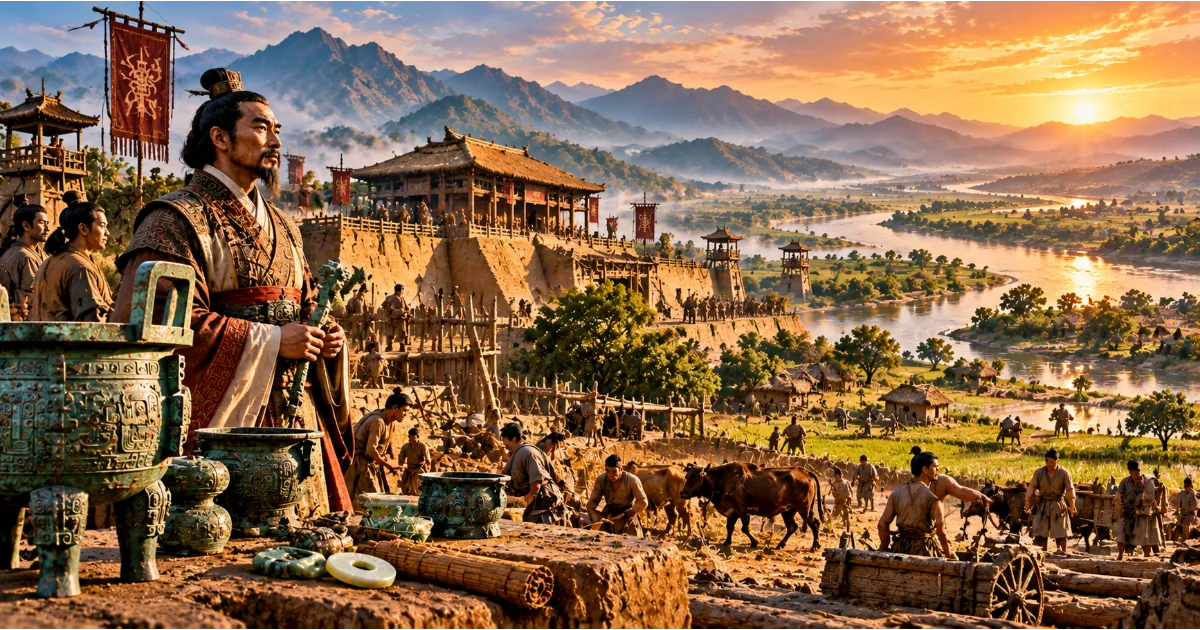
By the late Neolithic period and the beginning of the Bronze Age, some communities across northern China had developed increasingly complex forms of settlement and production. Certain sites contained evidence of specialised crafts, substantial buildings, defensive structures, and differences in wealth or social status. These developments indicate that some societies were moving beyond the scale of small agricultural villages.
The transition was not uniform. Different regions followed different paths, and communities did not all develop the same political institutions. Some settlements became major centres of activity, while others continued to depend primarily on local agriculture and exchange. Relationships between these communities helped create a varied and interconnected landscape.
The Erlitou archaeological site in present-day Henan Province provides important evidence of early Bronze Age society. Flourishing during the early second millennium BCE, Erlitou contained substantial architectural remains, evidence of bronze production, and signs of specialised activity. Scholars continue to debate its relationship to the Xia dynasty described in traditional Chinese histories.
The Shang dynasty provides firmer evidence of a developed early state. Its rulers controlled important political centres, supported specialised craft production, and participated in elaborate religious ceremonies. Oracle-bone inscriptions provide direct evidence of royal activities and an early form of Chinese writing.
These developments depended on foundations established over many generations. Agricultural production supported growing populations. Settlements created opportunities for cooperation and exchange. Craftspeople developed increasingly sophisticated techniques, while leaders acquired greater influence over resources and collective activities.
The Yellow River basin was an important setting for these changes, but the broader story includes the Yangtze basin and other regions as well. The development of Chinese civilization involved many communities whose agricultural practices, technologies, and cultural traditions contributed to the emergence of early states.
This long process reminds us that civilizations do not appear suddenly. Their institutions and achievements grow out of earlier experiences, practical knowledge, and relationships between people and their environment.
12. The Lasting Legacy of China's Early Agricultural Communities
The agricultural traditions that developed in early China had consequences far beyond the villages in which they began. Over time, farming supported larger populations, specialised occupations, exchange networks, and increasingly complex political systems. These developments contributed to the emergence of states and dynasties that shaped later Chinese history.
Millet cultivation remained important across northern China, while rice became central to agricultural life in many southern regions. The coexistence of these traditions reflected China's varied environments and the ability of communities to adapt their practices to local conditions. As contact between regions increased, agricultural knowledge and other cultural practices continued to move across geographical boundaries.
The history of early farming also helps explain the importance of food production in later Chinese government. Agricultural output became closely connected to taxation, public works, military organisation, and the support of urban populations. Later rulers depended on the productivity of rural communities, while floods, droughts, and crop failures could threaten political stability.
The Yellow River remained especially significant in this history. Its fertile surroundings supported agriculture, but its changing course and destructive floods repeatedly challenged communities. The need to manage water and protect settlements became an enduring concern for later Chinese societies.
Yet the legacy of early farmers extends beyond economic and political developments. Their knowledge of plants, soils, seasons, and tools formed part of a wider tradition of practical learning. Their pottery, settlements, burial practices, and other material remains continue to provide evidence of how human societies developed.
Perhaps the most important lesson is that civilization was a collective achievement. The farmers who cultivated millet and rice, the craftspeople who made tools and pottery, and the families who maintained settlements all contributed to the foundations of Chinese history. Most of these individuals remain unnamed, but their work made later developments possible.
Conclusion: The River That Helped Shape a Civilization
The Yellow River played an important role in the development of early Chinese civilization by providing water, fertile landscapes, and opportunities for settlement. Its surrounding plains supported agricultural communities, while its floods and changing course created continuing challenges. People responded through practical knowledge, adaptation, and cooperation, gradually developing more complex ways of living.
The story of Chinese agriculture, however, extends beyond the Yellow River. Millet farming in northern China and rice cultivation in the Yangtze basin demonstrate that several regional traditions contributed to the growth of early societies. These communities developed distinctive technologies, settlement patterns, and cultural practices, creating a diverse foundation for later Chinese civilization.
Agriculture changed how people obtained food, organised their work, and related to the land. It encouraged permanent settlements in many areas, supported specialised crafts, and helped some communities sustain larger populations. Over time, these developments contributed to the emergence of social hierarchies, political authority, and early states.
The earliest agricultural communities did not know that their experiments and achievements would eventually become part of the history of a vast civilization. They were responding to immediate needs, learning from experience, and passing knowledge from one generation to the next. Yet their efforts helped establish the foundations upon which later societies would build.
The Yellow River was therefore more than a geographical feature. It was part of a changing relationship between people, nature, and society that helped shape northern China's history. Alongside the Yangtze River and other regional environments, it supported the gradual development of communities that would eventually become part of the Chinese world.
In our next article, we will explore the Xia Dynasty: Between Legend and History, examining China's traditional account of its first dynasty, the archaeological discoveries associated with early Bronze Age societies, and the continuing debate over what can be established about this distant period.
History of China | A Journey Through Time
#HistoryOfChina #YellowRiver #AncientChina #ChineseCivilization #HistoryOfAgriculture #WorldHistory #AncientHistory #Archaeology #HistorySeries