
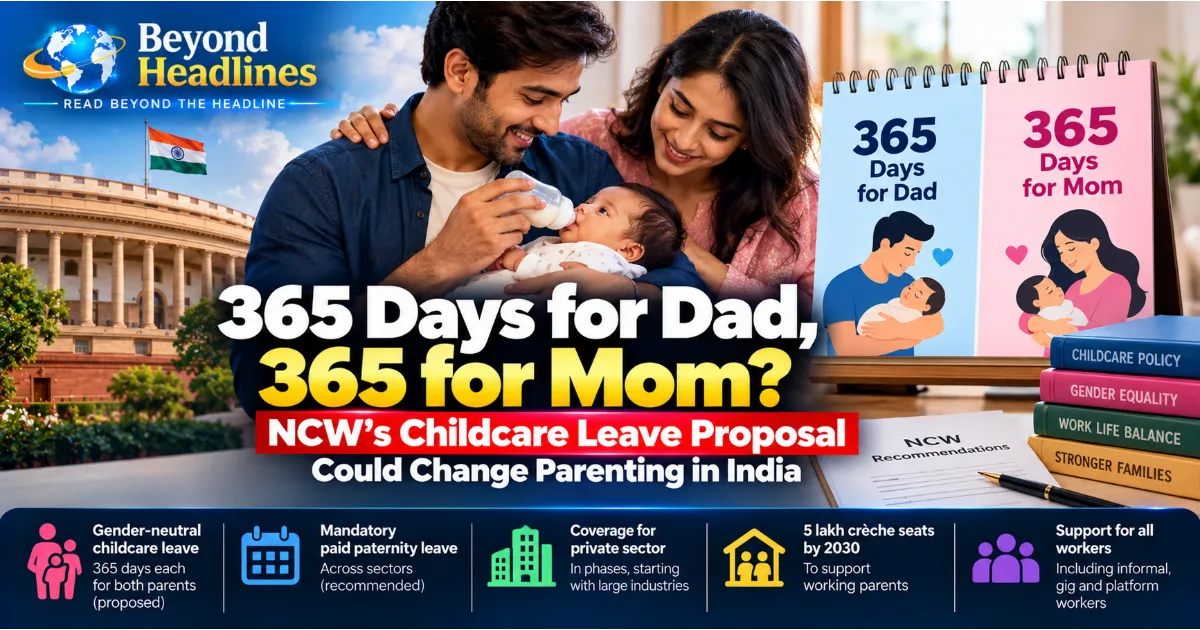
India's debate over working parents, childcare and gender equality has entered an important new phase. The National Commission for Women (NCW) has proposed a more gender-neutral approach to childcare leave, including a framework under which both working parents could receive 365 days of childcare leave each. The recommendations also call for paid paternity leave, wider coverage of private-sector employees and stronger childcare infrastructure.
The proposal could influence how India thinks about parenthood, women's careers and the responsibilities of fathers. For decades, childcare has often been treated primarily as a mother's responsibility, even when both parents work full-time. A policy that gives fathers a meaningful opportunity to take leave could help challenge that assumption and encourage families to share the work of raising children.
However, there is an important distinction between a recommendation and a legal entitlement. The NCW's proposal does not automatically give every mother and father in India 365 days of paid leave. Its implementation would require government decisions, appropriate legal or policy changes, funding arrangements and, potentially, different rules for different categories of employment.
The proposal is therefore significant not because every parent can immediately claim a year of leave, but because it raises a larger question about the future of work and family life in India. Should childcare be treated mainly as a benefit for mothers, or should both parents have meaningful time and support to care for their children?
What Exactly Has the National Commission for Women Proposed?
The National Commission for Women has submitted a set of 37 recommendations to the Union government covering maternity protection, childcare leave, paternity leave, workplace facilities and support for women employed outside the formal economy. The recommendations followed a national consultation on maternity and childcare laws held in New Delhi on May 5, 2026. The report was submitted to the Department of Personnel and Training, the Ministry of Women and Child Development and the Ministry of Labour and Employment in October 2026.
One of the most prominent proposals is to transform the existing women-centred Child Care Leave framework into a gender-neutral system. Under this proposal, the existing 730-day structure would be divided equally between both working parents, giving each parent 365 days. Where both parents work for the same organisation, the commission has also suggested the possibility of a common pool of leave.
The recommendation is intended to make childcare a shared responsibility rather than a benefit associated almost exclusively with mothers. It could give fathers a formal opportunity to spend extended periods caring for their children while allowing mothers to return to work without automatically becoming the default parent for every childcare requirement.
The commission has also proposed a 60:40 shared-care model between primary and secondary caregivers for children aged zero to two years. The broader recommendations include extending childcare leave to private-sector employees in phases, introducing mandatory paid paternity leave across sectors and improving access to childcare facilities.
These proposals are connected. Leave gives parents time to care for a child, paternity provisions encourage fathers to participate from the beginning, and childcare facilities help families when parents return to employment. A policy that addresses only one of these areas may not be sufficient to solve the practical difficulties faced by working families.
The commission's recommendations therefore represent a broader attempt to rethink the relationship between employment and family responsibilities. Their eventual impact will depend on how the government evaluates them, how the rules are designed and whether employers can implement them in a fair and financially sustainable way.
Understanding the Difference Between Existing Rules and the New Proposal
The headline about 365 days for each parent may create the impression that the benefit is already available throughout India. That is not the case. The recommendation must be distinguished from existing maternity and childcare provisions.
Under the current framework for eligible Central Government women employees, Child Care Leave can extend to 730 days over the employee's service for caring for minor children, subject to applicable rules and conditions. The arrangement is not a universal entitlement available to every parent employed in India. Private-sector policies, state government service rules and other employment arrangements differ.
Maternity leave is a separate benefit. Under the Maternity Benefit Act, eligible women covered by the applicable provisions can receive maternity leave of up to 26 weeks for the first two surviving children, subject to statutory conditions. That leave recognises the physical demands of pregnancy and childbirth as well as the recovery and early-care needs associated with becoming a mother.
Paternity leave is different again. Central Government employees currently have a limited paternity leave provision, while there is no equivalent general statutory entitlement to paid paternity leave covering all private-sector workers. Some employers voluntarily offer paternity or parental leave, but access depends on the employer's policy and the employee's circumstances.
The NCW's recommendation seeks to address this imbalance. Rather than treating childcare leave as something mainly reserved for women, it proposes a framework in which both parents have a defined role.
If adopted, such a system would require clear rules about eligibility, pay, the period during which leave could be used, the child's age, notice requirements and how leave would operate when parents work for different employers. Policymakers would also need to determine how the proposed entitlement would interact with maternity leave and existing employment benefits.
For families, the practical question is straightforward: what leave can each parent actually claim, for how long and under what conditions? The policy will become meaningful only when those questions are answered in enforceable rules.
Until then, parents should not assume that the proposed 365 days are immediately available to them. The recommendation is an important development in the policy debate, but it does not by itself change an employee's current legal entitlement.
Why Sharing Childcare Leave Could Matter for Mothers
For many women, having a child can affect their professional lives long after maternity leave ends. Pregnancy, childbirth and early childcare may require time away from work, changes to working hours or additional support from family members. Some women return to their jobs and continue their careers without major interruption, while others face difficulties that influence promotions, salaries and long-term employment opportunities.
The problem is not simply that mothers need time to care for children. The problem arises when employers assume that women will be more likely than men to interrupt their careers because of family responsibilities.
Such assumptions can influence recruitment and career development. An employer who expects women to take longer breaks may become reluctant to hire them for certain roles or invest in their advancement. Even when an individual woman is fully capable of meeting the demands of a job, assumptions about future childcare responsibilities can affect how she is evaluated.
A gender-neutral childcare leave framework could help challenge this pattern by making extended caregiving leave a possibility for both parents. If fathers can take substantial leave, employers may have less reason to regard childcare as an exclusively female responsibility.
This would not eliminate discrimination automatically. Employers could still make unfair assumptions, and workplace cultures may take time to change. But the existence of a formal right for fathers to participate in childcare could help shift expectations about who should be available to care for a child.
It could also give mothers greater flexibility in deciding how a family organises its time. In some households, the mother may take the longer initial break because of childbirth and recovery. In others, parents may divide later childcare responsibilities according to their work schedules, preferences and financial circumstances.
The important point is that families should have meaningful choices. A policy designed to promote equality should not pressure mothers to return to work before they are ready, nor should it assume that every family must divide caregiving in exactly the same way.
Maternity protection remains necessary because pregnancy and childbirth involve specific physical and medical needs. Gender-neutral childcare leave would complement that protection by recognising that caring for a child continues after the period covered by maternity leave.
Why Fathers Need More Than a Few Days at Home
The proposal also challenges the traditional idea that a father's role after childbirth is mainly to support the mother for a short period before returning to work. Many fathers want to participate more fully in caring for their children, but employment rules and workplace expectations can make that difficult.
When paid paternity leave is limited or unavailable, fathers may have to rely on annual leave, unpaid leave or informal arrangements with their employers. Some cannot afford to lose income, while others worry that taking time away from work could affect how managers view their commitment to their jobs.
These barriers can influence family life from the earliest days of a child's development. A father who is able to spend meaningful time caring for a newborn can become more familiar with everyday responsibilities, including feeding, soothing, changing clothes, attending appointments and responding to the child's needs.
Childcare is not a single task performed occasionally. It involves constant decisions, planning and attention. When both parents participate from the beginning, they have more opportunities to learn how to manage these responsibilities together.
Longer paternity and childcare leave could also provide practical support to mothers during recovery after childbirth. The physical and emotional demands of caring for a newborn can be substantial, and a partner's active participation may help distribute the work more fairly.
However, the value of paternal leave should not be measured only by the assistance it provides to mothers. Fathers are parents in their own right, and their relationship with their children matters independently. Time spent caring for a child can strengthen family bonds and help establish patterns of involvement that continue as the child grows.
The NCW's recommendation for mandatory paid paternity leave across sectors is therefore important. It recognises that fathers' participation should not depend entirely on whether a particular employer chooses to offer a benefit.
For the proposal to work, the leave would need to be financially accessible. A right that exists on paper but causes a family to lose a substantial portion of its income may be difficult to use. Paid leave, clear eligibility rules and protection against workplace retaliation would be important considerations.
The Private Sector Could Face a Major Policy Shift
One of the most consequential aspects of the proposal is the recommended extension of gender-neutral Child Care Leave to private-sector employees. The commission has suggested phased implementation, beginning with large industries and later extending the framework to medium and small enterprises.
Private-sector workplaces vary considerably. A large technology company may have human resources teams, multiple locations, formal leave policies and the capacity to redistribute work among employees. A small manufacturing business, retail shop or local service provider may have fewer staff and less flexibility when an employee takes an extended absence.
A new leave entitlement could therefore affect employers differently. Larger companies might be better positioned to develop structured parental leave programmes, arrange temporary cover and support employees returning from leave. Smaller businesses may need additional time, financial assistance or shared services to make the policy workable.
Employers would also need to consider continuity of work. If an employee takes several months of leave, the organisation must determine how responsibilities will be handled, whether another worker needs to be hired temporarily and how the returning employee can resume duties without losing professional opportunities.
These concerns do not necessarily justify rejecting the proposal. They indicate why the implementation framework matters. A policy that is too complicated may discourage employers from offering benefits voluntarily, while a policy that lacks adequate funding or transition arrangements could create difficulties for smaller organisations.
The NCW has recommended measures that include tax incentives and financial support for employers adopting childcare policies. It has also called for childcare leave to be incorporated into the Code on Social Security, 2020. Such recommendations would require careful consideration by the government before any new legal obligations could take effect.
The challenge is to create a system that protects parents without unnecessarily disadvantaging the businesses that employ them. That means considering employer size, the nature of the work, staffing arrangements and the need for consistent protections across sectors.
A phased approach could allow policymakers to learn from early implementation, identify problems and refine the system before extending it more widely. But the timeline must be clear enough that workers and employers understand what to expect.
Five Lakh Crèche Seats by 2030: Why Childcare Infrastructure Matters
The NCW's recommendations go beyond leave. They also propose the creation of five lakh crèche seats by 2030 through a proposed National Childcare Infrastructure Mission involving cooperation between the Union and state governments.
This is an important part of the proposal because leave alone cannot meet every childcare need. Parents eventually return to work, and many families require safe and reliable care during working hours. The availability of a nearby crèche can influence whether a parent is able to accept a job, resume employment or continue working full-time.
For families living in cities, childcare may be expensive or located far from home or work. For families in smaller towns and rural areas, suitable facilities may be limited or difficult to reach. Some parents depend on grandparents or other relatives, but not every household has that support.
Crèches can help fill this gap by providing structured care while parents work. Their usefulness depends on more than the number of seats created. Facilities need trained caregivers, safe buildings, appropriate hygiene, age-suitable activities, reliable supervision and procedures for responding to emergencies.
Affordability is equally important. A childcare facility may exist nearby but remain inaccessible to a family if the cost consumes a large share of its income. Government support, employer participation and community-based arrangements could help make services more accessible to different income groups.
The NCW has also suggested multiple models for establishments, including on-site crèches, shared facilities serving several employers and contributions to a state childcare fund. These approaches may be particularly relevant for smaller businesses that cannot independently maintain a dedicated facility.
A national effort to expand childcare infrastructure would need transparent planning and monitoring. Authorities would have to identify where demand is greatest, set standards for facilities, train workers and assess whether children are receiving safe and suitable care.
The proposed target of five lakh seats is ambitious, but its significance will ultimately depend on implementation. The number of facilities built is only one measure of success. Families also need to be able to afford them, reach them conveniently and trust the quality of care provided.
What About Women Working in Informal Jobs, Gig Work and Platform Services?
The debate about parental leave often focuses on people employed by large organisations with formal contracts and established human resources policies. Yet a substantial share of India's workforce operates outside these arrangements.
Women working in domestic service, agriculture, small businesses, home-based work and other informal occupations may have limited access to paid leave or employment-linked benefits. Gig and platform workers may have flexible working patterns, but flexibility does not automatically provide income security when a person needs time away from work.
For a salaried employee, a formal leave policy may protect income during a period of childcare. For a worker paid by the task, shift or delivery, taking time off may immediately reduce earnings. The difficulty can be particularly acute for households with limited savings.
The NCW has recommended extending maternity and childcare protections to informal, gig and platform workers, noting that more than 90% of women workers remain outside effective maternity coverage.
This raises a larger policy question: should parental support depend entirely on the type of employment a person has?
A system that benefits only workers in formal employment could leave many families without meaningful protection. At the same time, extending support to people who do not have a conventional employer requires different arrangements for eligibility, contributions, funding and delivery.
Potential approaches could include publicly funded benefits, social insurance mechanisms, support linked to verified work activity or schemes that reach eligible workers through existing welfare infrastructure. Each approach would need safeguards to ensure that support reaches the intended recipients without creating unnecessary administrative barriers.
For gig and platform workers, policymakers would also need to clarify the responsibilities of platforms, contractors and government agencies. The nature of work varies considerably, and a single mechanism may not suit every category.
The objective should be to make childcare support more inclusive without assuming that every worker has the same employment relationship. A parent should not lose all access to meaningful protection simply because their work does not fit the traditional salaried model.
Adoptive and Commissioning Mothers Are Also Part of the Debate
The NCW's recommendations address other gaps in maternity protection as well. Among them is a proposal to increase maternity leave for adoptive and commissioning mothers from 12 weeks to 26 weeks, bringing the proposed duration closer to the provision available to eligible biological mothers. The commission has also recommended parity in maternity benefits for these groups.
This aspect of the proposal recognises that families can form in different ways. Adoption and surrogacy involve distinct legal and medical circumstances, but they can also require substantial time for a parent to establish routines, provide care and build a relationship with a child.
The needs of a family adopting an infant may differ from those of a family adopting an older child. Commissioning mothers may face their own medical and practical circumstances. A policy framework must take these differences into account while ensuring that eligible parents are not unfairly disadvantaged.
The issue also connects to the wider question of how society values caregiving. If leave is designed only around a narrow definition of motherhood, some families may find that their circumstances do not fit the system.
A more inclusive framework can recognise the importance of caring for children while still accounting for different legal and medical needs. The challenge for policymakers is to define eligibility and benefits clearly, so families know which protections apply and employers can administer them consistently.
These changes would not simply expand the duration of leave. They would signal that childcare policy should reflect the variety of families and the different routes through which children enter them.
Could the Proposal Help Reduce the Motherhood Penalty?
The term "motherhood penalty" describes the disadvantages that some women experience in employment after becoming mothers. These can include lower earnings, slower career progression, reduced access to demanding assignments or difficulty returning to work after a break.
The reasons are complex. Some women voluntarily change their working arrangements to meet family needs. Others face limited childcare options, inflexible schedules or workplace assumptions that they will be less available after having children.
A gender-neutral leave policy could help reduce one source of inequality by encouraging fathers to take on a greater share of childcare. If men and women are both expected to use leave, employers may gradually become less likely to view caregiving as a reason to treat women differently.
However, the effect is not automatic. If fathers rarely use the leave because of workplace pressure, financial concerns or cultural expectations, the policy may exist without significantly changing behaviour. Some employers might continue to view mothers as the primary caregivers regardless of the formal rules.
The details of the policy would therefore matter. Paid leave that can be used flexibly, clear protection against discrimination and a workplace culture that supports both parents would be important. Employers would also need to ensure that taking approved leave does not lead to unfair treatment in promotions, performance reviews or future assignments.
The government would need to consider how compliance could be monitored and how employees could raise concerns safely. Formal rights are more effective when workers know how to exercise them and have a practical way to challenge violations.
There is also a broader cultural dimension. Equality in childcare cannot be created by legislation alone. Families, employers and communities must become more comfortable with fathers taking responsibility for everyday care and mothers pursuing their professional goals.
The NCW proposal provides a policy framework for encouraging that change. Its success would depend on whether it leads to real differences in how families divide work at home and how employers respond to parents in the workplace.
The Financial Question: Who Pays for Extended Leave?
One of the biggest questions surrounding the proposal is the cost of implementing it. Extended paid leave has financial implications for employees, employers and potentially the government, depending on the final design.
For families, paid leave can protect income during an important period. Without it, a parent may have to choose between caring for a child and earning enough to meet household expenses. The value of the benefit therefore depends partly on how much income is maintained and how accessible the entitlement is.
For employers, extended absences may require temporary recruitment, redistribution of responsibilities or changes to project schedules. These costs may be manageable for large organisations but more difficult for businesses with small teams or specialised roles.
If the policy places all costs on employers, some may worry that hiring workers who are likely to take parental leave will become more expensive. That could undermine the proposal's purpose if it encourages discrimination during recruitment.
Government support, social insurance arrangements or carefully designed financial incentives could help distribute the costs more fairly. However, each option involves decisions about funding, eligibility, contributions and the role of public expenditure.
The government would also need to clarify how the proposed 365-day childcare leave entitlement would interact with existing maternity leave. If the periods overlap, are additional to one another or are subject to a combined limit, the consequences for both families and employers would differ considerably.
The same applies to paternity leave. A defined period of paid paternity leave may be separate from the proposed shared childcare leave, but the relationship between the two would need to be specified.
These are not minor administrative details. They determine whether the policy provides meaningful support, how much it costs and whether it can be implemented consistently across different sectors.
A workable system must balance the needs of children and parents with the practical requirements of employers and public finances. That balance should be guided by evidence, clear rules and a commitment to making benefits genuinely accessible.
What Working Parents Should Watch Next
For parents, the most important next step is to follow the government's response to the NCW's recommendations. The report has been submitted to the relevant ministries, but implementation will require further decisions. The government may accept some recommendations, modify others, seek additional consultation or take a phased approach to reform.
Parents employed by the Central Government should continue to rely on the applicable service rules for their existing leave entitlements. Private-sector employees should check their current employment policies and any applicable legal provisions rather than assume that the proposed 365-day benefit is already available.
Employers can also begin examining their parental leave policies. Even before any new statutory requirement is introduced, organisations can assess whether their policies support fathers as well as mothers, whether returning parents receive appropriate support and whether childcare facilities are accessible.
Businesses may benefit from preparing for a future in which parental leave becomes more standardised. Clear policies can improve employee planning, reduce uncertainty and help managers handle leave requests consistently.
For policymakers, the next phase should involve consultation with workers, employers, childcare providers and organisations representing informal and gig workers. These groups experience different barriers, and the policy will need to account for those differences.
The government should also consider how progress will be measured. Relevant indicators could include access to paid leave, the number of fathers using the benefit, women's return-to-work rates, the availability and affordability of crèches and the experience of employees after returning from leave.
Without reliable monitoring, it would be difficult to know whether the reforms are improving family life or simply creating new provisions that remain inaccessible to many people.
Conclusion: A Potential Shift in How India Understands Parenthood
The NCW's proposal to divide 730 days of childcare leave into 365 days for each working parent could mark an important shift in India's approach to family and employment policy. By placing fathers more clearly within the childcare framework, the commission is challenging the assumption that the responsibility for raising young children should fall primarily on mothers.
The recommendations also recognise that leave is only one part of the solution. Paid paternity leave, crèches, maternity protection, support for informal and gig workers and safeguards against workplace discrimination are all connected to the question of whether parents can care for children without sacrificing their economic security.
For women, a more balanced childcare system could help reduce career disadvantages associated with motherhood. For fathers, it could create greater opportunities to participate in their children's early years. For children, it could support more consistent caregiving. For employers, it would require planning, clear rules and a workplace culture that treats parenthood as a shared responsibility.
Yet the distinction between a proposal and an enforceable entitlement remains essential. The recommendation does not mean that every working mother and father can currently claim 365 days of paid childcare leave. Government decisions and the details of any future legal framework will determine whether and how the proposal becomes reality.
The long-term question is whether India can build a system in which becoming a parent does not automatically place one worker at a disadvantage or force a family into difficult choices between employment and childcare.
If the proposals are implemented thoughtfully, they could help move the country towards a more inclusive approach to work and family life. The real measure of success will not be the headline figure of 365 days, but whether parents can use the support they need, children receive reliable care and women and men have a fairer opportunity to build both their careers and their families.
#BeyondHeadlines #NCW #ChildCareLeave #ParentalLeave #PaternityLeave #MaternityLeave #WorkingParents #GenderEquality #WomenAtWork #SharedParenting #WorkLifeBalance #Childcare #IndiaNews #PrivateSector #GigWorkers #WorkplacePolicy #FamilySupport #Crèche #ParentingInIndia #BeyondTheHeadline