
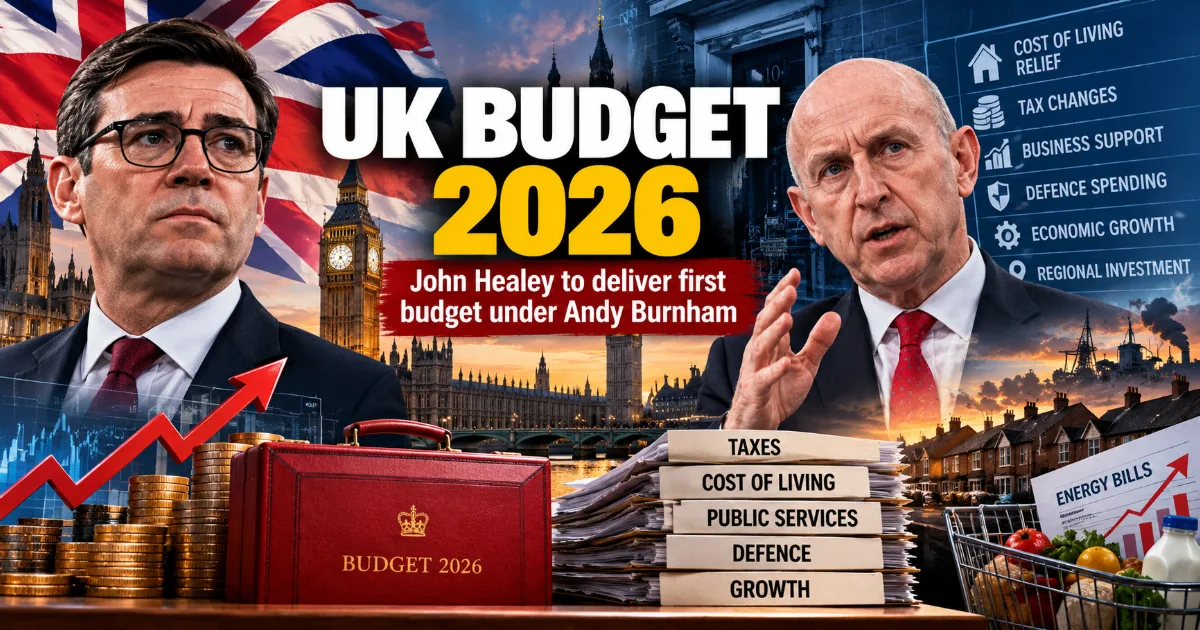
Andy Burnham's First Budget Promises Targeted Relief for Households, New Taxes on Banks and Businesses, and a Difficult Balancing Act Between Growth and Fiscal Discipline
Britain's new government faces a defining economic test as Finance Minister John Healey prepares to deliver his first budget under Prime Minister Andy Burnham on October 28, 2026. The budget arrives at a difficult moment for the United Kingdom, with elevated inflation, rising energy costs, expensive government borrowing and pressure on public services limiting the room available for major spending commitments. Healey must demonstrate that the government can ease the financial burden on households, support businesses and strengthen national defence without undermining confidence in Britain's public finances.
The stakes extend beyond a single financial statement. The budget will provide an early indication of how Burnham intends to turn his political promises into economic policy, and whether his administration can establish a credible alternative after years of pressure on living standards, public services and government finances. Voters want tangible improvements in everyday life, while businesses are looking for predictable policies, manageable costs and conditions that encourage investment.
The government has promised to provide breathing space for families facing higher bills while maintaining fiscal discipline. That is a difficult combination. Energy assistance, support for pensioners, public investment, defence commitments and better social care all require funding. Yet borrowing more could increase the cost of servicing the national debt, leaving less money available for public services in the years ahead.
The international environment has made the task more complicated. The US-led war on Iran has disrupted energy markets and increased uncertainty over supply routes, contributing to inflationary pressure and nervousness across financial markets. Higher energy costs affect households directly, but they also raise production, transport and operating expenses for businesses. When inflation rises, investors may demand higher returns on government bonds, increasing the cost of financing public debt.
Continue Reading
Healey is therefore expected to pursue a cautious budget, with targeted relief measures rather than a sweeping programme of immediate spending increases. Potential measures reported ahead of the announcement include additional support for lower-income households facing energy costs, changes affecting banks and gambling businesses, measures involving online marketplaces, and plans to give regional leaders greater control over some tax revenues. The government is also expected to address business costs, defence funding and selected changes to the minimum wage and fuel duty.
These are expectations reported before the budget announcement, rather than a final account of every measure adopted. The details announced by the chancellor will determine which proposals become policy, how they are funded and who ultimately benefits.
The central question is whether Healey can deliver enough immediate relief to make a difference to households while convincing investors that Britain remains committed to a sustainable financial path. The budget must also show that the government has a credible plan for economic growth, productivity and public-service reform, rather than relying on short-term measures to manage a prolonged period of financial pressure.
A Budget Shaped by Economic Pressures at Home and Abroad
The most immediate challenge facing the government is the combination of rising living costs and limited financial flexibility. British households have faced years of pressure from housing costs, food prices, energy bills and borrowing expenses. Although economic conditions can improve in some areas, families may continue to feel squeezed when essential expenses rise faster than their disposable incomes.
The latest budget comes at a time when the government must respond to both domestic weaknesses and international uncertainty. The conflict involving Iran has disrupted energy markets, adding another source of inflationary pressure. For a country that depends on international energy markets, geopolitical instability can quickly affect household bills and business costs.
Higher energy prices create a chain reaction throughout the economy. Manufacturers pay more to operate machinery, transport companies face increased fuel expenses, and retailers encounter higher distribution costs. Businesses may pass some of these expenses on to customers, while others absorb them through lower profit margins. Either outcome can weaken economic confidence.
The government also faces pressure from higher borrowing costs. When investors demand higher yields on government bonds, the state must pay more to borrow money and refinance existing debt. Because Britain has a substantial stock of public debt, changes in interest rates can have significant consequences for the budget.
This creates a difficult policy environment. If the government increases spending without identifying reliable funding, investors may worry about the sustainability of its financial plans. If it cuts spending too sharply or raises taxes too aggressively, it risks weakening household demand and business investment at a time when the economy needs support.
Healey's challenge is to find a middle path. Targeted support can help households facing the greatest pressure without committing the government to an expensive, universal assistance programme. At the same time, measures designed to improve productivity and encourage private investment could strengthen the economy over the longer term.
However, targeting assistance is not straightforward. Governments must determine which households need support, how eligibility should be assessed and how quickly payments can be delivered. Poorly designed programmes can exclude people who are struggling or provide assistance to households that do not need it. The administrative cost of delivering support must also be considered.
The budget will therefore be judged not only on the total amount allocated to cost-of-living relief but also on the quality of its design. The government needs to demonstrate that public money reaches the people most affected by rising costs while preserving sufficient resources for essential services and future investment.
The Cost-of-Living Crisis Remains the Central Political Test
For millions of households, the most important question is whether the budget will make daily life more affordable. National economic indicators can show improvements while families continue to struggle with rent, mortgages, energy bills, childcare and food expenses.
The cost-of-living crisis is particularly challenging because its effects differ between households. A family living in an energy-inefficient home may spend a large share of its income on heating. A pensioner living alone may have limited flexibility to reduce electricity consumption. A low-paid worker may find that commuting expenses and childcare absorb much of a monthly wage increase.
These differences make broad economic measures less effective than they may initially appear. A tax reduction that benefits higher earners may do little for households with limited taxable income. A general energy subsidy may provide help to everyone but cost significantly more than a programme targeted at vulnerable groups.
Reports ahead of the budget suggest that Healey is considering temporary assistance for households facing higher energy bills, particularly those on lower incomes. Such support could provide immediate relief during a period of international uncertainty. It may also help prevent an energy-price shock from pushing more households into arrears or financial hardship.
Yet temporary assistance cannot resolve the underlying causes of high household expenses. Britain needs a longer-term strategy to improve housing efficiency, strengthen energy security and reduce exposure to sudden international price movements. Investment in home insulation, modern heating systems and more resilient energy infrastructure could reduce the amount households spend on energy over time.
The government also faces a broader question about wages. If pay increases fail to keep pace with the cost of essential goods and services, households may continue to experience declining purchasing power. If wage costs rise significantly faster than productivity, however, businesses may respond by raising prices, reducing recruitment or limiting investment.
A durable solution requires productivity growth, better-paid employment and affordable essential services. Public policy can help by improving skills, transport, childcare and access to employment, but the effects of these investments take time to materialise.
The immediate budget may offer some breathing space, but the political test will be whether families notice a meaningful improvement. If assistance is too limited, it may be criticised as inadequate. If it is too expensive, it could increase pressure on public finances and weaken the government's credibility.
Why Higher Taxes on Banks Are Being Considered
One of the most closely watched elements of the budget is the possibility of increasing taxes on banks. Reports ahead of the announcement suggest the government is considering changes to the bank surcharge, potentially reversing some earlier reductions and raising additional annual revenue.
Banks occupy an important position in Britain's economy. They provide payment services, savings accounts, mortgages, business loans and financing for investment. Their lending decisions affect households and companies, while their performance can influence financial stability and investor confidence.
The government may argue that banks can contribute more to the public finances at a time when households are under pressure and public borrowing costs are elevated. Additional revenue could help finance targeted support without requiring the government to increase borrowing by the same amount.
However, the economic consequences depend on how the tax is designed. Banks may absorb some of the cost through lower profits, but they may also respond through changes to lending rates, fees, deposit products or business strategy. The extent of any pass-through to customers would depend on market competition and the wider financial environment.
Smaller businesses could be particularly sensitive to changes in lending conditions. Companies often depend on bank financing to purchase equipment, manage cash flow and expand operations. If higher taxes contribute to tighter credit conditions, the policy could undermine some of the growth objectives the government is trying to achieve.
Supporters of a higher bank tax may argue that the sector should make a greater contribution because of its profitability and its importance to the economy. Critics may respond that Britain needs a competitive financial sector capable of attracting international investment and financing new businesses.
The policy question is not simply whether banks should pay more. It is whether the expected revenue justifies the potential economic costs and whether the tax can be structured to minimise unintended consequences.
Investors will also examine the government's approach to the broader financial sector. A clear and stable tax framework is generally easier for businesses to plan around than frequent policy changes. If companies believe the rules can change unpredictably, they may become more cautious about long-term investment.
Healey must therefore balance the political appeal of raising revenue from banks with the practical need to maintain a financial system that supports lending, investment and economic growth.
Online Marketplaces and the Challenge of Fair Taxation
Online marketplaces have become an increasingly important part of Britain's retail economy. Platforms allow businesses to reach customers across the country and beyond, but they also raise questions about tax compliance, competition and responsibility for transactions conducted through digital systems.
Reports ahead of the budget indicate that online marketplaces may face new responsibilities for collecting taxes owed by businesses selling through their platforms. This could affect major companies that connect buyers with thousands of independent sellers.
The government's argument is likely to centre on fairness and effective enforcement. Traditional retailers must comply with tax obligations and regulatory requirements, while online platforms can host large numbers of sellers operating through complex supply chains. Ensuring that the correct taxes are collected can help create a more consistent competitive environment.
However, the details matter. A platform may facilitate a transaction without directly controlling every aspect of the seller's business. New collection responsibilities could require changes to software, seller verification, reporting systems and compliance procedures.
Smaller sellers may also face difficulties if the rules are complicated or implemented too quickly. Independent businesses often rely on online marketplaces because they cannot afford the marketing and distribution networks available to large retailers. Additional administrative costs could affect their ability to compete.
The government will need to distinguish between improving compliance and creating unnecessary barriers to digital commerce. Clear guidance, appropriate implementation periods and proportionate enforcement could help businesses adapt.
A well-designed system may also improve consumer protection by making it easier to identify sellers, clarify responsibility for transactions and ensure that businesses meet their legal obligations.
The wider issue is how tax systems should adapt to an economy in which digital platforms increasingly control the infrastructure through which goods and services are sold. Governments need to protect public revenue while allowing new business models to develop.
Britain's approach could influence the decisions of international companies considering investment in the country. Predictable rules are essential if the government wants to attract digital investment while ensuring that companies operating in its market contribute fairly to public finances.
Gambling Taxes and the Search for Additional Revenue
Gambling businesses are another sector reportedly under consideration as Healey looks for ways to finance the government's priorities. Changes to taxes on gambling could provide additional revenue while responding to wider concerns about the social costs associated with gambling-related harm.
The gambling industry includes betting shops, casinos, online bookmakers and other digital services. Its activities generate employment and tax revenue, but they also raise questions about addiction, consumer protection and the financial consequences for vulnerable individuals.
A higher tax burden could provide the government with a new source of income at a time when its options are limited. It could also encourage a reassessment of the balance between commercial activity and public-health concerns.
However, taxation alone cannot address gambling-related harm. Effective policy may require stronger consumer safeguards, access to support services, responsible advertising standards and systems that help identify dangerous patterns of behaviour.
The effect of tax changes on the industry would depend on the size and structure of the increase. Companies might absorb some of the additional cost, alter their commercial strategies or pass costs on through less favourable customer terms. There is also a risk that poorly designed policies could encourage some activity to move towards less regulated markets.
The government must therefore consider revenue objectives alongside enforcement and consumer protection. If the tax system is too weak, public revenue may be lower than expected. If the rules create substantial incentives for unregulated activity, the intended benefits could be undermined.
For consumers, the important question is whether the budget supports a responsible market while ensuring that the public sector receives a fair contribution from commercial activity.
The government's wider fiscal challenge makes such revenue sources attractive, but their effectiveness will depend on implementation and the behaviour of businesses and consumers after the changes take effect.
Public Debt and the Importance of Fiscal Discipline
Britain's public debt is one of the most important constraints on the budget. The country has accumulated substantial borrowing over many years, reflecting a combination of economic crises, public spending commitments, tax revenues and decisions made by successive governments.
Debt is not inherently a problem. Governments borrow to manage economic downturns, respond to emergencies and finance investments that can support future growth. The challenge arises when borrowing costs become difficult to manage or when debt grows faster than the economy's capacity to support it.
The cost of servicing debt can place pressure on the public finances even when the government does not introduce new programmes. If interest rates rise, refinancing existing borrowing may become more expensive. That can leave less money available for healthcare, education, transport, housing and defence.
This is why Healey has emphasised fiscal discipline. The government's stated approach is to remain within its fiscal rules, including commitments intended to ensure that day-to-day spending is funded sustainably and that debt falls relative to the size of the economy over time.
The rules are designed to reassure investors that the government has a framework for managing public finances. However, the credibility of those rules depends on whether the government can meet them under realistic economic assumptions.
Financial headroom is especially important. It represents the margin between the government's projected position and the limits set by its fiscal rules. If economic growth weakens, borrowing costs rise or tax revenues fall, that margin can shrink quickly.
Reports before the budget suggested that Healey's available headroom could decline significantly from earlier projections. That would make it harder to fund new initiatives without raising taxes, reducing spending elsewhere or changing the government's financial plans.
The danger is that repeated adjustments can make fiscal policy appear unstable. Businesses and investors value predictability, while households need confidence that support programmes will not be abruptly withdrawn.
A credible budget must therefore show how the government's commitments will be funded, how sensitive its forecasts are to economic shocks and what it would do if conditions deteriorate further.
Can the Government Protect Public Services Without Raising More Taxes?
The government's financial pressures are intensified by demands for better public services. Healthcare, social care, education, housing and local government all require funding, while public expectations remain high.
Many public services have faced capacity problems, staff shortages, ageing infrastructure and growing demand. These challenges cannot always be solved simply by allocating more money. Better management, workforce planning, technology and service design may improve outcomes, but reforms can take time and require investment before savings appear.
Social care is a particularly difficult area. An ageing population can increase demand for support, while inadequate provision may place additional pressure on hospitals and unpaid family carers. Improving access to social care could help people maintain independence and reduce some avoidable hospital admissions, but the system needs sustainable funding.
Burnham's government has indicated that improving social care is one of its priorities. That creates a direct tension with the commitment to fiscal discipline. If the government wants to expand services, it must identify reliable revenue or make savings elsewhere.
Tax increases are politically sensitive, especially after previous tax measures have already affected households and businesses. The government has also made commitments not to raise certain headline taxes on working people. These promises limit the range of available options.
The budget may therefore focus on targeted changes and defer larger decisions until a later spending review. Such an approach can give departments more time to assess needs and allow the government to develop a longer-term funding plan.
However, postponing decisions carries risks. Public services cannot indefinitely defer maintenance, staffing and investment without consequences. If the government repeatedly delays difficult choices, pressures may accumulate and require more expensive interventions later.
The key is to distinguish between sensible sequencing and avoidance. A government may reasonably need time to design major reforms, but it must still provide a credible explanation of how services will be funded and improved.
Defence Spending Becomes a Major Test for Burnham's Government
Defence funding is another significant issue in the budget. The government faces pressure to strengthen Britain's military capabilities and establish a credible path towards higher defence spending commitments.
The international security environment has changed considerably since Russia launched its full-scale invasion of Ukraine. European governments are reassessing military readiness, equipment stocks, ammunition production and the ability to sustain operations during a prolonged crisis.
Britain has a substantial defence industry and remains an important NATO member, but military modernisation requires long-term funding. New equipment programmes, personnel costs, maintenance, cyber capabilities and support for allies all compete for resources.
Healey's position is particularly notable because he previously served as defence secretary and resigned over concerns about inadequate funding. His move into the finance ministry places him in a position where he must reconcile the military ambitions he previously advocated with the constraints of the national budget.
The government is expected to set out additional investment for defence-related industries and a pathway towards its spending commitments. However, the precise timetable and scale of the funding will be crucial.
Increasing defence spending does not automatically translate into greater military effectiveness. Funds must be directed towards the capabilities most needed, including equipment readiness, trained personnel, logistics, ammunition, intelligence and resilient infrastructure.
The government must also consider the domestic economic effects. Defence investment can support skilled employment, manufacturing and research, but only if procurement decisions are efficient and projects deliver their intended capabilities.
A credible defence plan needs stable funding over several years. Sudden increases followed by reductions can make it difficult for manufacturers to invest in facilities, recruit workers and expand production. Long-term commitments can help industry plan, but they also reduce flexibility in future budgets.
Healey must show how Britain can strengthen national security without undermining other public priorities or creating a fiscal plan that investors consider unsustainable. The challenge is not simply to spend more, but to ensure that additional expenditure produces measurable improvements in readiness and resilience.
Business Costs, Investment and the Search for Growth
Economic growth is essential if the government wants to ease fiscal pressures without relying continuously on tax increases. A larger and more productive economy can generate higher tax revenues while improving wages and employment opportunities.
However, British businesses face a range of challenges, including energy costs, financing expenses, regulation, labour availability and uncertainty about future demand. Smaller firms may have limited cash reserves and fewer options for absorbing sudden increases in operating costs.
Reports ahead of the budget indicate that the government intends to reduce administrative burdens and provide businesses with some breathing space. It has also signalled measures intended to encourage investment in areas such as artificial intelligence, defence and green energy.
These sectors offer potential opportunities for productivity improvements and high-skilled employment. Artificial intelligence may help companies automate routine processes, analyse information and develop new products. Defence investment can strengthen manufacturing and engineering capabilities. Green energy projects may reduce exposure to imported fossil fuels and support new industries.
Yet public support must be designed carefully. Investment incentives can produce benefits when they address genuine barriers to growth, but they can also transfer public money to projects that companies would have pursued anyway.
The government should therefore assess whether incentives create additional investment, improve productivity and generate benefits beyond the immediate recipient businesses. Transparent criteria and regular evaluation can help ensure that public funds are used effectively.
Reducing paperwork may also help firms, particularly when compliance requirements are complex or duplicated across departments. However, removing unnecessary administration should not mean abandoning essential safeguards relating to safety, consumer protection, competition or the environment.
The budget's long-term success will depend on whether it creates conditions in which businesses can invest with confidence. Predictable taxation, reliable infrastructure, access to skilled workers and stable regulation may matter as much as any individual grant or tax relief.
Growth cannot be manufactured through announcements alone. It requires consistent policies and an environment in which businesses believe that investment will generate a reasonable return.
Regional Devolution and the Promise to Move Power Beyond Westminster
One of Burnham's political commitments is to move more power and resources away from central government and towards local and regional leaders. The budget is expected to include a roadmap for devolving some tax revenues and expanding the ability of local leaders to shape economic development.
The case for devolution is based partly on the diversity of Britain's economy. Different regions face different problems, from transport shortages and housing pressures to industrial decline, skills gaps and unequal access to investment.
Central government cannot always respond effectively to local conditions through a single national programme. Regional leaders may be better placed to identify infrastructure needs, coordinate training and support businesses that operate within their areas.
Greater control over some revenues could give local authorities and regional administrations a stronger incentive to support economic growth. If local leaders can influence how revenue is collected and spent, they may be able to align infrastructure investment more closely with regional priorities.
However, devolution also raises difficult questions about accountability and fairness. Wealthier regions may have a larger tax base and greater capacity to fund services, while poorer areas may struggle to generate sufficient revenue.
A successful system needs to ensure that local decision-making does not create unacceptable differences in essential services. National government may still need to provide funding mechanisms that help less prosperous areas meet basic needs.
There are also practical issues involving administrative capacity, data sharing and coordination between local and national institutions. Devolution can create opportunities, but it requires clear responsibilities and effective oversight.
The budget's roadmap will therefore matter as much as the principle itself. Businesses and local communities need to know which powers will be transferred, how funding will work and when changes will take effect.
If implemented effectively, devolution could support more responsive economic policy and improve local accountability. If responsibilities are transferred without adequate resources, it could simply move financial pressures from Westminster to regional administrations.
Minimum Wages, Younger Workers and Employment Opportunities
Wage policy presents another delicate balance. Reports ahead of the budget suggest that the government plans to increase the minimum wage by nearly 4%, while slowing the rate of increase for workers under the age of 21.
The objective is to improve pay for lower-income workers while responding to concerns that rising employment costs may discourage businesses from hiring younger people.
Minimum-wage increases can improve living standards for workers whose earnings are otherwise insufficient to cover essential expenses. They can also support consumer demand because lower-paid households tend to spend a significant share of additional income.
However, the effect on employment depends on the economic environment and the size of the increase. Businesses may respond through higher prices, lower profits, changes to working hours or adjustments to recruitment. Firms with strong productivity and pricing power may be better able to absorb the costs than small businesses operating on narrow margins.
Younger workers may face particular difficulties when employers are deciding whether to recruit and train inexperienced staff. If the cost of hiring rises faster than the value of the work produced during the training period, some employers may reduce entry-level opportunities.
Slowing the increase for younger workers could be intended to preserve access to employment. But such a policy also raises questions about fairness. Young employees may face many of the same housing, transport and food costs as older workers, even when they receive a lower minimum wage.
The government must therefore consider both sides of the issue. Higher wages can reduce financial hardship, while access to employment provides experience, skills and opportunities for future earnings growth.
A durable policy should be supported by measures that improve productivity and training. Employers are more likely to sustain higher wages when workers have access to better equipment, relevant skills and effective management.
The budget will need to explain how wage policy fits into the broader strategy for employment, skills and economic growth. The objective should be to improve pay without unnecessarily limiting the opportunities available to people entering the workforce.
What the Budget Means for Britain's Economic Future
The budget is not simply an exercise in balancing government accounts. It is an opportunity to establish the economic direction of Burnham's administration and demonstrate whether its promises can be converted into a credible programme.
The government's immediate priorities include easing cost-of-living pressures, supporting businesses, strengthening defence and improving public services. These goals are politically important, but they compete for limited financial resources.
A budget that focuses only on short-term relief may help households temporarily without resolving the structural weaknesses that make the economy vulnerable to shocks. A budget focused exclusively on fiscal consolidation could improve investor confidence but leave households and public services under pressure.
The government needs a strategy that combines immediate assistance with longer-term reforms. That could include targeted energy support, better housing efficiency, investment in skills, improved infrastructure, responsible use of technology and policies that encourage productive private investment.
It also needs credible fiscal planning. Public borrowing should be used in ways that support economic stability and worthwhile investment, while recurring spending commitments should have reliable funding. Tax changes must be assessed for their effects on investment, employment and household demand.
The international environment will remain a major source of uncertainty. Britain cannot control global energy prices or every geopolitical development, but it can improve resilience by diversifying energy supplies, investing in infrastructure and maintaining credible public finances.
Economic growth will ultimately depend on the productivity of workers and businesses. The government can influence the conditions in which growth occurs, but it cannot guarantee results through budget announcements alone.
The quality of implementation will therefore be decisive. Measures must be delivered efficiently, public funds must be monitored and policies must be adjusted when evidence shows that they are not achieving their objectives.
Conclusion: A Test of Credibility as Much as a Test of Spending
John Healey's first budget under Andy Burnham arrives at a moment when Britain faces competing economic demands and limited room for error. Rising energy costs, inflationary pressure, expensive borrowing and the need to strengthen public services have created a difficult environment for the government.
The expected emphasis on targeted household assistance, additional revenue from selected sectors, business support, regional devolution and defence investment reflects an attempt to address immediate concerns without abandoning fiscal discipline. The final measures announced will determine whether the government has found a workable balance.
For households, the most important question is whether the budget reduces financial pressure in a meaningful way. For businesses, it is whether the policies provide predictability and encourage investment. For investors, it is whether the government can fund its commitments without weakening confidence in the sustainability of public finances.
The budget also represents an early test of Burnham's leadership. His government has promised to improve living standards, support regional economies and strengthen national security. Those objectives will require more than careful language and temporary relief measures. They will demand difficult choices about taxation, public spending, productivity and the distribution of resources.
Britain's economic future will depend on whether the government can move beyond crisis management towards a more resilient model of growth. That means supporting vulnerable households today while investing in the conditions that make energy, housing, employment and public services more affordable over time.
A cautious budget may be the most realistic response to current financial conditions, but caution alone is not a long-term economic strategy. The government must show that restraint is accompanied by a clear plan for reform and growth.
Ultimately, Healey's budget will be judged by what it delivers after the announcements fade. If it protects households, supports productive investment and preserves fiscal credibility, it could establish a foundation for a more stable economic future. If it offers too little relief or postpones difficult decisions without a convincing plan, the same pressures will return in the next budget cycle.
The challenge is to make every public pound count while ensuring that Britain does not sacrifice its long-term prospects in an attempt to manage the immediate crisis. That is the test facing Healey, Burnham and the wider government as they seek to restore confidence in Britain's economy.