Gunfire near the actor’s vehicle, injuries to two other people, and an ongoing police investigation have brought renewed attention to the safety of public figures and the wider risks of organised crime
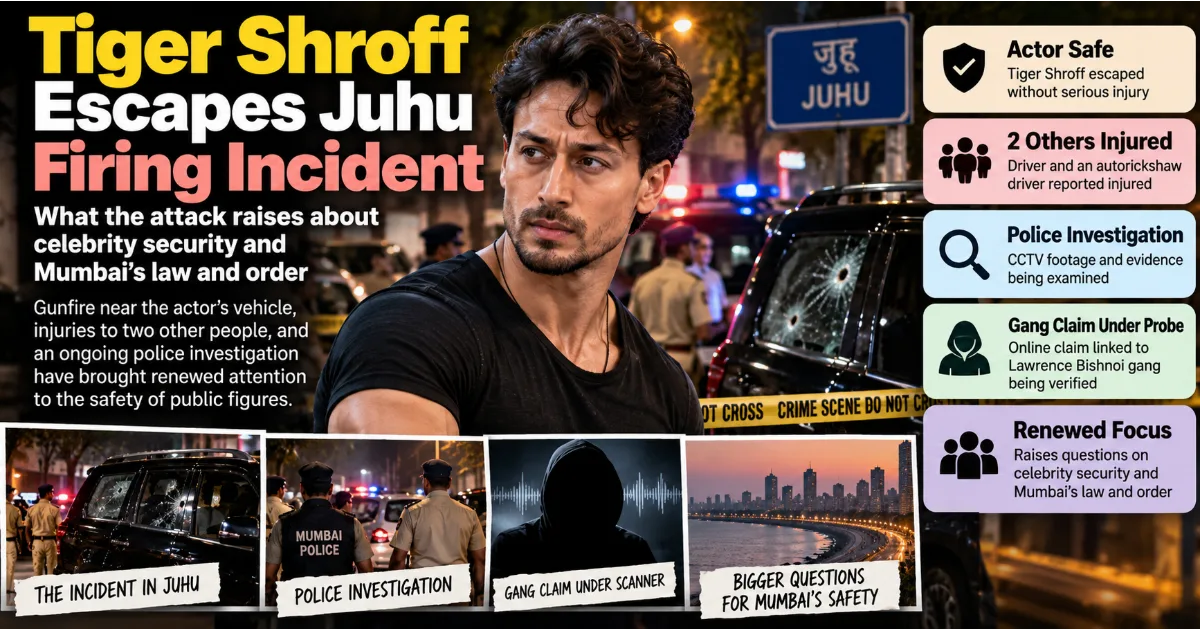
Bollywood actor Tiger Shroff was caught up in a frightening firing incident in Mumbai’s Juhu area on October 18, 2026, when unidentified assailants allegedly opened fire at the vehicle in which he was travelling. The actor escaped without serious injury, but his driver and another person were reported injured. The incident has triggered a police investigation, raised questions about the security of high-profile personalities, and renewed public concern about the possibility of criminal threats reaching the entertainment industry.
The incident reportedly took place near Pushpa Park after Shroff had played football with fellow actors. As he was leaving the area, a motorcycle-borne group allegedly approached the vehicle and fired several rounds before escaping. Investigators have been examining CCTV footage, the suspected escape route, and other evidence to establish exactly what happened and identify those responsible.
The most important fact is that Shroff survived the incident without a reported gunshot injury. However, the fact that other people were injured makes this more than a celebrity news story. It is also a serious public safety matter involving the use of firearms in a populated urban neighbourhood.
A video and online claims attributed to people allegedly associated with the Lawrence Bishnoi gang have added another dimension to the case. Such claims have circulated widely, but a claim of responsibility on social media is not, by itself, proof of who planned or carried out a crime. Investigators must establish the authenticity of the material, identify the individuals involved, and determine whether any alleged criminal organisation had a genuine role.
Continue Reading
The episode also comes amid wider concerns about threats and attacks involving prominent personalities in the Indian entertainment industry. It has renewed questions about whether security arrangements adequately account for public appearances, predictable personal routines, and the risks created when celebrities travel through areas where fans can gather close to their vehicles.
For Tiger Shroff, who has built a public identity around action films, physical training, and an active lifestyle, the incident is an unsettling reminder that real-world violence is very different from action sequences performed for the screen. For Mumbai, the priority is to establish the facts, protect those affected, and ensure that those responsible face the legal consequences of their actions.
What Happened Near Pushpa Park in Juhu?
The incident occurred on Sunday evening, October 18, in Mumbai’s Juhu neighbourhood. According to reports, Tiger Shroff had been playing football with other actors before preparing to leave the area. The gathering was a familiar kind of recreational outing for people in the entertainment industry, where sports and fitness activities can provide a break from filming schedules and promotional commitments.
The situation reportedly changed when the actor’s vehicle was approached by unidentified people travelling on a motorcycle. Several shots were fired in the direction of the vehicle. Initial reports differed on the precise number of rounds, with accounts mentioning three, four, or more shots. The exact sequence and number of shots will need to be established through forensic examination, witness statements, and other evidence.
The incident created alarm in the area. Gunfire in a crowded neighbourhood can cause confusion within seconds, particularly when people do not immediately know where the shots are coming from or whether additional violence is likely. Bystanders may run for cover, vehicles may stop unexpectedly, and people nearby can be injured even if they are not the intended targets.
Shroff was reported safe and did not sustain a gunshot injury. His driver, identified in reports as Firdaus, was injured, while another person, described as an autorickshaw driver, was also reported to have been hurt. The injured individuals were taken for medical treatment. The condition and subsequent recovery of those affected are important parts of the story that deserve attention alongside the investigation into the actor’s safety.
The circumstances surrounding the firing remain central to the police inquiry. Investigators need to determine whether the attackers were specifically targeting Shroff, whether the vehicle was followed or approached deliberately, and whether the incident was connected to a wider criminal plan. Those questions cannot be answered solely through early eyewitness accounts or online speculation.
The incident also demonstrates why early reports in a developing crime story can contain conflicting details. Information emerges from multiple witnesses, police sources, hospital updates, videos, and social media posts. Some details may later be corrected as investigators obtain clearer evidence. Responsible reporting must therefore separate established facts from preliminary accounts.
Tiger Shroff’s Safety and the Injuries to Others
The immediate relief following the incident was that Tiger Shroff survived without a reported gunshot wound. Public attention naturally focused on the actor because he was the most recognisable person involved. However, the injuries reported among other people are an equally important part of the event.
A driver accompanying a public figure is often responsible for navigating busy roads, responding to unexpected situations, and helping ensure that passengers reach their destinations safely. In a sudden shooting, a driver may have little time to react. Even a person who is not the intended target can be exposed to bullets, shattered glass, or the confusion that follows an attack.
The reported injury to an autorickshaw driver is also significant. It highlights how violence directed at one person can place unrelated members of the public in danger. People working on the streets, waiting for customers, travelling home, or passing through an area may become unintended victims of an incident they had no reason to anticipate.
This is one of the most troubling features of firearm violence in a city. The risk does not remain confined to the individual who may have been targeted. A crowded street can turn a personal or criminal dispute into a public emergency.
The medical needs of the injured, the support available to their families, and the investigation into how they were harmed should remain part of the public conversation. Celebrity status should not determine whose safety matters most. Every person injured in such an incident deserves proper medical care and an opportunity to seek justice.
For Shroff, the incident is likely to prompt a review of personal security arrangements and travel routines. For those around him, it may also lead to greater caution when attending public activities. Yet the responsibility for preventing such incidents cannot rest solely on the potential victims. Law enforcement, intelligence gathering, criminal investigation, and the prosecution of offenders remain essential to public safety.
How Mumbai Police Are Investigating the Case
Mumbai Police have launched an investigation into the firing. Reports on October 19 described efforts to examine CCTV footage, trace the movements of the suspected attackers, and identify the motorcycle believed to have been used in the incident. Authorities were also reported to have deployed multiple teams to pursue leads.
Investigators typically begin by establishing a detailed timeline. They need to know when the suspects arrived, where they travelled, how long they remained near the target, the direction in which they escaped, and whether they changed vehicles or clothing. CCTV footage from nearby buildings, shops, roads, and transport facilities can help reconstruct movements before and after a crime.
Witness statements are another important source of evidence. People who were present may have seen the motorcycle, noticed the appearance of the suspects, heard the shots, or observed what happened immediately afterwards. Investigators must compare these accounts carefully because people experiencing a sudden and frightening event may remember different details.
Physical evidence can provide additional answers. Investigators may examine bullet marks, cartridge cases, damage to the vehicle, and any other material recovered from the scene. Forensic examination can help establish the type of weapon used, the approximate direction of the shots, and other details relevant to reconstructing the incident.
The suspected escape route is also important. News reports on October 19 described CCTV images of people believed to be involved and a motorcycle reportedly found abandoned near Andheri railway station. These developments may help investigators narrow their search, but the identification of suspects and the confirmation of their roles require evidence that can withstand legal scrutiny.
Reports about whether a person had been detained were not entirely consistent during the early investigation. Such differences illustrate why it is important not to declare a suspect guilty or announce a confirmed arrest unless authorities establish the relevant facts. Questioning, detention, arrest, formal charges, and conviction are distinct legal stages.
A successful investigation must go beyond locating individuals who may have been involved in the immediate attack. Police must also establish whether the firing was planned, whether the attackers received assistance, whether weapons were supplied by others, and whether anyone financed or directed the operation. If a wider conspiracy is suspected, investigators need evidence linking each participant to the alleged crime.
The Lawrence Bishnoi Gang Claim and the Need for Verification
One of the most widely discussed aspects of the incident has been an online claim attributed to individuals allegedly connected to the Lawrence Bishnoi gang. Reports described a message or video in which a person identifying himself as associated with the group claimed responsibility and referred to Shroff’s alleged connection with actor Salman Khan.
The claim has attracted attention because the Bishnoi gang has been associated in previous public reporting with threats and violent incidents involving Bollywood personalities. However, a history of allegations involving a criminal organisation does not automatically prove that it was responsible for a new attack.
Anyone can publish a statement online claiming responsibility for a crime. Such a statement may be genuine, exaggerated, misleading, or intended to influence public perception. Criminal groups may also use threats and publicity to create fear beyond the immediate incident. Investigators must therefore verify the source, establish whether the person has an authentic connection to the alleged organisation, and determine whether the claim matches evidence gathered at the scene.
The distinction matters for both public safety and justice. If the claim is genuine, authorities need to establish who ordered the attack, what motive was involved, and whether further threats are credible. If the claim is false or intended to mislead, the investigation must identify that possibility as well.
The language used in such messages can also be designed to provoke fear. Threats against other public figures may be intended to make a group appear more powerful, attract media coverage, intimidate people, or create the impression that its influence extends across the entertainment industry. Repeating such threats without context can amplify the intended effect.
Responsible reporting should not turn an unverified message into a confirmed explanation of the crime. It is appropriate to report that a claim has surfaced and is being examined. It is not appropriate to treat the claim as conclusive proof before the evidence has been established.
For the public, the practical response is to rely on verified police updates and credible reporting rather than circulate unconfirmed names, accusations, or threatening messages. Sharing unverified material can endanger innocent people, interfere with an investigation, and create unnecessary panic.
Why Bollywood Celebrities Can Face Distinct Security Risks
Public figures live under conditions that are different from those experienced by most people. Their work requires visibility, publicity, public appearances, fan engagement, travel, and attendance at events where large numbers of people may gather. These activities help build careers, but they can also create security challenges.
Celebrities may have regular fitness routines, favourite restaurants, familiar travel routes, and recurring professional commitments. Some routines become known through photographs, fan posts, or frequent public appearances. If an individual with harmful intentions can anticipate where a person is likely to be, that predictability may create a security risk.
This does not mean that every public appearance is dangerous or that celebrities should withdraw from ordinary activities. It means security planning must account for the possibility that public information can be used in unexpected ways. A routine that is convenient for the individual may also become predictable to someone monitoring their movements.
The presence of fans can create another challenge. Admirers often gather around a celebrity's vehicle to request photographs, wave, or express support. Most fan interactions are peaceful and enthusiastic. Nevertheless, a dense crowd can make it harder for security personnel to identify suspicious behaviour or respond quickly when a threat emerges.
Security arrangements need to balance accessibility with protection. Excessive restrictions can make public life difficult and distance performers from their audiences, while insufficient planning can expose both celebrities and members of the public to risk. The appropriate measures depend on the person's risk profile, the location, the nature of the event, and the information available to authorities.
A high-profile actor may require different arrangements for a private recreational activity than for a ticketed event with organised security. A venue with controlled access, clear entry and exit points, and professional security coordination offers different protections from an open public space where people can approach vehicles freely.
The Juhu incident may therefore encourage wider discussion about how security is planned for informal celebrity appearances. The challenge is not to eliminate every ordinary activity from an actor’s life. It is to ensure that known risks are assessed sensibly and that appropriate precautions are taken without creating unnecessary disruption.
The Wider Question of Public Safety in Mumbai
Mumbai is a large, densely populated city where residential neighbourhoods, commercial establishments, entertainment venues, and major roads often exist close together. Public safety requires coordination across police stations, traffic authorities, emergency medical services, local administrations, and communities.
A shooting in Juhu raises questions about how quickly officers can respond, how evidence is preserved, and how suspects can be traced through a busy urban environment. It also prompts questions about whether authorities have sufficient intelligence to identify threats before they turn into violence.
However, a single incident cannot by itself provide a complete assessment of law and order across the city. Public safety must be evaluated through reliable data, crime trends, investigation outcomes, conviction rates, response times, and the experiences of residents across different neighbourhoods.
Political reactions to a high-profile crime are common, particularly when an incident involves a celebrity or other prominent individual. Opposition leaders may question the government's handling of security, while the administration may promise swift action. Such responses are part of democratic accountability, but they should not replace a careful assessment of evidence.
The public has a legitimate interest in knowing whether law enforcement agencies are adequately equipped, whether criminal networks are being disrupted, and whether victims receive timely protection. Those questions deserve clear answers based on investigation results and measurable outcomes.
The government also has a responsibility to communicate responsibly. Premature claims about motives or suspects can undermine public confidence if they later prove inaccurate. Equally, vague assurances without meaningful progress can leave people uncertain about whether the threat has been addressed.
In this case, the most immediate priority is to establish the sequence of events, identify those responsible, and determine whether any wider criminal organisation was involved. The investigation's findings will provide a stronger basis for evaluating the effectiveness of the response than speculation during the first hours after the incident.
What the Incident Means for Tiger Shroff’s Career
Tiger Shroff has built his film career around action-oriented roles, demanding physical training, martial arts, and elaborate movement sequences. His screen image is closely associated with agility, discipline, and the ability to perform physically challenging scenes. Yet an incident involving real firearms is entirely different from a controlled film production.
Action sequences are generally planned through rehearsals, stunt coordination, safety checks, controlled environments, and professional supervision. Even when a scene looks dangerous, its risks are supposed to be managed through preparation and technical safeguards. A real shooting offers none of those protections to the people caught in it.
For an actor, such an experience may have consequences beyond the immediate physical event. It can affect personal confidence, family concerns, professional scheduling, and decisions about public appearances. The psychological impact of a frightening incident can also persist after physical injuries have healed, although no assumptions should be made about Shroff’s personal response unless he chooses to discuss it publicly.
The entertainment industry may need to consider how such events affect work. Film schedules often involve travel, outdoor shoots, public promotions, meetings, and coordination among large teams. A credible security threat can lead to changes in schedules or additional precautions for the actor and colleagues.
At the same time, it would be premature to speculate about the incident's effect on Shroff's future projects or commercial prospects. The investigation is still developing, and there is no reason to assume that his career will necessarily be altered by the event. His professional decisions remain separate from the legal process surrounding the shooting.
What can be said is that the incident has drawn attention to the vulnerability of public figures outside their professional environments. Fame can create recognition and opportunity, but it does not provide physical protection by itself. A person may be surrounded by fans one moment and exposed to a serious threat the next.
For audiences, the event is a reminder that actors are people who also need privacy, safety, and the freedom to engage in ordinary activities. The public's interest in a celebrity should not erase the need to protect that person's personal space.
The Role of Social Media in a Developing Crime Story
Social media can provide immediate information during breaking news. Witnesses may share videos, residents may report what they heard, and public figures may communicate directly with their audiences. These channels can sometimes help journalists understand what happened before a complete official account is available.
However, speed also creates risks. Videos can be taken out of context, old footage can be recirculated as new, and speculation can spread faster than verified information. A person appearing in a clip may be wrongly identified, while a statement attributed to a criminal group may not be authentic.
In a case involving alleged organised crime, these risks become particularly serious. False claims can frighten the public, damage reputations, and divert attention from the evidence. Reposting graphic or unverified material may also distress people who were present or are concerned about those affected.
Readers should look for clear distinctions between confirmed facts and allegations. Reports should identify when information comes from police statements, eyewitnesses, anonymous sources, or social media claims. These sources do not carry identical levels of reliability.
A police statement confirming that an actor is safe is different from an online account speculating about why the incident occurred. A CCTV image released or described by investigators may provide a useful lead, but it does not automatically establish the identity or guilt of the people shown. A purported confession or claim of responsibility must be examined before it is treated as evidence of involvement.
News organisations also have a responsibility to update stories when facts change. If the number of shots, the identity of an injured person, or the status of a suspect is corrected, the updated account should reflect that correction. The goal is not simply to publish the earliest report, but to provide the most accurate understanding available.
For audiences, a few simple habits can reduce misinformation. Check whether several credible outlets independently report the same key fact, distinguish official statements from unverified claims, and avoid forwarding messages that identify suspects without reliable confirmation. In serious criminal cases, restraint is part of responsible public behaviour.
Why Predictable Routines Require Thoughtful Security Planning
Reports surrounding the incident have raised the possibility that the attackers may have known about Shroff’s regular football routine. That possibility has not, by itself, established who planned the attack or how much preparation occurred. Investigators will need to determine whether the suspects had prior knowledge of the actor's movements or encountered him by chance.
Nevertheless, the question of predictable routines is relevant to public-figure security. A repeated schedule can make it easier for someone to anticipate a person's location. Public posts, event photographs, and informal announcements may reveal more about movements than individuals realise.
Security professionals often consider routine, access, visibility, and escape routes when assessing risk. They may recommend varying travel arrangements, reviewing entry and exit points, limiting unnecessary disclosure of real-time locations, and coordinating with venue staff when circumstances warrant additional protection.
Such precautions should be proportionate. It would be unreasonable to suggest that every person must conceal every aspect of their life. Most people can maintain ordinary routines without significant security measures. High-profile individuals, however, may face a different risk environment because their movements are more visible and their identities are widely recognised.
The wider lesson also applies to businesses, public officials, and other people whose schedules are frequently disclosed. Security awareness involves understanding which information is necessary to share publicly and which details could create avoidable exposure.
Yet security cannot depend entirely on the potential victim changing their behaviour. If an attack is planned, the responsibility lies with the perpetrators, and law enforcement must investigate and prevent such crimes. Personal precautions can reduce risk, but they are not a substitute for effective policing and criminal accountability.
The Importance of Due Process and Evidence
When an incident receives national attention, public pressure for immediate arrests can become intense. People understandably want answers, particularly when a prominent individual has been threatened or when others have been injured. But a strong investigation must be based on evidence rather than pressure to announce a quick result.
The legal process distinguishes between a person being questioned, a suspect being detained, an arrest being made, charges being filed, and a court reaching a verdict. Each stage has a different meaning. Confusing them can create the impression that guilt has already been established when the investigation may still be examining basic facts.
Investigators must establish the roles of everyone suspected of involvement. The person who allegedly fired a weapon may have a different role from someone who supplied the weapon, arranged transport, communicated instructions, or helped the suspects escape. If a larger conspiracy is alleged, evidence must connect the relevant individuals to the alleged plan.
Digital evidence may form part of that process. Communication records, location information obtained lawfully, messages, financial transactions, and online statements can sometimes help investigators establish connections. Such material must be authenticated and interpreted in context rather than treated as conclusive merely because it exists.
Witnesses may also need protection from intimidation or pressure. People who saw an incident or possess relevant information should be able to cooperate with investigators without fear of retaliation. Preserving evidence and ensuring reliable testimony are essential to any successful prosecution.
Due process protects the integrity of the investigation. It helps ensure that the people responsible can be held accountable while reducing the risk of innocent individuals being wrongly accused. A case does not become stronger because authorities announce a conclusion quickly. It becomes stronger when the evidence is reliable, the procedures are lawful, and the findings can withstand scrutiny in court.
Could This Change How Bollywood Manages Celebrity Security?
The incident may encourage actors, managers, production companies, event organisers, and security professionals to revisit how personal safety is handled during informal appearances. Such a review would be reasonable even before the investigation reaches its conclusion, provided it does not assume an unproven motive or assign blame without evidence.
Celebrity security is not limited to bodyguards standing beside an actor. It can involve advance planning, venue assessments, communication between teams, transport arrangements, emergency procedures, and decisions about how public interactions are managed. The appropriate combination depends on the level of risk and the circumstances of the appearance.
Production companies may need to consider whether actors face different risks while travelling to outdoor locations, attending promotional events, or participating in activities that are not part of a formal production. Event organisers can help by ensuring that entrances and exits are managed, crowds are not allowed to block emergency access, and security personnel know how to respond to a developing threat.
There is also a role for coordination with local police when a credible threat has been identified. Authorities can assess whether additional precautions are necessary and determine whether information about a potential risk requires further investigation. Such coordination should be guided by evidence and appropriate legal procedures rather than public speculation.
At the same time, security arrangements should not unnecessarily restrict ordinary life. Actors, like other citizens, should be able to exercise, meet friends, travel, and spend time outside work. The goal is to manage identifiable risks without treating every public space as inherently dangerous.
The industry can also benefit from reviewing how information about public figures is shared. Real-time location posts and predictable schedules can sometimes expose individuals to avoidable risks. Responsible communication does not mean eliminating publicity; it means considering whether revealing a person's immediate whereabouts serves a genuine purpose.
Whether the Juhu incident leads to broader changes will depend on the facts established by investigators and the decisions made by people responsible for security. It should nevertheless prompt a practical discussion about prevention, emergency readiness, and the protection of everyone who may be caught in a violent incident.
A Story Bigger Than Celebrity Headlines
Tiger Shroff’s name has made the incident a national entertainment story, but the underlying issues extend well beyond Bollywood. The use of firearms in a populated neighbourhood threatens the safety of people who may have no connection to the intended target. It also raises questions about criminal intimidation, the effectiveness of policing, and the responsibility to verify claims made in the aftermath of violence.
The reported injuries to the actor’s driver and another person demonstrate why public attention should not focus exclusively on the celebrity. Those affected by a crime may include workers, bystanders, local residents, and people whose names never appear in headlines. Their safety and recovery deserve the same seriousness as the protection of a famous individual.
The investigation must now establish what happened, who was responsible, and whether the attack was connected to a wider criminal operation. Until those facts are established, claims about the motive and the identities of the perpetrators should be treated cautiously. An online claim of responsibility may be an important lead, but it is not a substitute for proof.
The incident also illustrates the complicated relationship between fame and security. Public recognition is central to an actor's career, yet that visibility can make personal routines easier to observe. The answer is not to blame celebrities for living publicly or to normalise violence as an unavoidable cost of fame. It is to improve risk assessment, strengthen law enforcement, and hold those responsible for criminal acts accountable.
For Mumbai, the outcome of the investigation will matter more than the volume of speculation surrounding the case. Identifying suspects, establishing their roles, protecting witnesses, and building a legally sound prosecution are the steps that can provide meaningful answers. If a wider network was involved, the authorities will need to determine its extent through evidence.
For the entertainment industry, the episode is a reminder that security planning must cover ordinary moments as well as major public events. A football match, a restaurant visit, or a journey home may seem routine, but circumstances can change rapidly when a credible threat exists.
Conclusion: Safety Must Matter More Than Celebrity Status
The firing incident involving Tiger Shroff in Mumbai’s Juhu area has brought a serious public safety issue into the spotlight. The actor was reported safe after unidentified assailants allegedly fired at his vehicle, while his driver and another person were reported injured. Police are investigating the attack, examining available evidence, and attempting to establish who was responsible.
Claims linking the incident to the Lawrence Bishnoi gang have added to public concern, but those claims must be verified rather than accepted as a final explanation. Investigators need to determine whether the alleged connection is genuine, establish the motive, and identify the people who planned or carried out the attack.
The case also highlights the importance of protecting ordinary people who may be caught in violence directed at someone else. A celebrity may be the focus of public attention, but the risks created by a shooting extend to drivers, workers, residents, and bystanders. Their safety must remain central to the response.
Beyond the immediate investigation, the incident should encourage a serious discussion about celebrity security, public safety, criminal intimidation, and responsible reporting. Authorities must act on credible leads, communicate verified information, and ensure that the legal process remains grounded in evidence. The public can contribute by avoiding rumours and allowing investigators to establish the facts.
Tiger Shroff’s survival is a relief, but it does not erase the seriousness of what occurred. The measure of the response will be whether the people responsible are identified, the injured receive appropriate care, and the circumstances that allowed the incident to happen are properly examined.
Beyond Headlines, the larger message is clear: safety should never depend on how famous a person is. A city is safer when every resident, worker, visitor, and public figure can move through its streets without fear of armed violence. The priority now is not speculation or sensationalism, but verified answers, accountability, and practical steps to prevent similar incidents in the future.
#BeyondHeadlines #TigerShroff #MumbaiNews #Juhu #BollywoodNews #MumbaiPolice #CelebritySecurity #PublicSafety #LawAndOrder #CrimeNews #EntertainmentIndustry #IndiaNews