The Zhou Dynasty and the Age of Philosophers
How the Defeat of the Shang Dynasty Created a New Theory of Political Legitimacy That Shaped Chinese History for Centuries
Introduction: A Conquest That Changed Chinese Political Thought
Around the middle of the eleventh century BCE, a powerful political transformation took place in ancient China. The Zhou, a people whose power base lay west of the Shang royal center, defeated the Shang Dynasty and established a new ruling house. Their victory changed the political landscape of northern China, but its significance extended far beyond the replacement of one royal family by another. The Zhou developed an influential explanation for why one dynasty could lose power and another could legitimately take its place. This idea became known as the Mandate of Heaven.
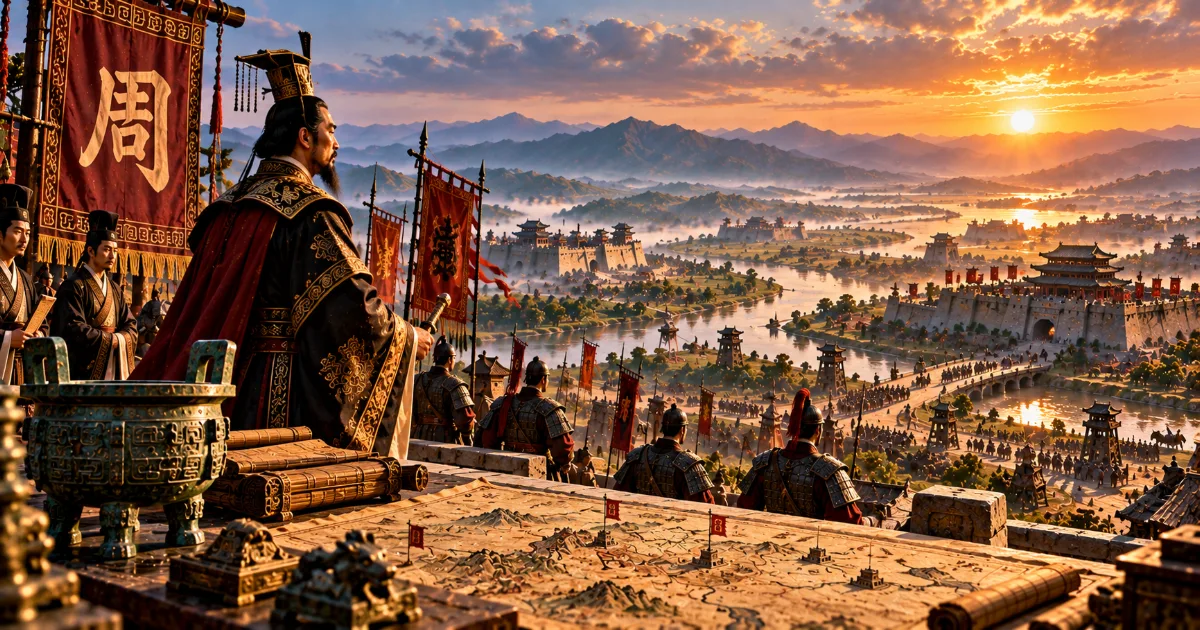
The Zhou conquest is traditionally associated with King Wu of Zhou and the Battle of Muye, commonly dated to around 1046 BCE, although the chronology of early Zhou history remains subject to scholarly discussion. Later Chinese historical accounts describe the last Shang ruler, King Zhou, as cruel and irresponsible. They present the Zhou victory as a justified response to a ruler who had lost the support of Heaven and the people. The Zhou king, by contrast, was portrayed as restoring proper order.
The central idea was revolutionary in its long-term implications. A ruler's authority did not belong permanently to a family simply because its ancestors had conquered the land. Instead, political power carried responsibilities. A ruler who governed responsibly could retain Heaven's support, while a ruler who became oppressive or failed to maintain order might lose it. The Mandate of Heaven therefore provided a moral framework for understanding political legitimacy and dynastic change.
This concept did not create democracy in the modern sense, nor did it mean that ordinary people could freely select their rulers. The Zhou system remained hierarchical, and political power was concentrated among royal families and regional elites. Nevertheless, the idea established that a ruling house could be judged according to its conduct. It gave later historians and political thinkers a way to explain why powerful dynasties sometimes collapsed and why new rulers claimed the right to govern.
The Zhou also faced a practical challenge after their conquest. Defeating the Shang was only the beginning. They needed to secure their territories, manage relationships with local elites, establish political authority across a large region, and prevent the restoration of the defeated dynasty. Their solution involved a network of regional rulers, many connected to the Zhou royal house through kinship or political allegiance.
This article explores the origins of the Zhou, the conquest of the Shang, the political problems faced by the new dynasty, and the development of the Mandate of Heaven. It also examines the historical evidence and explains why this idea became one of the most enduring principles in Chinese political history.
1. The Zhou People Before the Conquest
Before the Zhou became the ruling dynasty of China, they were one of several political communities competing for influence in the region. Their power base lay in the west, in an area associated with the Wei River valley in present-day Shaanxi Province. The region provided access to agricultural land and routes connecting different parts of northern China.
The Zhou developed within a world shaped by farming, regional exchange, military rivalry, and changing political relationships. The Shang Dynasty was the most prominent established power in the central plains, but its influence did not necessarily extend equally across every community. Local rulers and regional groups retained their own interests and could cooperate with or oppose powerful centers depending on circumstances.
The Zhou gradually strengthened their position. Later historical traditions describe a sequence of Zhou leaders who expanded their influence and prepared the way for the conquest. One particularly important figure was King Wen of Zhou, who became central to later accounts of the dynasty's rise. He is remembered as a wise and virtuous leader who developed the Zhou's strength before the final campaign against the Shang.
The historical details of King Wen's activities are difficult to reconstruct in full. Much of the narrative comes from later sources that present the Zhou conquest as the outcome of moral leadership and careful preparation. These traditions are valuable, but they must be read alongside archaeological evidence and the political circumstances of the period.
The Zhou's location may have offered strategic advantages. Their western base allowed them to develop independently of the Shang royal center while maintaining connections with other communities. As their influence grew, they could build alliances, obtain resources, and organize forces capable of challenging the established dynasty.
Political competition in early China was not simply a struggle between two clearly defined nations. Regional identities, kinship ties, and local loyalties mattered greatly. Some groups may have supported the Zhou because they saw opportunities for greater influence, while others may have opposed them or remained uncertain about the outcome.
The Zhou conquest was therefore the result of a longer process of political consolidation. The dynasty did not emerge from nowhere in a single battle. Its rise reflected changes in the balance of power across northern China and the ability of its leaders to turn regional influence into a successful challenge against the Shang.
2. The Shang Dynasty Before Its Fall
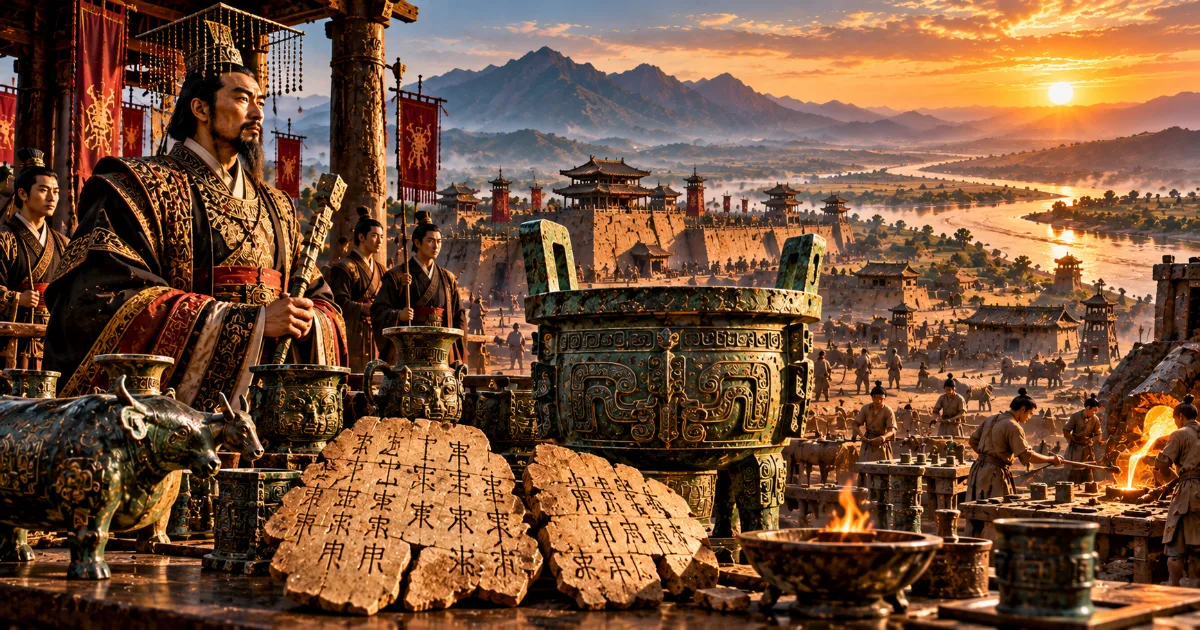
The Shang Dynasty had developed a sophisticated political and ritual system. Its rulers presided over royal centers, organized military campaigns, commissioned bronze vessels, and consulted ancestral spirits through divination. Oracle-bone inscriptions from the later Shang period provide direct evidence of royal concerns about warfare, harvests, weather, health, and ceremonies.
The Shang court's authority depended on several connected foundations. It required agricultural production to sustain the royal household and its dependents. It relied on relationships with regional leaders and the ability to mobilize military forces. It also drew legitimacy from ritual practices that connected the king with ancestral powers.
These institutions did not guarantee permanent stability. The kingdom operated in a world of rivalry and changing alliances. Military campaigns required resources, regional leaders had their own interests, and the royal household needed to maintain relationships with influential groups. A ruling house could remain powerful for generations and still face serious challenges.
Later Chinese histories describe the last Shang ruler, King Zhou, as a tyrant whose excesses alienated his subjects. He is portrayed as indulgent, cruel, and unwilling to listen to wise advisers. These accounts make his behavior the principal explanation for the dynasty's collapse.
Such stories became important in Chinese political thought, but historians cannot accept every detail as a verified description of the final Shang king. The surviving accounts were shaped by the Zhou and later traditions, which had strong reasons to explain the conquest as morally justified. A new ruling house benefited from presenting its predecessor as unworthy of power.
The actual fall of the Shang probably involved a combination of political, military, and strategic factors. The Zhou had developed sufficient strength to challenge the royal center, and the outcome of the conflict depended on alliances and the ability to organize forces. The Shang's defeat demonstrates that established power could be overturned when a rival group combined military capability with political opportunity.
The archaeological record confirms that the Shang royal center was a substantial political and cultural institution. It does not, however, provide a complete account of the events that led to the Zhou conquest. The traditional narrative and the material evidence must therefore be distinguished, even while both contribute to our understanding of the transition.
3. King Wen and the Preparation for Victory
King Wen occupies an important place in Zhou historical memory. Later accounts describe him as a leader whose personal virtue and political judgment strengthened the Zhou before their final victory over the Shang. He became a model of wise leadership and was associated with the moral foundation of the new dynasty.
In traditional narratives, King Wen did not simply seek power through military force. His reputation rested on restraint, good judgment, and the ability to attract support. The contrast with the Shang's final ruler helped explain why the Zhou were considered worthy of replacing the older dynasty.
These descriptions should be treated carefully. Later writers often portrayed exemplary rulers through moral ideals that reflected the concerns of their own periods. A historical leader might have been capable and influential, but the surviving portrait could also have been refined to communicate lessons about proper government.
The Zhou's growing strength nevertheless suggests that their leaders were effective at building political relationships. Military success required more than a single army. It depended on supplies, leadership, alliances, and knowledge of the region. The ability to secure cooperation from other communities could be as important as the number of warriors available.
The Zhou also needed a reason to challenge the Shang beyond simple ambition. A successful conquest could establish a new ruling family, but it could also create resistance among communities that remained loyal to the defeated dynasty. Presenting the Zhou as morally justified helped address this problem by offering an explanation for why the transfer of power should be accepted.
The idea that virtue and political authority were connected became central to the Zhou's interpretation of its victory. King Wen's remembered qualities helped create a narrative in which the new dynasty was not merely stronger than the Shang. It was also presented as more deserving of rule.
This narrative became part of the wider political philosophy associated with the Mandate of Heaven. The Zhou claimed that their success reflected Heaven's judgment, while the Shang's defeat demonstrated that the older ruling house had lost its support.
4. King Wu and the Battle of Muye
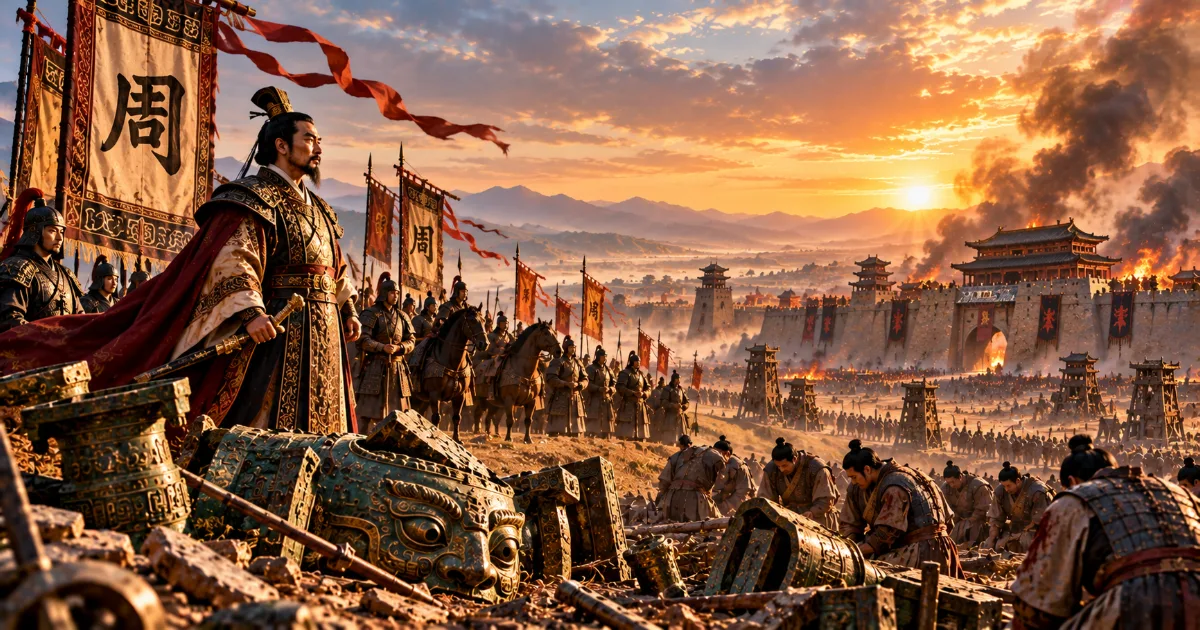
The decisive Zhou victory is traditionally associated with King Wu, the son of King Wen. The Battle of Muye, generally dated to around 1046 BCE, is remembered as the confrontation in which Zhou forces defeated the Shang and opened the way for the establishment of the new dynasty.
Later accounts describe the Zhou army advancing against the Shang forces near the royal center. The battle is presented as the culmination of the Zhou's preparations and the result of the Shang ruler's loss of legitimacy. Some narratives emphasize that the Shang army was weakened by disloyalty or that its troops failed to fight effectively. These details belong to the traditional account and cannot all be independently verified.
The victory would have required effective military organization. The Zhou needed to gather forces, secure supplies, coordinate their movements, and confront a powerful rival. The outcome suggests that the balance of military and political power had shifted sufficiently for the Zhou to challenge the Shang successfully.
The precise scale and course of the battle remain difficult to establish. Ancient sources were written or compiled later, and they often explain events through moral themes. The archaeological evidence does not provide a complete battlefield record that would allow historians to reconstruct every stage of the conflict.
Nevertheless, the conquest marked a major political transition. The Zhou took control of the Shang's former sphere of influence and began establishing their own system of rule. They also inherited the challenge of governing communities that had previously been connected to the Shang royal house.
Victory alone could not ensure lasting authority. The Zhou needed to manage local elites, prevent opposition, maintain economic resources, and create a political explanation that justified their rule. The Mandate of Heaven became one of the most important elements of that explanation.
The Battle of Muye thus mattered for two reasons. It ended Shang dominance and established the Zhou as the leading political power. It also became the historical event through which the Zhou explained a new theory of legitimate government, one in which the right to rule depended on more than ancestry or military strength.
5. What Was the Mandate of Heaven?
The Mandate of Heaven, known in Chinese as Tianming, became one of the most influential concepts in Chinese political thought. It expressed the belief that Heaven granted a ruler the authority to govern, but that this authority was conditional rather than permanent.
The concept emerged in the context of the Zhou conquest and was developed through Zhou political and ritual traditions. The Zhou argued that their victory over the Shang was not simply a result of military strength. It reflected Heaven's decision to withdraw support from the Shang and allow the Zhou to take its place.
Heaven in this context should not be understood as identical in every respect to the personal deity described in some later religious traditions. In early Chinese political thought, Heaven could be understood as a powerful cosmic and moral authority associated with order, legitimacy, and the proper conduct of rulers. The precise meaning developed over time.
The central principle was that political authority carried responsibilities. A ruler was expected to maintain order, protect the realm, and govern in a manner consistent with the moral expectations of the political tradition. If a ruling house failed badly enough, it could lose the Mandate.
This idea provided a framework for understanding dynastic change. When a new ruling house defeated an older one, it could claim that the previous dynasty had lost Heaven's support and that the new dynasty had received the mandate to govern. The replacement of one ruling family by another could therefore be presented as part of a larger moral order.
The Mandate of Heaven was not a written constitution, nor did it provide a precise procedure for determining when a ruler had lost legitimacy. There was no independent institution that could formally declare the Mandate withdrawn. In practice, political leaders and later historians interpreted events through the concept, especially when a dynasty had already weakened or fallen.
The idea could therefore be used both to justify existing authority and to explain its collapse. A successful ruler could claim that victory demonstrated Heaven's favor. A defeated ruler could be described as having lost the Mandate because of misconduct, failure, or an inability to maintain order.
This flexibility helped the concept endure. It offered a way to connect political power with moral responsibility while allowing later generations to explain major changes in government. The Mandate of Heaven became one of the principal ideas through which Chinese historians interpreted the rise and fall of dynasties.
6. Why the Zhou Needed a New Theory of Legitimacy
Overthrowing the Shang created a problem for the Zhou. The Shang had ruled for generations, and its royal authority was embedded in established political relationships and ritual practices. A victorious Zhou leader could control the royal center, but military success alone did not automatically convince every community that the new dynasty had a rightful claim to govern.
The Zhou needed to explain why the transfer of power was legitimate. If political authority belonged permanently to a ruling family simply because its ancestors had once conquered the territory, the Zhou would have had difficulty explaining why they were entitled to replace the Shang. They therefore developed an argument that linked legitimacy to Heaven's judgment and the moral conduct of rulers.
This theory allowed the Zhou to portray the conquest as more than a struggle for power. The Shang had supposedly failed in its responsibilities, while the Zhou had demonstrated qualities that made them more suitable rulers. Their victory could thus be presented as evidence of a larger political and moral principle.
The argument also helped the Zhou address the problem of continuity. The new dynasty inherited institutions, territories, and communities from the Shang. By claiming that Heaven had transferred its support rather than abandoned the entire political order, the Zhou could present themselves as successors to an established civilization.
The Mandate of Heaven also created a warning for the Zhou themselves. If the Shang had lost legitimacy through misconduct, then the Zhou could theoretically face the same judgment. The principle did not guarantee that the new dynasty would rule forever. Its authority remained connected to the way it governed.
This feature distinguished the concept from a simple claim of permanent hereditary entitlement. Although the Zhou system was hereditary and hierarchical, its political ideology allowed the possibility that a ruling family could become unworthy of its position.
The theory did not eliminate political conflict. Rulers could interpret their own interests as evidence of Heaven's support, and opponents could accuse them of failing in their responsibilities. Yet it provided a shared language through which people could discuss authority, morality, and dynastic change.
The Zhou's political achievement was therefore partly ideological. They used a theory of conditional legitimacy to explain their conquest and to establish a principle that later Chinese dynasties would repeatedly invoke.
7. Heaven, the People, and the Responsibilities of Rulers
The Mandate of Heaven connected political legitimacy with the conduct of rulers. A king was expected to maintain order, protect the realm, and avoid the kind of behavior that could undermine the welfare of the population.
Later Chinese traditions associated with the Zhou emphasized that Heaven's judgment was reflected in the condition of the state. Political disorder, rebellion, famine, military defeat, and widespread suffering could be interpreted as signs that a ruler had failed. Such events did not automatically prove that the Mandate had been withdrawn, but they could become part of the argument used to explain a dynasty's decline.
The relationship between Heaven and the people is especially important. The concept did not establish popular sovereignty in the modern democratic sense. Ordinary people did not possess a formal mechanism for voting a ruler out of office, and the political system remained dominated by kings, aristocratic families, and regional elites.
Nevertheless, the welfare of the population could be invoked as a measure of good government. A ruler who imposed excessive burdens, allowed disorder to spread, or neglected basic responsibilities could be criticized as failing to govern properly. This gave later thinkers a moral language for discussing the obligations of political power.
The principle also affected how historians described successful and unsuccessful rulers. A dynasty's longevity could be interpreted as evidence that its rulers had maintained Heaven's favor, while its collapse could be explained through failures of leadership. This approach turned political history into a series of lessons about responsibility and legitimacy.
However, it is important not to assume that every historical disaster was understood in the same way by every person. Interpretations varied, and rulers could use the concept selectively. A famine might be explained through environmental conditions, ritual failures, administrative mistakes, or a combination of factors. The Mandate of Heaven provided a framework for interpretation rather than a single automatic explanation.
The concept's enduring importance came from its ability to connect practical government with moral judgment. It suggested that the possession of power was not enough to guarantee rightful rule. Leadership had to be justified through the conduct of the ruler and the condition of the political community.
This idea became a recurring theme in Chinese political philosophy. Later thinkers developed different accounts of what responsible government required, but the relationship between moral conduct and political authority remained central to debates about good leadership.
8. Establishing Zhou Rule After the Conquest
After defeating the Shang, the Zhou faced the challenge of governing a large and politically diverse region. Their authority needed to extend beyond the immediate royal center, and they had to maintain control over territories where local elites possessed their own resources, followers, and traditions.
The Zhou responded by establishing a network of regional rulers. Some were members of the royal family, while others were allied elites or people whose loyalty the new dynasty sought to secure. These rulers received territories and responsibilities in return for recognizing the Zhou king's superior position and providing political or military support.
This arrangement is often described using the term fengjian, referring to the enfeoffment system through which rulers granted territories and established subordinate political relationships. The system was not identical to European feudalism, and the comparison can be misleading if treated as an exact match. Zhou political relationships were shaped by Chinese kinship traditions, ritual practices, royal authority, and the particular circumstances of early state formation.
The regional rulers had considerable responsibilities. They needed to govern local communities, maintain their own political centers, organize resources, and provide support when required. Their authority depended partly on their relationship with the Zhou king, but they also developed local bases of power that could become increasingly independent.
The royal court used ritual and kinship to reinforce these relationships. Ceremonies, titles, gifts, and formal recognition helped define the position of regional leaders. Such practices were important in a society where political authority was maintained through both practical control and shared ideas about status and obligation.
The system helped the Zhou establish influence over a broad area without requiring a fully centralized administration. It also created risks. Regional rulers possessed their own territories and resources, and their loyalty could weaken over generations. As local power grew, the royal court found it increasingly difficult to enforce its wishes across the entire political system.
The Zhou arrangement therefore contained the seeds of later fragmentation. It was an effective way to consolidate authority after conquest, but it depended on relationships that could change over time. The decline of royal control would become one of the defining developments in Zhou history.
9. The Mandate of Heaven and the Future of Chinese Dynasties
The Mandate of Heaven outlived the Zhou Dynasty and became a recurring feature of Chinese political thought. Later dynasties used the concept to explain their own rise to power and to justify the replacement of previous ruling houses.
The Qin Dynasty, which unified China in 221 BCE, established an imperial system that differed significantly from the earlier Zhou order. Yet the broader question of political legitimacy remained important. Later Chinese rulers continued to face the challenge of explaining why their authority was rightful and why their predecessors had failed.
The Han Dynasty and subsequent ruling houses inherited a historical tradition in which dynastic succession could be understood through moral and political change. Historians often described the rise of a dynasty as the result of capable leadership and the decline of its predecessor as the consequence of corruption, disorder, or failure.
The Mandate of Heaven did not determine every political decision, and different dynasties interpreted it in different ways. It was nevertheless useful because it provided a common framework for explaining major transitions. It also allowed historians to present dynastic history as a sequence of moral lessons rather than simply a record of military victories.
The concept could be used to support authority, but it could also undermine it. If a ruler's legitimacy depended on maintaining Heaven's favor, then rebellion and defeat could be interpreted as evidence that the ruler had lost the right to govern. Successful challengers could claim that Heaven had transferred the Mandate to them.
This created a powerful pattern in Chinese historical writing. A new dynasty could portray its predecessor as having become unworthy, while presenting its own founder as a leader who restored order. Later historians could then examine the dynasty's conduct and explain its eventual decline through the same framework.
The concept was not unique in every aspect to China, since many societies connected political authority with religious or moral principles. Its particular importance in Chinese history came from the way it became integrated into dynastic ideology, historical writing, and discussions of responsible government.
The Mandate of Heaven therefore remained influential long after the original Zhou conquest. It became one of the central ideas through which Chinese rulers and historians understood the relationship between power, morality, and political change.
10. What the Historical Evidence Can Tell Us
The Zhou conquest and the development of the Mandate of Heaven are known through a combination of archaeological evidence and written traditions. These sources do not all provide the same kind of information, and they must be evaluated carefully.
Later Chinese texts preserve accounts of the Zhou rulers, the fall of the Shang, and the moral reasoning used to justify the conquest. Some traditions associated with the Book of Documents are particularly important for understanding early Zhou political ideology. However, the text has a complex history of composition and transmission, and individual passages cannot all be assumed to date directly from the events they describe.
Bronze inscriptions provide another important source. Early Zhou bronzes sometimes record royal grants, ceremonies, military achievements, and relationships between rulers and elite families. Such inscriptions can help historians understand the political culture of the early Zhou and compare it with later written narratives.
Archaeology also reveals changes in settlement patterns, elite burials, material culture, and regional organization. These discoveries provide evidence for the development of Zhou political centers and the wider world in which the dynasty operated. Yet archaeological remains rarely provide a complete account of a particular battle or explain the full reasoning behind a political ideology.
The Mandate of Heaven must therefore be studied as both a historical idea and a tradition that developed over time. The Zhou conquest provides the central context for its emergence, but later writers expanded and interpreted the concept in response to the political concerns of their own periods.
This distinction matters because the familiar story of a virtuous Zhou overthrowing a wicked Shang ruler is also a justification of Zhou authority. It tells us how the Zhou wanted their victory to be understood. It may preserve historical memories, but it also reflects the political needs of the new dynasty.
A careful account recognizes that the Zhou victory was a real political transformation while treating the detailed moral narratives as traditions requiring critical examination. The Mandate of Heaven became historically influential regardless of whether every detail of the conquest story can be verified.
By combining texts, inscriptions, and archaeology, historians can examine both the events that changed early China and the ideas through which later generations explained them.
Conclusion: A New Understanding of Political Authority
The Zhou conquest of the Shang marked a turning point in Chinese history. The victory established a new ruling house and created the political circumstances in which the Mandate of Heaven became an influential explanation of legitimate government.
The concept connected political authority with moral responsibility. A ruler's position was not necessarily permanent, and a dynasty could lose legitimacy if its leadership failed to maintain order and govern responsibly. The Zhou used this principle to justify their victory, while later Chinese dynasties adapted it to explain their own rise and the collapse of their predecessors.
The Mandate of Heaven did not create democratic government, nor did it eliminate hereditary power or political inequality. Zhou society remained hierarchical, and the royal family depended on regional elites to maintain control. Nevertheless, the concept established an enduring way of discussing the duties of rulers and the conditions under which political authority could be challenged.
The Zhou also faced the practical difficulties of governing after conquest. Their network of regional rulers helped secure the new dynasty but gradually created powerful local centers that could weaken the royal court. The tension between central authority and regional independence would become a defining feature of later Zhou history.
The dynasty's political legacy extended far beyond its own era. The Mandate of Heaven shaped Chinese historical writing and influenced how later rulers understood legitimacy. Its emphasis on the responsibilities of government also created a foundation for philosophical debates about morality, leadership, and the proper relationship between rulers and the people.
The Zhou conquest therefore changed more than the identity of China's ruling family. It introduced a political framework that would remain important for centuries and helped establish the historical setting for the intellectual transformations that followed.
In the next article, we will examine Feudal Order, Royal Authority, and the Decline of Zhou Power, exploring how the Zhou's regional political system developed, why local rulers grew increasingly independent, and how the weakening of royal authority eventually helped create the conditions for the Warring States period.
#HistoryOfChina #ZhouDynasty #MandateOfHeaven #KingWu #KingWen #AncientChina #ChinesePoliticalThought #WorldHistory