How Bronze Technology, Oracle-Bone Inscriptions, Royal Ancestors, and Powerful Kings Revealed the World of Early China
1. Introduction: Entering the Age of Written History
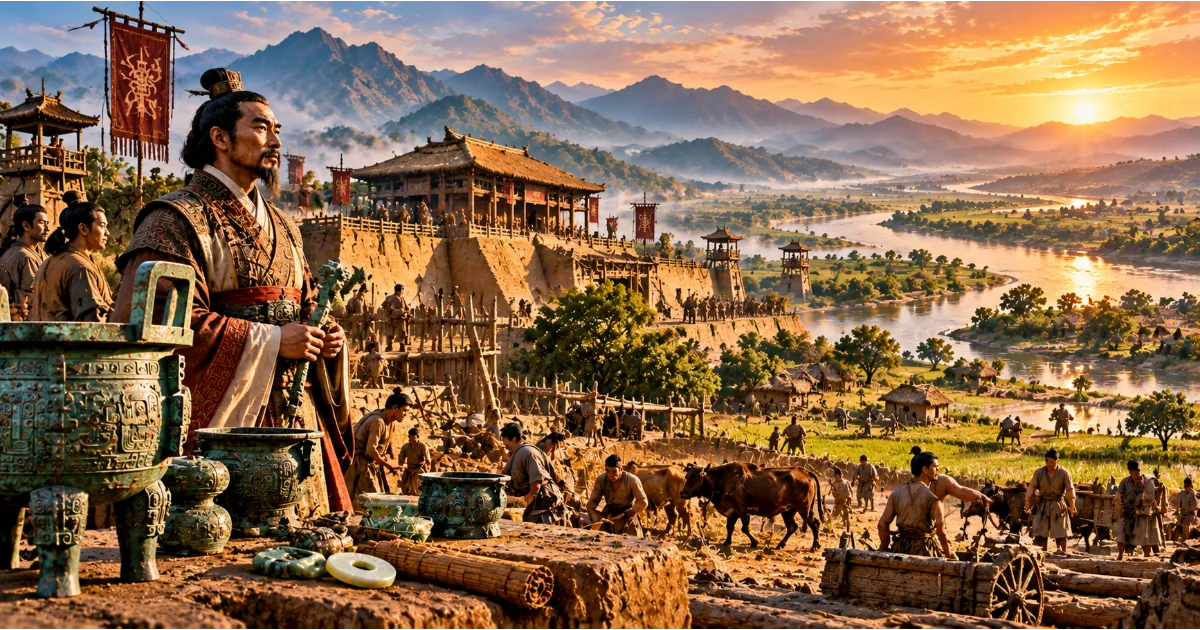
The Shang Dynasty occupies a decisive place in the history of Chinese civilization. While the earlier Xia Dynasty is remembered through traditional accounts whose historical details remain debated, the Shang is supported by a remarkable combination of archaeological discoveries and written evidence. Excavations have uncovered royal settlements, elaborate bronze vessels, elite tombs, workshops, and thousands of inscribed animal bones and turtle shells. Together, these discoveries reveal a society in which kingship, warfare, ritual, agriculture, and technological expertise were closely connected.
The Shang is generally dated to approximately 1600 to 1046 BCE, although the chronology of its earliest phases and the relationship between traditional king lists and archaeological evidence continue to receive scholarly attention. Its most extensively documented period is associated with the royal center at Anyang in present-day Henan Province. There, archaeologists discovered remains of buildings, workshops, burials, and oracle-bone inscriptions that transformed the study of early Chinese history.
The Shang rulers did not govern a modern nation-state with fixed borders and a uniform administration. Their influence operated through royal settlements, regional centers, local leaders, military power, exchange relationships, and ritual authority. The king stood at the center of this system, serving as political leader and principal intermediary between the living community and powerful ancestral spirits.
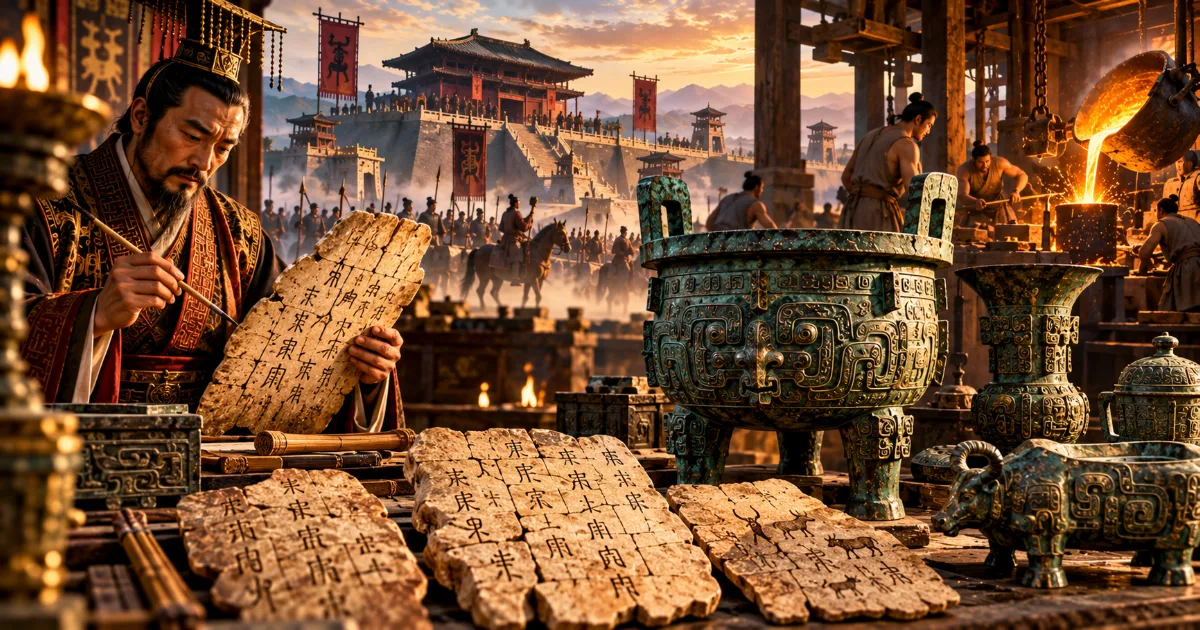
One of the Shang Dynasty's most significant achievements was the development of a sophisticated writing system preserved on oracle bones. These inscriptions recorded questions about harvests, warfare, hunting, health, weather, childbirth, and ritual offerings. They demonstrate that writing was already being used for important royal activities and that Shang elites maintained detailed relationships with their ancestors.
The dynasty also became famous for its bronze technology. Shang craftspeople produced large ritual vessels, weapons, tools, and other objects using complex casting methods. Such production required skilled artisans, access to raw materials, and the ability to organize labor on a considerable scale.
The Shang story is therefore about much more than a sequence of kings. It offers a window into the emergence of documented political authority in China, the relationship between religion and government, the organization of early urban centers, and the material foundations of elite power.
Understanding the Shang also helps clarify the transition from the uncertain historical world of the Xia to the better-documented traditions of later Chinese dynasties. The evidence left by Shang rulers allows us to move beyond legend and examine how an early Chinese kingdom actually operated.
2. The Rise of the Shang Kingdom
Traditional Chinese histories describe the Shang as the dynasty that replaced the Xia. According to the familiar account, a leader named Tang defeated the last Xia ruler, Jie, and established a new ruling house. Tang became the founding king of the Shang and was later remembered as an example of a ruler who could replace a failing dynasty.
The traditional story presents the change as a moral and political transformation. The Xia ruler had supposedly lost the support of his people through misconduct, while Tang was portrayed as a leader whose actions restored proper government. This narrative became part of a broader Chinese historical tradition in which dynastic replacement could be explained through the behavior of rulers and the consequences of their decisions.
The historical details of the conquest are less certain than the traditional narrative suggests. There is no contemporary Shang inscription that provides a complete account of Tang's overthrow of Jie. Historians therefore distinguish between the remembered story of dynastic succession and the archaeological evidence for the development of early Bronze Age political centers.
The Shang did not necessarily emerge as a single centralized kingdom overnight. Its growth likely involved a longer process of political consolidation, competition among regional powers, control of productive land, and the development of networks connecting settlements. The ability to organize warfare, maintain alliances, and command skilled workers would have helped some centers expand their influence over neighboring communities.
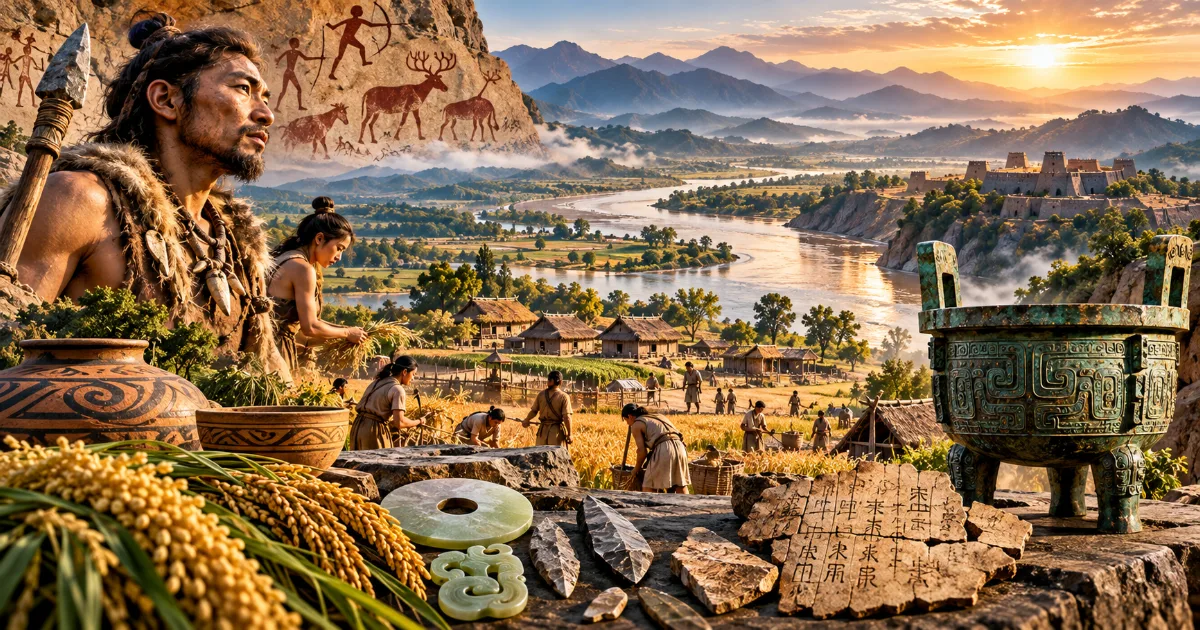
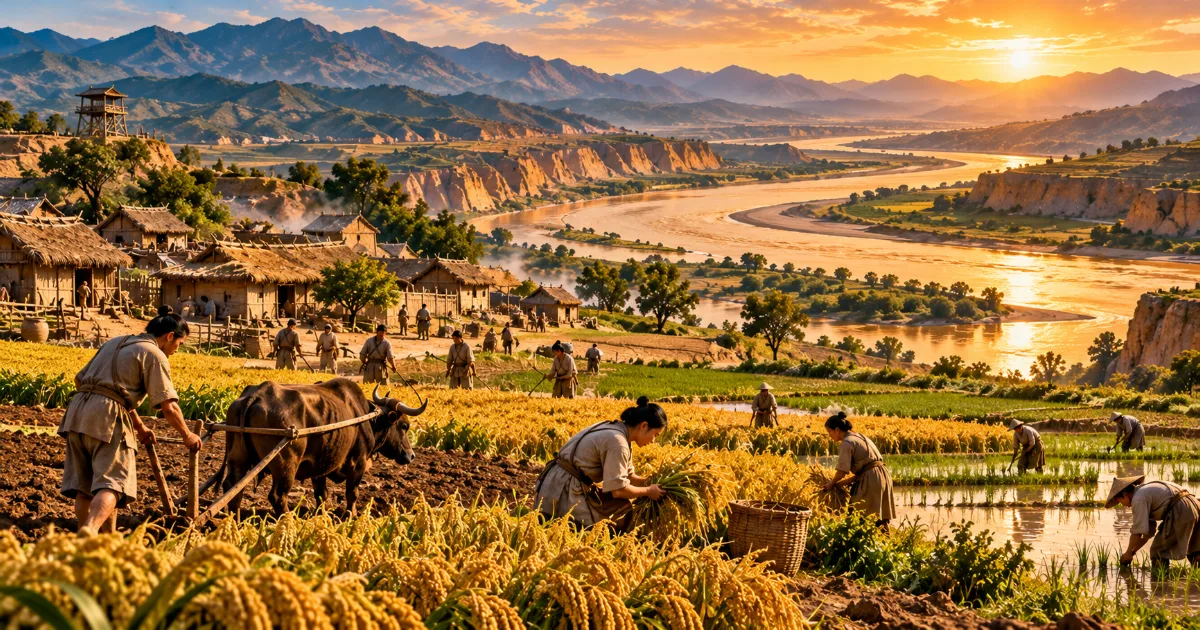
The Yellow River basin was an important setting for these developments. Agricultural communities depended on fertile land, seasonal rainfall, rivers, and local water sources. The production and storage of food supported larger settlements and allowed some people to specialize in crafts, administration, military activity, and ritual responsibilities.
The emergence of powerful centers also changed relationships between communities. Leaders who controlled important resources or occupied strategically valuable locations could gain influence through exchange, military strength, or ceremonial authority. Their power might extend beyond their immediate settlement through alliances with local chiefs and other influential families.
Over time, one political center could become dominant without exercising equal control over every surrounding community. Early kingship often depended on maintaining relationships with other leaders rather than relying entirely on a permanent bureaucracy. Such relationships could be reinforced through gifts, marriages, warfare, ritual gatherings, and the distribution of prestigious objects.
The Shang Dynasty developed within this changing political landscape. Its later rulers left written records that reveal an established royal institution, a sophisticated ritual system, and the ability to mobilize resources for warfare and large-scale craft production.
3. Anyang: The Royal Center of the Shang

Anyang, in modern Henan Province, is one of the most important archaeological locations in Chinese history. The remains associated with the Shang royal center are known as Yinxu, commonly translated as the Ruins of Yin. Excavations have revealed the foundations of major buildings, elite tombs, craft workshops, and extensive collections of oracle bones.
The site is especially important because it connects material evidence with written records produced by the people who lived there. Archaeologists can study the remains of buildings and objects while also reading inscriptions that refer to kings, royal ancestors, military campaigns, harvests, and ritual practices. This combination provides a level of historical detail that is unavailable for many earlier societies.
The Shang royal center was not simply a residential settlement. It was a place where political authority, ritual activity, specialized production, and elite life converged. Major buildings required organized construction, while workshops produced bronze objects, pottery, bone tools, and other goods. The presence of these activities suggests a settlement that drew resources and workers from a wider region.
The royal court relied on agricultural production to sustain its population and support people who did not spend all their time farming. Food had to be grown, transported, prepared, and distributed. Skilled artisans required raw materials and time to develop their techniques. Ritual specialists needed objects and offerings for ceremonies, while military forces required weapons, equipment, and provisions.
The remains of elite tombs reveal striking differences in status. Some burials contained elaborate objects and evidence of considerable expenditure, while others were much less richly furnished. These differences suggest that access to wealth, ritual privileges, and social recognition varied considerably among individuals.
The royal center also participated in wider networks of exchange. Materials used in craft production could originate far from the settlement, and finished goods could circulate among influential families or regional leaders. Such networks helped connect political power to economic relationships across the kingdom.
Although Anyang is the best-known Shang capital, it is important not to assume that it was the dynasty's only royal center throughout its history. Traditional texts describe several changes of capital, and archaeology indicates that Shang political centers developed over time. The dynasty's history was therefore not confined to a single city.
Yinxu's importance lies in the evidence it preserves. It reveals a society capable of supporting complex political institutions, elaborate ritual practices, specialized craftsmanship, and written record keeping. It is one of the clearest windows into the early development of Chinese state organization.
4. The Shang Kings and the Structure of Political Power
The Shang king occupied the central position in the kingdom's political and religious life. He led military campaigns, participated in major rituals, maintained relationships with influential families, and sought guidance from ancestral spirits. His authority was not merely administrative. It was also connected to the belief that royal ancestors could influence the welfare of the living.
The oracle-bone inscriptions provide evidence of kings asking questions about matters that affected the kingdom. These included whether a military campaign would succeed, whether rain would arrive, whether a harvest would be favorable, or whether a ritual offering should be performed. The king's decisions were therefore connected to a system of divination that treated the spiritual world as an active force in political life.
Shang political organization depended on relationships between the royal household and other powerful groups. Local leaders may have exercised authority over settlements and territories while acknowledging the king's superior status. Their loyalty could be reinforced through ritual participation, military cooperation, the exchange of goods, or kinship ties.
This system should not be imagined as a fully standardized administration like those of later Chinese empires. The extent of royal control probably varied across regions and periods. Some communities may have been closely connected to the royal center, while others maintained more independence or entered the kingdom's sphere of influence through shifting alliances.
Military power was an important part of kingship. The inscriptions record campaigns against rival groups and questions about the outcome of military operations. Warfare could help secure territory, obtain resources, capture people, and reinforce the authority of the royal household. At the same time, campaigns required substantial preparation and could expose the kingdom to risks.
The king's ritual responsibilities helped distinguish him from other leaders. By conducting ceremonies and consulting ancestral powers, he presented himself as the person best placed to protect the kingdom's relationship with the supernatural world. Political authority and religious responsibility were therefore closely connected.
Royal power also depended on practical capabilities. A king who could organize workers, maintain alliances, obtain resources, and lead successful campaigns was better positioned to preserve influence. Ritual prestige alone could not eliminate competition or guarantee the loyalty of every regional leader.
The Shang political system combined these different foundations of power. Royal ancestry, military strength, economic resources, ceremonial authority, and personal relationships reinforced one another. This combination helped sustain a powerful kingdom, but it also created vulnerabilities whenever leadership weakened or rival groups challenged the center.
5. Oracle Bones: The Written Voice of Early China

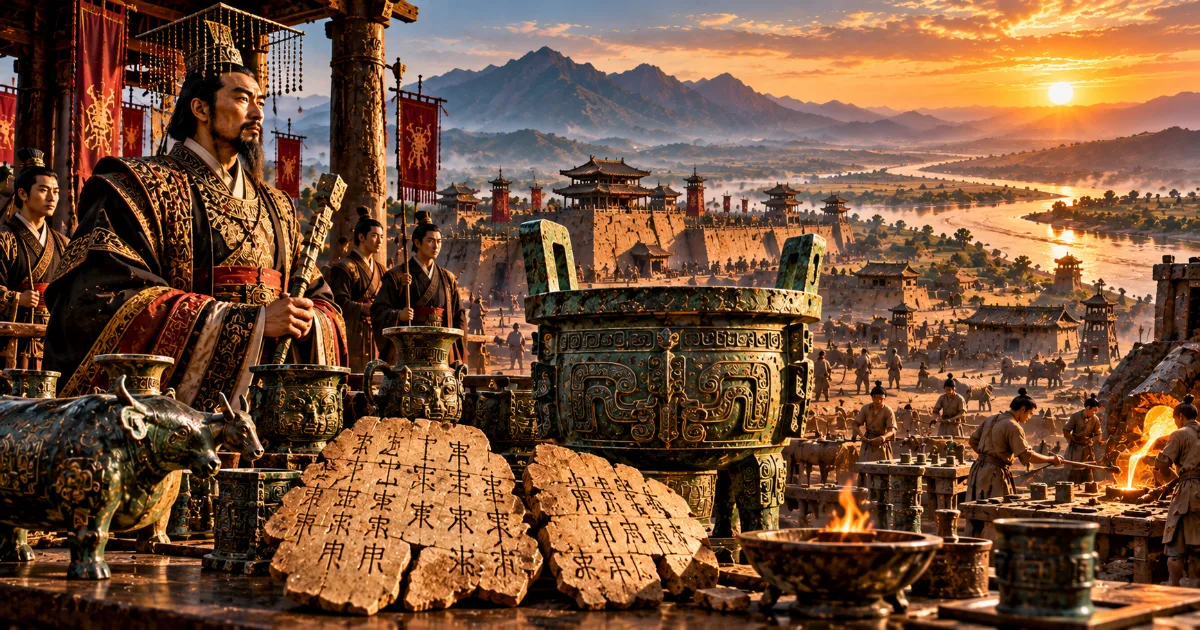
Oracle-bone inscriptions are among the most important discoveries in the study of ancient China. They were generally carved on animal bones, particularly shoulder blades, and on turtle shells. The inscriptions record divination activities associated with the Shang royal court, providing direct evidence of the concerns and decisions of its rulers.
The process involved preparing a bone or shell and applying heat in a controlled way that produced cracks. Diviners interpreted the resulting patterns, and the inscriptions recorded the question being asked and, in some cases, the king's assessment or the outcome. The exact procedures varied, but the central purpose was to seek guidance about uncertain events.
Questions concerned a wide range of subjects. Kings asked about the likelihood of rain, the success of harvests, the health of royal family members, the timing of sacrifices, hunting expeditions, and military campaigns. These records show that divination was not limited to private religious concerns. It was connected to decisions that affected the royal household and the wider political community.
The inscriptions also reveal the importance of ancestors. Shang rulers frequently sought guidance from deceased members of the royal family. Ancestors were not regarded simply as figures of the past. They were believed to retain the ability to influence the living, sometimes providing assistance and sometimes requiring appeasement through ritual offerings.
The king's role in divination strengthened his authority. If the royal household was responsible for communicating with ancestral powers, then political leadership and ritual expertise became intertwined. Decisions could be presented not only as choices made by a human ruler but also as actions considered within a larger spiritual relationship.
The inscriptions are historically valuable because they were produced in the Shang world itself. They are not merely later accounts describing what earlier people supposedly believed. They are surviving objects associated with the actual activities of the royal court.
Their content also reveals aspects of Shang language and writing. The characters include early forms related to many signs used in later Chinese writing, although the script developed considerably over time. The oracle bones demonstrate that a sophisticated writing system was already in use by the late Shang period.
Not every aspect of Shang society appears in these records. The inscriptions primarily reflect royal concerns, so they provide much less direct information about ordinary farmers, women outside the royal household, craftspeople, and communities distant from the court. Historians must combine them with archaeological evidence to reconstruct a fuller picture.
Even with these limitations, oracle bones changed the study of early Chinese history. They made it possible to investigate named kings, royal lineages, military activities, ritual practices, and aspects of the Shang calendar through contemporary evidence.
6. The Development of Chinese Writing
The Shang writing system was already complex enough to record specific questions, names, dates, and ritual details. Its existence demonstrates that writing did not suddenly appear as a simple invention. It emerged through a process of development that remains only partly understood.
The oracle-bone script includes recognizable signs for people, places, animals, natural phenomena, and ritual concepts. Some characters appear to have originated in pictures or simplified representations, while others combine elements to convey meaning or sound. The system allowed scribes to record information in a relatively compact form.
Writing served practical and ceremonial purposes at the Shang court. It helped preserve the content of divination sessions and made it possible to refer back to earlier questions or outcomes. The inscriptions also demonstrate the presence of people who possessed specialized knowledge of written signs and the procedures for preparing records.
The existence of scribes and divination specialists implies a degree of training and social organization. Writing was not necessarily a skill shared equally across the population. Its use at the royal center suggests that literacy was concentrated among people connected to political and ritual institutions.
The Shang script forms an important early stage in the long history of Chinese writing. Later Chinese scripts changed in shape, structure, and use, but the relationship between many modern characters and earlier forms can be studied through surviving inscriptions and artifacts.
However, historians should avoid imagining an uninterrupted and fully documented line of development from every Shang character to its modern form. Some signs changed substantially, some became uncommon, and the historical evidence is uneven. The development of Chinese writing involved many stages, and later conventions cannot simply be projected backward.
The significance of the Shang script extends beyond its technical features. Writing allowed certain aspects of royal activity to be recorded in a durable form. It connected language to material objects and helped preserve information that might otherwise have depended on memory or oral transmission.
The oracle bones thus reveal the beginnings of a documented political world. They show a royal court concerned with the future, attentive to ancestral relationships, and capable of maintaining a specialized written practice. This evidence provides one of the strongest reasons the Shang holds such a central place in Chinese history.
7. Bronze Technology and the Power of Ritual

The Shang Dynasty is renowned for its bronze vessels, many of which display extraordinary technical skill and elaborate decoration. These objects were used in ceremonies involving food, drink, and offerings to ancestors. They also communicated social status and demonstrated the resources available to the people who commissioned them.
Bronze production required sophisticated knowledge. Craftspeople had to obtain copper and other metals, prepare furnaces, make molds, control temperatures, and manage the flow of molten material. Producing large vessels was particularly demanding because a mistake during casting could ruin an object that had consumed considerable time and resources.
Shang artisans developed complex casting techniques, including methods that used shaped clay sections to create decorated surfaces. This approach allowed them to produce intricate forms and repeated patterns. Many vessels feature animal imagery, abstract designs, and motifs that later scholars have grouped under labels such as taotie, although the exact meaning of these designs in Shang society remains uncertain.
Bronze vessels were not simply decorative objects. Their use in ritual ceremonies connected them to the authority of the royal family and other elites. A person who possessed elaborate vessels could demonstrate access to skilled artisans, valuable materials, and the labor needed to produce them.
The production of bronze also depended on economic networks. Raw materials had to be acquired and transported, while craftspeople needed food, shelter, tools, and time to work. This suggests that bronze technology was embedded within a wider system of agriculture, exchange, and political organization.
Bronze weapons added another dimension to the technology. Axes, spearheads, and other objects could be associated with warfare and the power to command armed forces. Their distribution and production reflected the importance of military capability in Shang society, although the precise military role of each object varied.
The technical achievements of Shang artisans should not obscure the human effort behind them. Large-scale production required coordination among many workers, including people responsible for mining or obtaining materials, preparing molds, maintaining furnaces, and finishing objects. The archaeological record preserves the products of their work more readily than their individual identities.
The Shang bronze tradition continued to influence later Chinese metalworking. Subsequent societies developed their own styles and techniques, but the Shang period established an important foundation for the ritual use and artistic treatment of bronze in early China.
8. Ancestor Worship and the Spiritual World
Religion was deeply woven into Shang political and social life. The royal household believed that ancestral spirits could affect events in the living world, making ritual communication an important responsibility of the king and his divination specialists.
Ancestors could be approached for guidance about warfare, harvests, health, weather, and other matters. The inscriptions suggest that particular ancestors were associated with specific questions or circumstances. Ritual offerings helped maintain relationships between the royal family and its deceased members.
This system of belief shaped how Shang rulers understood uncertainty. A military campaign was not only a question of soldiers and weapons. It could also require determining whether the timing was favorable and whether ancestral powers would support the undertaking. A harvest depended on rainfall and agricultural work, but ritual questions reveal that the royal court also sought spiritual reassurance about its outcome.
The Shang religious world included more than royal ancestors. Inscriptions refer to powers associated with natural phenomena and a high deity commonly known through the term Di. The exact relationship between this deity, ancestral spirits, and other supernatural forces remains a subject of scholarly interpretation.
Rituals were not separate from political power. The ability to conduct important ceremonies reinforced the king's special position, while the production and use of bronze vessels gave material form to elite ritual practices. Royal authority could therefore be strengthened through both practical achievements and claims to spiritual responsibility.
Ancestor worship also connected generations. The living royal family looked to deceased rulers for support, while its own actions would shape how future generations remembered it. This relationship helped establish continuity within the ruling house and made genealogy an important element of political identity.
It would be misleading, however, to assume that every person in Shang society followed exactly the same religious practices. The oracle bones primarily reflect the royal court, and other communities may have maintained local traditions that are less visible in the surviving evidence. Religious life probably varied according to region, social position, and household practice.
What the inscriptions establish is that divination and ancestral relationships were central to the royal system. They reveal a political culture in which human decisions were understood in relation to a spiritual world that demanded attention, interpretation, and ritual action.
9. Agriculture, Trade, and Everyday Life
Although royal inscriptions and bronze vessels dominate discussions of the Shang, the kingdom depended on agricultural communities whose work sustained the political center. Farmers cultivated crops, raised animals, collected resources, and maintained the food supplies required by households, artisans, soldiers, and ritual specialists.
Millet was an important crop in northern China, while other plants and animals contributed to the diet. Agricultural practices differed according to local environments, and farming households needed to adapt to seasonal conditions. A successful harvest could support storage and exchange, while poor yields could create serious hardship.
Animal husbandry contributed food and other useful resources. Cattle, pigs, dogs, and other animals appear in archaeological evidence, although their roles varied. Animals were also important in ritual contexts, where offerings formed part of the relationship between the royal household and ancestral powers.
Craft production extended beyond bronze. Potters produced vessels for storage and cooking, while other craftspeople made bone tools, stone objects, ornaments, and textiles. Many everyday objects were made from perishable materials and have not survived, which limits what archaeologists can reconstruct.
Trade and exchange linked settlements across the region. Raw materials, finished objects, and other goods moved through networks that connected political centers with surrounding communities. These networks could reinforce alliances and create dependencies, particularly when elite groups relied on resources that were unavailable locally.
The growth of royal centers also affected the organization of labor. Some people specialized in crafts, construction, transport, or ritual service rather than concentrating exclusively on farming. Others continued to live in smaller settlements and supplied food or materials to the wider political system.
Social inequality shaped access to resources. Elite burials and prestigious objects indicate that some individuals enjoyed privileges unavailable to much of the population. The exact status of workers and the nature of labor obligations remain difficult to establish in many cases, but the scale of royal construction and craft production suggests that leaders could mobilize considerable human effort.
Daily life was therefore connected to the larger political structure even for people whose names never entered the written record. The kingdom's rituals, bronze objects, and royal buildings depended on the work of farmers, builders, artisans, and transporters. The Shang was both a royal civilization and a society sustained by countless ordinary activities.
10. Warfare and Relations With Neighboring Peoples
Warfare was a recurring concern in the Shang inscriptions. Kings asked whether campaigns would succeed, whether particular groups would attack, and whether military expeditions should be undertaken. These questions indicate that the royal court operated in a world of rivalry and shifting relationships.
Military campaigns could serve several purposes. They might defend territory, punish opponents, obtain resources, capture people, or reinforce the authority of the king. Successful campaigns could enhance royal prestige and strengthen relationships with allies. Failures, by contrast, could consume resources and weaken political influence.
The Shang military system likely relied on the ability to gather forces from the royal center and allied or subordinate communities. The precise organization of those forces varied and remains incompletely understood. The inscriptions provide evidence of campaigns and military concerns, but they do not always reveal the size of armies, the full course of battles, or the long-term political results.
Weapons and military equipment formed part of the material culture of the kingdom. Bronze objects could be used in combat, while other materials were also important. The presence of military equipment in archaeological contexts demonstrates that warfare was part of Shang life, but the relationship between weapons, rank, and actual battlefield practice must be considered carefully.
Relations with neighboring groups were not defined solely by violence. Exchange, diplomacy, ritual interaction, and alliances also shaped the political landscape. A community might cooperate with the royal center at one time and oppose it at another. Early kingdoms often depended on flexible relationships because they lacked the capacity to impose uniform control across every region.
The royal inscriptions also reveal that kings did not regard military success as a matter of human strength alone. Divination helped determine whether a campaign was advisable and whether ancestral powers would support it. This combination of practical preparation and ritual consultation reflects the Shang understanding of kingship.
Warfare could contribute to the growth of the kingdom, but it also imposed costs. Soldiers needed food and equipment, and campaigns could disrupt agricultural production. Rivalries among influential families or regional leaders could threaten the stability of the royal system. Maintaining power therefore required more than winning battles. It required the continuing management of alliances, resources, and political obligations.
11. The End of the Shang Dynasty
Traditional Chinese histories identify the final Shang ruler as King Zhou, who is often portrayed as cruel and extravagant. Later accounts describe a ruler whose conduct alienated his subjects and weakened the dynasty. He is said to have been defeated by King Wu of Zhou, whose victory established the Zhou Dynasty.
As with the Xia, the traditional narrative presents dynastic change through a moral framework. The last Shang ruler loses legitimacy because of his behavior, while the Zhou claim authority by defeating a ruler who has failed in his responsibilities. This explanation became central to the political philosophy associated with the Mandate of Heaven.
The historical transition was likely more complex than the moral story alone suggests. The Zhou were a rising power in the west, and their expansion involved political alliances, military organization, and competition with the Shang. The Battle of Muye, traditionally dated to around 1046 BCE, is associated with the decisive defeat of the Shang forces, although aspects of the campaign and its chronology remain subjects of historical study.
The Shang kingdom had endured for centuries and developed substantial political and ritual institutions. Its fall did not erase the knowledge, practices, and cultural traditions created during that time. Bronze technology, writing, ritual practices, and many social conventions continued to influence the societies that followed.
The Zhou rulers inherited and transformed aspects of the Shang world. They developed their own political ideology, including the argument that Heaven could withdraw its support from an unworthy ruling house. This concept helped explain why the Zhou believed they had the right to replace the Shang and offered later rulers a framework for evaluating political legitimacy.
The Shang's end therefore marked both a political break and a form of continuity. A new dynasty took power, but it entered a world shaped by earlier developments in writing, metallurgy, ritual, and kingship. The Zhou would reinterpret that inheritance and leave a lasting mark on Chinese political thought.
Conclusion: The Dynasty That Made Early Chinese History Visible
The Shang Dynasty provides one of the earliest clear views of documented Chinese civilization. Its royal centers, oracle-bone inscriptions, bronze vessels, elite tombs, and craft workshops reveal a society with complex political institutions and a sophisticated ritual world.
The oracle bones are particularly important because they preserve the concerns of Shang rulers in their own written system. They show kings seeking guidance about harvests, warfare, health, and ancestral relationships. The inscriptions demonstrate that writing had become an essential part of royal ritual and record keeping by the late Shang period.
Bronze technology reveals another side of Shang achievement. Skilled craftspeople produced objects that required specialized knowledge, substantial resources, and organized labor. These vessels and weapons were not merely products of technical ability. They were part of a wider system through which political authority, social status, and religious practice were expressed.
The Shang also depended on farmers, builders, transporters, artisans, and other people whose work sustained the royal center. Its history cannot be understood solely through kings and ceremonies. The kingdom's power rested on agricultural production, regional exchange, labor organization, and relationships with neighboring communities.
The dynasty's fall to the Zhou marked a major transition in Chinese political history. The Zhou inherited many elements of the Shang world while developing new ideas about the moral basis of government. Their concept of the Mandate of Heaven would become one of the most influential explanations of dynastic rise and decline in Chinese history.
The Shang Dynasty matters because it turns early Chinese history into something that can be investigated through direct evidence. Its inscriptions allow historians to study the concerns of rulers who lived thousands of years ago, while archaeology reveals the settlements, objects, and working environments that surrounded them.
In the next article, we will examine Oracle Bones, Bronze Technology, and Early Chinese Writing, looking more closely at the discoveries and innovations that made the Shang period a turning point in the history of Chinese civilization.
#HistoryOfChina #ShangDynasty #AncientChina #OracleBones #ChineseWriting #BronzeAge #ChineseCivilization #WorldHistory