
Why Cash Reserves Could Become a Startup's Biggest Advantage
For startup founders, raising money is often celebrated as a sign of success. A new funding round can attract media attention, strengthen investor confidence, help companies hire employees and provide the resources needed to enter new markets. But behind every funding announcement lies a more practical question: how long can the business survive if its next round of investment takes longer than expected?
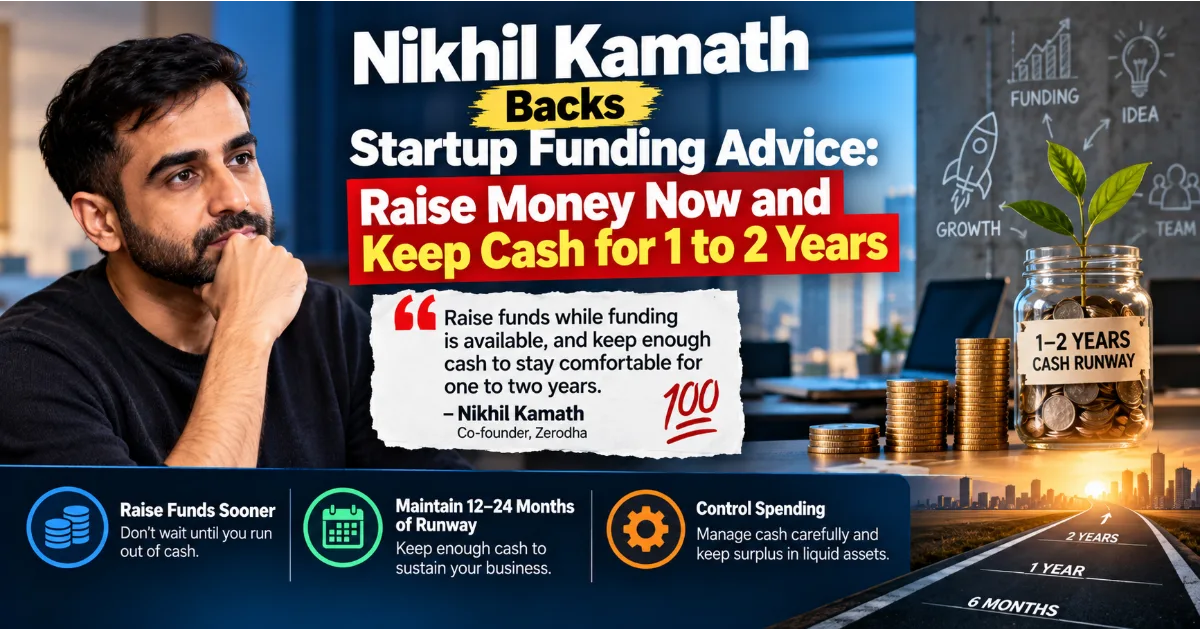
That question has returned to the spotlight after Zerodha co-founder Nikhil Kamath endorsed advice urging startup founders to raise capital while funding opportunities remain available and maintain enough cash to sustain their businesses for one to two years. The message circulated in early October 2026 and drew attention because it challenged founders to think about financial survival before they are forced to make difficult decisions.
The important detail is that Kamath endorsed a post sharing this advice rather than publishing the entire recommendation as his own original statement. The distinction matters when interpreting the news. His endorsement brought attention to a broader concern among entrepreneurs and investors: companies should not assume that capital will always be available precisely when they need it.
The advice is straightforward, but its implications are significant. A startup that has sufficient cash can continue developing its product, serving customers, paying employees and adjusting its business model during a difficult period. A company with limited reserves may be forced to raise money quickly, accept less favourable investment terms, reduce its workforce or even shut down, regardless of whether its underlying business has long-term potential.
This is particularly relevant in a market where investors may remain willing to finance promising businesses but become more selective about which companies receive capital. A startup can have a useful product and a growing customer base and still struggle if it runs out of money before its revenue becomes sufficient to support operations.
The central lesson is not that every startup should raise as much money as possible or that a funding crisis is inevitable in 2027. It is that financial planning should not depend on the most optimistic scenario. Founders need to prepare for the possibility that fundraising will take longer, growth will cost more than expected or customers will take longer to pay.
In the startup world, ambition may create the opportunity to build a business, but financial discipline can determine whether that business survives long enough to succeed.
What Nikhil Kamath's Endorsement Means
Nikhil Kamath is best known as the co-founder of Zerodha, the Indian brokerage business that grew into a major financial services company. His views on entrepreneurship attract attention because Zerodha's journey has offered an alternative to the conventional startup model of raising repeated rounds of venture capital to finance expansion.
The funding advice he endorsed focused on three connected ideas: raise capital before the business is under pressure, maintain a cash reserve covering roughly 12 to 24 months of operations, and manage the money carefully rather than assuming another funding round will arrive on schedule.
These ideas are especially relevant for businesses that depend heavily on external capital. Many startups spend money on product development, technology infrastructure, employee salaries, marketing and customer acquisition long before they generate enough revenue to cover those expenses. Investment allows them to build and grow during that gap, but it also creates a dependency if the business cannot eventually support itself.
A funding round can buy time, but it does not automatically create a sustainable business. If a company raises money and immediately increases spending without improving its underlying economics, it may find itself returning to investors sooner than expected. If the next round is delayed, the company can face a cash shortage despite having raised substantial amounts in the past.
Kamath's endorsement therefore brings attention to a basic principle of business management: the time to prepare for financial difficulty is before financial difficulty arrives. Waiting until cash is nearly exhausted leaves founders with fewer choices and less negotiating power.
It is equally important not to interpret the advice as a prediction that all startups will struggle next year. Fundraising conditions vary by sector, company performance, investor appetite and the wider economy. Some businesses may continue attracting investment, while others may face longer fundraising timelines or more demanding terms.
The recommendation is best understood as a risk-management strategy. Founders cannot control every change in the investment market, but they can improve their ability to withstand uncertainty by planning their cash requirements, monitoring spending and building a business that can operate through more than one financial scenario.
Why the Startup Funding Environment Matters
Startup funding does not move in a straight line. Periods of strong investor enthusiasm can be followed by more cautious phases in which investors scrutinise revenue, profitability, customer retention and spending more closely. Businesses that previously attracted capital on the strength of rapid growth projections may then be asked to demonstrate a clearer path towards financial sustainability.
According to funding figures cited by The Economic Times, Indian startups raised approximately $10.3 billion across 1,134 funding rounds between January and September 2026. During the same period in 2025, the reported total was about $9.7 billion across 1,838 rounds.
These figures require careful interpretation. The increase in the reported total amount raised does not, by itself, indicate that funding has become easier for every startup. At the same time, the lower number of rounds does not establish that the market has completely shut down. Total funding can rise even as investment becomes concentrated among fewer companies or larger transactions.
For a founder, the distinction between total market funding and the ability to raise money for a specific business is crucial. Headlines about billions of dollars flowing into startups may create a positive impression, but that capital is not distributed equally. Investors make individual decisions based on their expectations of growth, the quality of the business, competition, risk and the potential return on their investment.
A company with strong revenue growth, high customer retention and a credible plan for reaching profitability may remain attractive even when investors become more selective. Another company with high expenses, uncertain demand and weak revenue visibility may struggle to secure capital, even if its sector continues to receive investment.
The investment environment can also differ across industries. Software businesses, consumer brands, financial technology companies, healthcare startups, deep technology ventures and manufacturing businesses have different capital requirements and timelines. A software company may be able to reduce some operating costs relatively quickly, while a business developing physical products or industrial technology may need substantial spending on equipment, testing, inventory or regulatory approvals.
The lesson from the reported funding numbers is therefore not that a crisis is guaranteed. It is that founders should not rely on aggregate market figures to judge their own financial safety. Their most important question is whether their company can continue operating if access to new capital becomes slower or more expensive.
What Does 12 to 24 Months of Cash Runway Mean?
The term cash runway describes how long a business can continue funding its operations with the cash it has available, taking into account its expected spending and incoming revenue. It is one of the most useful measures founders can track because it translates the company's financial position into a practical estimate of time.
Suppose a startup has ₹6 crore in cash available and spends ₹50 lakh more each month than it receives from customers and other operating income. If that net cash outflow remains constant, the company has approximately 12 months of runway.
If the same company holds ₹12 crore under the same assumptions, its runway is approximately 24 months. The additional cash gives management more time to develop revenue, improve its business model, respond to market changes or raise another round without facing immediate financial pressure.
The calculation is simple:
The phrase net cash burn is important. It is not necessarily the same as total monthly expenses. A business may spend ₹80 lakh in a month and collect ₹45 lakh in revenue, leaving a net operating cash outflow of ₹35 lakh, assuming those figures accurately reflect cash movements and there are no other relevant inflows or outflows.
In this example, a company with ₹4.2 crore in available cash would have roughly 12 months of runway if the monthly net burn stayed at ₹35 lakh. However, the calculation would need to be updated if revenue changed, expenses increased, customers delayed payments or the company made a major investment.
Cash runway is therefore not a permanent number. It changes as the business develops, and it should be reviewed regularly rather than calculated once when a funding round closes.
The 12-to-24-month recommendation should also not be treated as a universal rule. A company with predictable revenue and low cash burn may be able to operate safely with a different reserve, while a business facing a long product-development cycle or uncertain revenue may need more protection. The appropriate runway depends on the company's business model, financial commitments, access to capital and the time it would realistically need to respond to a shortfall.
What matters most is that the company has enough time to make decisions deliberately instead of being forced into emergency measures.
Why Raising Money Before You Need It Can Matter
Fundraising is often a lengthy process. Founders may need to identify suitable investors, secure introductions, prepare financial information, explain their strategy, answer due-diligence questions and negotiate terms. Even when investors express interest, a transaction can take longer than anticipated or fail to reach completion.
This creates a problem when a startup begins fundraising only after its cash reserves have fallen sharply. The company may have only a few months left to pay employees, meet supplier obligations and keep its services running. Investors may recognise that the business is under pressure, which can weaken the founder's negotiating position.
Raising capital earlier can reduce this pressure. A company with a healthy bank balance has more time to evaluate potential investors, compare offers and decide whether a proposed investment supports its long-term objectives. It can also walk away from terms that are unsuitable rather than accepting them simply because it needs immediate cash.
Early fundraising does not mean that every founder should raise money whenever an investor is willing to provide it. Equity investment has a cost: founders generally surrender a portion of ownership and may accept governance requirements or other contractual conditions. Taking on unnecessary capital can dilute ownership without delivering a corresponding benefit to the business.
The decision should depend on what the money will enable the company to accomplish and how much financial protection it needs. A founder should understand whether additional capital will fund product development, accelerate customer acquisition, support expansion into new markets or provide a reserve against uncertainty. The purpose should be specific enough to guide spending and measure results.
Timing matters because fundraising conditions can change. Investors may become more cautious after disappointing economic data, changes in interest rates, market volatility or a series of weak startup exits. A sector that attracts substantial attention today may face a more difficult investment environment later. Founders cannot predict every change, but they can reduce their exposure to sudden shifts by avoiding unnecessary dependence on last-minute fundraising.
There is also a psychological benefit to having a reasonable reserve. When management is not constantly worried about the next payroll cycle, it can focus more effectively on customers, product quality and long-term decisions. Financial security does not eliminate business risk, but it can prevent short-term cash pressure from dominating every strategic choice.
The strongest interpretation of the advice is not to raise money out of fear. It is to approach fundraising as a planned business activity rather than an emergency response.
The Danger of Spending Too Much After a Funding Round
One of the most common financial risks for startups appears after a successful fundraising announcement. Fresh capital can create confidence, and founders may feel pressure to demonstrate rapid growth to investors, employees and the wider market. Hiring accelerates, marketing budgets expand, new offices are opened and additional products are launched.
Some of these investments may be justified. A business with strong demand might need to recruit quickly, increase infrastructure capacity or expand its sales team. Spending is not inherently irresponsible, and a startup that refuses to invest in growth may miss valuable opportunities.
The problem begins when spending rises faster than the business's ability to generate value. A company may hire ahead of actual demand, pay heavily for customers who do not remain active or expand into markets before its original business model is proven. In such circumstances, the new capital can disappear without creating the durable growth that investors expected.
A funding round should therefore be accompanied by a clear operating plan. Founders need to identify which expenses are essential, which investments can be delayed and what outcomes should be expected from each major expenditure. Hiring plans should be linked to business needs, while marketing spending should be assessed against customer acquisition costs, retention and revenue rather than impressions alone.
Cash management also requires attention to the timing of payments. A startup can appear healthy on paper but experience a cash shortage if customers pay late while salaries, taxes, rent and supplier bills must be paid on schedule. Finance teams should monitor receivables, contractual obligations and upcoming payments, not merely the balance shown in a bank account.
Another risk arises when founders treat the amount raised as permission to postpone difficult decisions. If a product is not attracting customers or a sales model is not working, additional funding can extend the time available to solve the problem. But it can also postpone necessary changes if management continues spending without examining the evidence.
A longer runway is most valuable when it gives a company the ability to learn and improve. It is much less useful if it merely allows an ineffective strategy to continue unchecked.
Cash Reserves Are Not a Substitute for a Sustainable Business
Maintaining cash for one or two years can provide protection, but reserves alone cannot guarantee a startup's survival. A business can burn through a large amount of capital and still fail if customers do not value its product, its costs remain too high or its market is smaller than expected.
The purpose of a reserve is to create time for a company to build a stronger business. During that period, management should work towards more reliable revenue, healthier margins, better customer retention and a clearer understanding of what drives demand. The financial buffer should support progress towards sustainability, not replace it.
For some startups, profitability may be a realistic near-term goal. Others may need to continue investing in research, infrastructure or market expansion before they can generate positive cash flow. A long-term growth company should not necessarily be judged by whether it is profitable immediately, but it should have a credible explanation for how investment will translate into a stronger business.
Founders should understand the difference between growth and efficiency. Revenue may increase rapidly while the company loses more money on every additional customer. Conversely, a company with slower growth may be improving its margins and developing a business model that can survive with less external capital.
Investors increasingly need to understand these distinctions when evaluating companies. A funding announcement does not necessarily indicate that a startup has solved its underlying business challenges. Equally, a company that raises less money than its competitors may be in a strong position if it generates meaningful revenue and manages expenses effectively.
The most resilient startups tend to combine financial discipline with a willingness to invest where evidence supports it. They do not cut every expense simply to preserve cash, nor do they spend aggressively just because capital is available. They assess the expected value of each investment and adjust when results differ from expectations.
In this sense, runway is a strategic resource. It gives a company the time to test assumptions, improve operations and respond to changing conditions. Its real value depends on what management accomplishes before that time runs out.
How Founders Should Prepare for a Difficult Funding Year
If fundraising becomes more selective in 2027, startups with strong financial planning may be better positioned to navigate the change. Preparation should begin with a realistic assessment of the company's cash position, rather than an assumption that revenue will rise or another investment round will arrive on time.
The first priority is to prepare a rolling cash-flow forecast. This should show expected revenue, payroll, operating expenses, debt payments, taxes and other major commitments over the coming months. Founders should update the forecast as actual results arrive and compare them with the original assumptions. A forecast is useful only when it reflects the business's changing circumstances.
The second priority is to test different scenarios. Management should calculate how long the company could operate if revenue fell below expectations, a major customer delayed payment or a planned funding round took several additional months. A business that looks secure under optimistic assumptions may have a very different outlook under more difficult conditions.
The third priority is to decide which expenses can be adjusted without damaging the business. Some costs are essential for delivering the product or meeting contractual obligations. Others can be delayed, reduced or redesigned if financial conditions deteriorate. Identifying these differences in advance allows founders to respond more carefully than they might during an emergency.
Startups should also establish clear fundraising milestones. Instead of waiting until cash reserves become critically low, founders can begin discussions when their financial position is still stable and they have enough time to complete due diligence. The right starting point will vary by business, but the general principle is to leave sufficient room for delays.
Another consideration is where surplus cash is held. A company should prioritise liquidity, capital preservation and access to funds needed for operations. Money required for payroll or near-term commitments should not be exposed to unnecessary investment risk in pursuit of higher returns. Decisions about cash management should reflect the company's obligations, risk tolerance and applicable regulations.
Finally, founders should communicate honestly with investors, employees and other stakeholders. Financial pressure is easier to manage when leadership understands the company's position and makes decisions using reliable information. Hiding deteriorating conditions or relying on overly optimistic projections can make a difficult situation worse.
These measures do not guarantee success, but they improve a founder's ability to respond to uncertainty. They also encourage a more disciplined approach to growth, in which capital is treated as a resource that must be deployed thoughtfully.
Does Every Startup Need Two Years of Cash?
Not necessarily. The recommendation to maintain 12 to 24 months of runway is a useful planning principle, but it should not be applied identically to every business.
A startup with recurring revenue, low fixed costs and a stable customer base may face less uncertainty than a company developing a complex product with a long route to market. A business that depends on large enterprise contracts may have to account for lengthy sales cycles and delayed payments. A consumer startup may face unpredictable demand, while a manufacturing company may need to finance inventory and equipment before receiving revenue.
Founders should also consider the practical availability of future funding. A company with strong investor relationships and consistent performance may have different options from a startup in a capital-intensive sector that has not yet demonstrated product-market fit. Even then, future investment should not be treated as guaranteed.
The right target is the amount of runway that gives a company enough time to meet its obligations, achieve important milestones and respond to setbacks. For some, that could mean maintaining a reserve closer to 12 months. Others may decide that 18 to 24 months offers more appropriate protection, particularly when fundraising cycles are long or revenue is uncertain.
What matters is that the target is supported by a financial plan. Raising extra capital without a clear purpose can create unnecessary dilution and encourage inefficient spending. Keeping too little cash can force decisions that undermine the business. Good financial management lies in balancing these risks.
Conclusion: Raise Strategically, Spend Carefully and Protect the Future
Nikhil Kamath's endorsement of advice urging startups to raise capital early and preserve one to two years of cash has drawn attention to a fundamental issue in entrepreneurship: a promising business needs enough financial stability to survive uncertainty.
The funding figures reported for India's startup ecosystem show that aggregate investment and the number of funding rounds can move in different directions. More money entering the market does not mean every founder will find it easy to raise capital, just as fewer deals do not prove that a funding crisis is inevitable.
The practical lesson is to prepare rather than panic. Founders should know their monthly cash burn, understand their runway, maintain realistic financial forecasts and begin fundraising before they are under immediate pressure. They should also avoid spending aggressively simply because a funding round has closed.
Capital is most valuable when it helps a business build something customers need, improve its economics and move towards a sustainable future. A reserve provides time, but the decisions made during that time determine whether the company becomes stronger.
For founders, the goal should not be to raise money endlessly or to preserve cash at the expense of every growth opportunity. It should be to build a business that can withstand setbacks, use investment responsibly and remain focused on its customers even when market conditions change.
The next year may bring different opportunities and challenges for India's startup ecosystem. No one can know exactly how fundraising conditions will develop. But businesses that plan for uncertainty will have more choices than those that assume their next round is always just around the corner.
The smartest fundraising strategy is not simply to secure the next cheque. It is to make sure the business has enough time, discipline and financial resilience to succeed even when that cheque takes longer to arrive.
#BeyondHeadlines #NikhilKamath #Zerodha #StartupFunding #IndianStartups #StartupIndia #VentureCapital #CashRunway #StartupFinance #Entrepreneurship #Fundraising #BusinessStrategy #FinancialPlanning #FounderAdvice #CashFlowManagement #VentureFunding #BusinessNews #BeyondTheHeadline