Navratri is a sacred Hindu festival that celebrates the divine feminine power through the worship of Maa Durga and her nine forms, known as Navdurga. Each day introduces devotees to a different aspect of the Goddess and offers spiritual lessons that can be applied to everyday life.
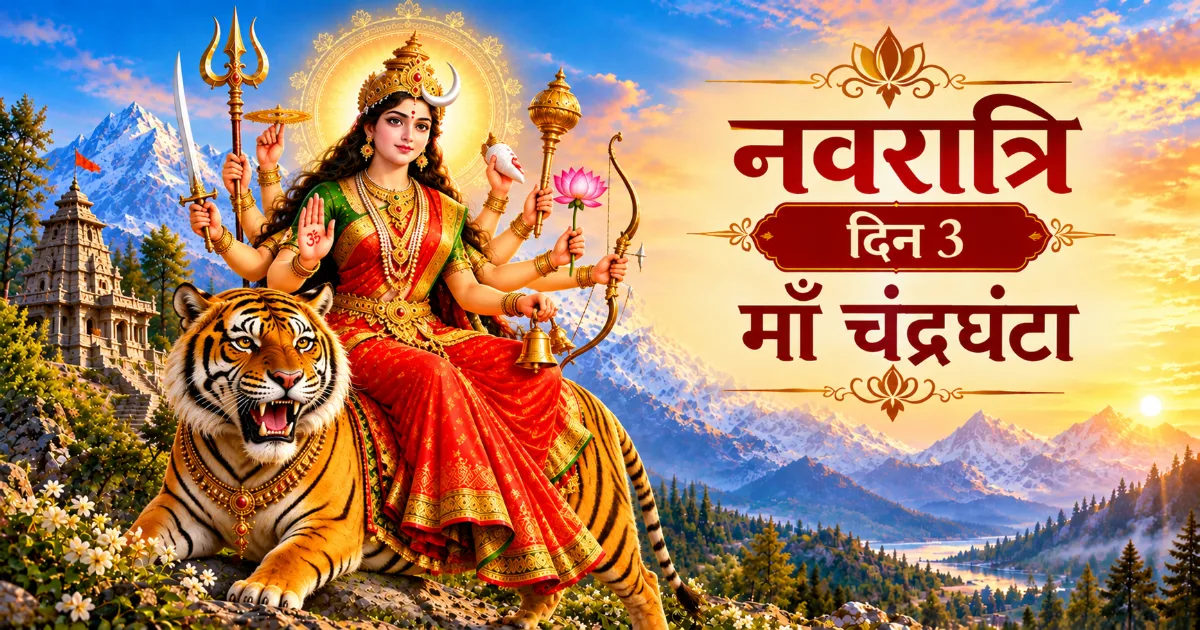
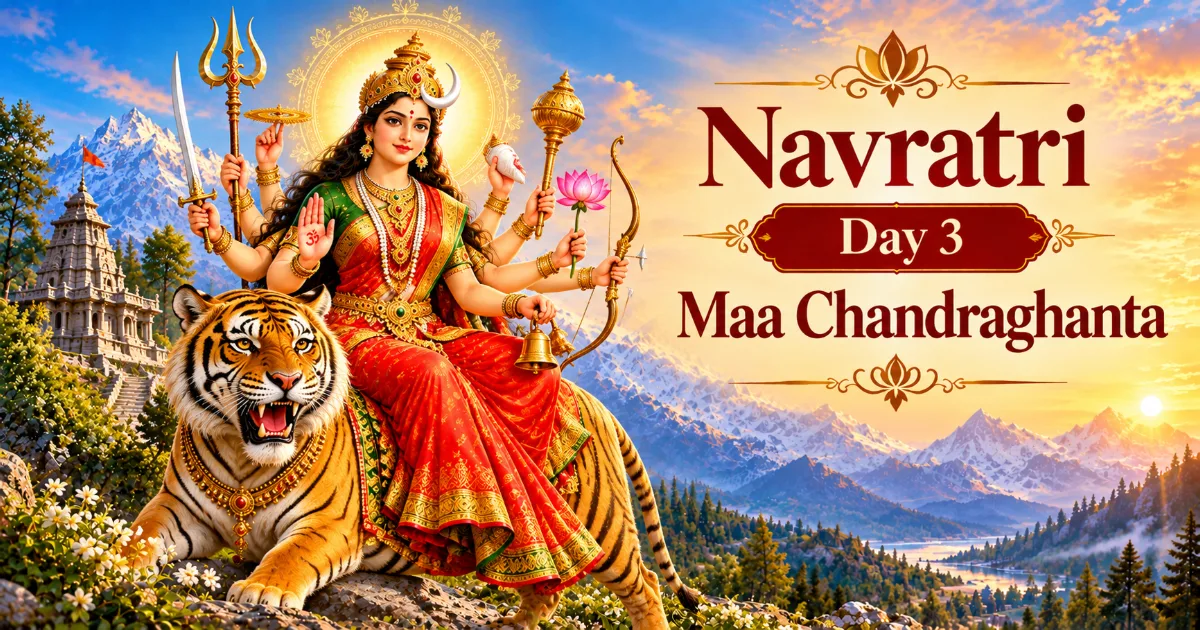
The third day of Navratri is dedicated to Maa Chandraghanta, the third form of Goddess Durga. She represents courage, strength, alertness, peace, and protection. Her name comes from the crescent-shaped bell associated with her forehead. In traditional depictions, this crescent resembles a bell, giving the Goddess her distinctive name.
Maa Chandraghanta is often shown riding a tiger or lion, with several arms holding divine weapons and other sacred objects. Although her appearance conveys readiness to confront evil, her expression is calm and compassionate. This combination of strength and serenity is central to her symbolism.
Her worship reminds devotees that courage does not have to mean aggression, and peace does not mean weakness. A person can remain kind and composed while standing firmly against injustice. Through her divine form, Maa Chandraghanta teaches the importance of facing difficulties with confidence, protecting what is right, and maintaining balance even during challenging times.
Continue Reading
Who Is Maa Chandraghanta?
Maa Chandraghanta is the third manifestation of Goddess Durga worshipped during Navratri. She is closely associated with courage, vigilance, and the protection of devotees from negative forces.
The name Chandraghanta is formed from two Sanskrit words: Chandra, meaning moon, and Ghanta, meaning bell. The crescent moon on her forehead is traditionally described as having the shape of a bell. This distinctive feature gives her the name Chandraghanta.
According to Hindu devotional traditions, this form of the Goddess reflects her readiness to defend dharma, or righteous conduct, and protect the world from destructive forces. Her divine presence represents the power required to confront wrongdoing without abandoning wisdom or compassion.
Maa Chandraghanta is generally depicted with ten hands, although artistic representations can vary. Her hands hold weapons such as a trident, sword, and mace, along with other sacred objects. She is commonly shown riding a tiger or lion, both of which symbolise courage and strength.
Despite these powerful attributes, her face is often peaceful. This detail carries an important message: true strength is not simply the ability to fight. It also involves self-control, clear judgment, and the wisdom to know when and how to act.
The Story and Significance of Maa Chandraghanta
The worship of Maa Chandraghanta is connected with the broader story of Goddess Parvati and Lord Shiva. In Hindu tradition, Parvati performs deep penance to attain Lord Shiva as her husband. After her devotion is accepted, their divine marriage becomes an important event in the sacred stories associated with the Goddess.
In popular accounts of Navdurga, after her marriage to Lord Shiva, Parvati assumes the form of Chandraghanta. Her appearance reflects a transformation into a powerful guardian who is prepared to protect the world from evil and injustice.
Her forehead bears the crescent-shaped moon, while her divine weapons represent her readiness to confront threatening forces. Some devotional narratives describe the powerful sound of her bell as capable of frightening away demons and destructive energies.
These stories are traditionally understood as expressions of the Goddess's protective power. They illustrate the triumph of righteousness over harmful forces and the importance of standing up against injustice.
Maa Chandraghanta's story also highlights the relationship between peace and strength. Peace is not always achieved by avoiding difficult situations. Sometimes, protecting peace requires courage, preparation, and a willingness to confront what threatens it.
The Goddess therefore represents a balanced form of power. She is compassionate toward those who seek refuge and fearless when confronting evil. Her example encourages devotees to combine kindness with firmness and wisdom with courage.
The Symbolism of Maa Chandraghanta
The traditional image of Maa Chandraghanta contains several symbols that explain her spiritual significance. Each element offers a lesson about courage, awareness, and responsible action.
The Crescent Moon: Divine Identity and Awareness
The crescent moon on her forehead is the most distinctive feature of Maa Chandraghanta. It resembles a bell and is the source of her name.
The moon is often associated with calmness, reflection, and the rhythms of nature in Indian spiritual traditions. In the Goddess's form, it contributes to the image of divine awareness and composure.
The crescent moon also makes her identity immediately recognisable to devotees. It reminds them that power guided by awareness and wisdom is more meaningful than power used without thought.
The Bell: Alertness and the Removal of Fear
The bell is central to the meaning of her name. In Hindu worship, bells are used in temples and during rituals to mark the beginning of prayer and focus the attention of devotees.
In devotional interpretations of Maa Chandraghanta, the sound associated with her bell represents the force that challenges darkness and drives away harmful influences.
The bell can also be understood as a reminder to remain awake and attentive to what is happening around us. In daily life, awareness helps people recognise problems early, make thoughtful decisions, and respond before difficulties become more serious.
The Tiger or Lion: Courage and Leadership
Maa Chandraghanta is commonly depicted riding a tiger or lion. Both animals are associated with power, fearlessness, and the ability to confront danger.
This symbol encourages devotees to face difficult circumstances rather than allow fear to control their choices. Courage does not mean being free from fear. It means acting responsibly even when a situation feels uncertain or intimidating.
The image also represents the importance of controlling one's own strength. Courage becomes meaningful when it is guided by justice, restraint, and concern for others.
The Divine Weapons: Protection of Dharma
The weapons held by Maa Chandraghanta symbolise her readiness to protect the innocent and confront destructive forces. In religious art, these weapons represent divine power used in the service of dharma.
Their deeper message is not that every disagreement should become a battle. Instead, they remind devotees that harmful behaviour and injustice should not always be ignored.
In modern life, protecting dharma may involve speaking honestly, standing up for someone being treated unfairly, fulfilling responsibilities, and refusing to participate in wrongdoing.
Her Peaceful Face: Balance Between Strength and Compassion
Although Maa Chandraghanta is depicted as a powerful warrior Goddess, her face often expresses serenity. This contrast is one of the most meaningful aspects of her form.
It teaches that courage and compassion can exist together. A person can defend their principles without becoming cruel, and they can disagree with others without losing their dignity.
Her peaceful expression reminds devotees to act with clarity rather than anger. The strongest response is often the one that protects what matters without creating unnecessary harm.
Why Is Maa Chandraghanta Worshipped on the Third Day of Navratri?
The third day of Navratri is dedicated to the worship of Maa Chandraghanta. Following the first day's association with Maa Shailputri and the second day's focus on Maa Brahmacharini, this day highlights courage, alertness, and the strength to face challenges.
The sequence of the nine forms is often understood as a spiritual journey. Devotees begin by establishing a foundation of faith, develop discipline and commitment, and then seek the courage to confront obstacles.
Maa Chandraghanta's worship is associated with prayers for protection, confidence, peace of mind, and the ability to overcome fear. Devotees may remember her when facing uncertainty, dealing with difficult circumstances, or trying to make a principled decision.
Her message is particularly relevant when people must protect their families, fulfil demanding responsibilities, or stand up for what is right. She reminds devotees that courage is not reserved for extraordinary moments. It is also expressed through honest choices and responsible actions in everyday life.
How Do Devotees Worship Maa Chandraghanta?
Worship practices vary across regions and families, but many devotees begin the third day of Navratri with a bath, prayers, and the preparation of a clean place for worship.
A picture or idol of Maa Chandraghanta may be placed in the prayer area. Devotees offer flowers, incense, a lamp, fruits, and other items according to their family traditions. Some recite devotional hymns or read passages dedicated to Goddess Durga.
A widely recited mantra for Maa Chandraghanta is:
ॐ देवी चन्द्रघण्टायै नमः॥
Om Devi Chandraghantayai Namah.
The mantra is a respectful salutation to Maa Chandraghanta. Devotees recite it as an expression of faith and a prayer for courage, protection, and peace.
Some traditions also observe fasting during Navratri. The form of fasting depends on individual health, family customs, and regional practices. Religious observances should be approached thoughtfully, with attention to personal well-being.
Beyond formal rituals, devotees can honour the values of Maa Chandraghanta by acting with honesty, helping people who need support, treating others fairly, and remaining calm during disagreements. Such actions connect the spiritual meaning of worship with daily conduct.
Spiritual Lessons We Can Learn from Maa Chandraghanta
The teachings associated with Maa Chandraghanta are relevant to many situations in modern life. Her form encourages people to develop courage while maintaining patience, compassion, and sound judgment.
1. Courage Means Doing What Is Right
Courage is not limited to facing physical danger. It can also mean telling the truth when it is difficult, admitting a mistake, refusing to follow harmful pressure, or defending someone who is being treated unfairly.
Maa Chandraghanta reminds devotees that doing the right thing may require determination, particularly when the easier choice is to remain silent.
2. Peace Requires Strength and Awareness
Peace is sometimes misunderstood as avoiding every disagreement. However, ignoring a serious problem does not always resolve it.
The Goddess's symbolism teaches that peace may require people to recognise harmful situations and respond thoughtfully. A calm conversation, a clear boundary, or a firm stand against unfair behaviour can help protect peace more effectively than silence.
3. Control Your Anger Before Acting
Maa Chandraghanta combines a warrior's strength with a peaceful expression. This combination offers a useful lesson about emotional control.
Anger can arise naturally when people experience unfairness or frustration. What matters is how they respond. Pausing before speaking, considering the consequences, and choosing words carefully can prevent temporary emotions from causing lasting damage.
Being calm does not mean accepting mistreatment. It means responding in a way that is purposeful rather than impulsive.
4. Protect Those Who Need Support
The Goddess is revered as a protector. Her example encourages people to care about the safety and dignity of others.
Protection in everyday life may mean helping a vulnerable person, supporting someone who is being bullied, listening to a friend in difficulty, or reporting serious wrongdoing through appropriate channels.
Small acts of support can make a meaningful difference, especially when someone feels alone or powerless.
5. Strength Must Be Guided by Wisdom
Power without judgment can cause harm. The weapons and fearless appearance of Maa Chandraghanta symbolise strength used for protection and the defence of righteousness.
Her message encourages people to think carefully before using authority, influence, or physical strength. A strong person is not someone who always dominates others. It is someone who knows how to use their abilities responsibly.
6. Confidence Grows Through Responsible Action
Fear often becomes stronger when people feel unprepared or powerless. Taking practical steps can help build confidence.
Preparing for an examination, learning a new skill, seeking advice, or creating a sensible plan for a difficult situation can make challenges easier to manage. Maa Chandraghanta inspires devotees to meet uncertainty with preparation and determination.
Maa Chandraghanta and the Meaning of Inner Peace
Inner peace does not mean that life will always be free from difficulties. People experience disagreements, responsibilities, disappointment, and unexpected changes. A peaceful mind is one that can respond to these experiences without being completely controlled by fear or anger.
Maa Chandraghanta's calm expression, combined with her warrior-like form, represents this balance. She shows that peace and courage are not opposing qualities. In fact, inner peace can help people act more bravely because they are better able to think clearly.
Practising patience, taking time for prayer or reflection, maintaining healthy relationships, and asking for help when needed can support emotional balance. These habits do not remove every difficulty, but they can help people approach challenges with greater clarity.
The Goddess's symbolism encourages devotees to develop both the strength to face problems and the wisdom to avoid unnecessary conflict.
The Cultural Significance of the Third Day of Navratri
Navratri is celebrated throughout India, with regional traditions that reflect the country's rich cultural diversity. Some communities organise temple ceremonies and devotional gatherings, while others celebrate through music, dance, fasting, and family worship.
The third day provides an opportunity for families to discuss the meaning of courage, responsibility, and protection. Through stories about Maa Chandraghanta, children can learn that strength should be used to help others and that standing up for what is right is an important part of a responsible life.
Religious stories, songs, rituals, and artistic representations help preserve cultural knowledge across generations. They also allow communities to express shared values while maintaining their own local customs.
Maa Chandraghanta's form is a powerful example of how Hindu religious imagery communicates several ideas at once. Her weapons represent readiness, her mount symbolises courage, her bell suggests alertness, and her peaceful expression reflects self-control.
Together, these symbols create a message that remains relevant beyond the festival: protect what is right, remain alert to injustice, and never allow strength to become an excuse for cruelty.
Conclusion: Be Courageous, Stay Peaceful, and Stand for What Is Right
Maa Chandraghanta, the third form of Goddess Durga worshipped during Navratri, represents courage, peace, vigilance, and protection. Her divine form brings together the strength of a warrior and the serenity of a compassionate guardian.
Her worship encourages devotees to face challenges with confidence, control their anger, support those who need help, and use their abilities responsibly. The lessons associated with her form can be practised through simple daily actions, from speaking truthfully to standing up against unfairness.
On the third day of Navratri, devotees can honour Maa Chandraghanta through prayer and traditional worship while reflecting on the values she represents. Her story reminds us that real courage is not about creating fear in others. It is about overcoming our own fear, protecting what matters, and choosing the right path even when it is difficult.
May Maa Chandraghanta bless everyone with courage, peace, wisdom, and protection from harm.
Jai Maa Chandraghanta!
#ShubhoMahalaya #MaaDurga #DurgaPuja2026 #DivineFeminine #Shakti #CulturesOfIndia