Brazil's Presidential Election Delivers a Major Political Comeback, Deepens National Divisions and Raises Questions About the Country's Future Relationship With the United States
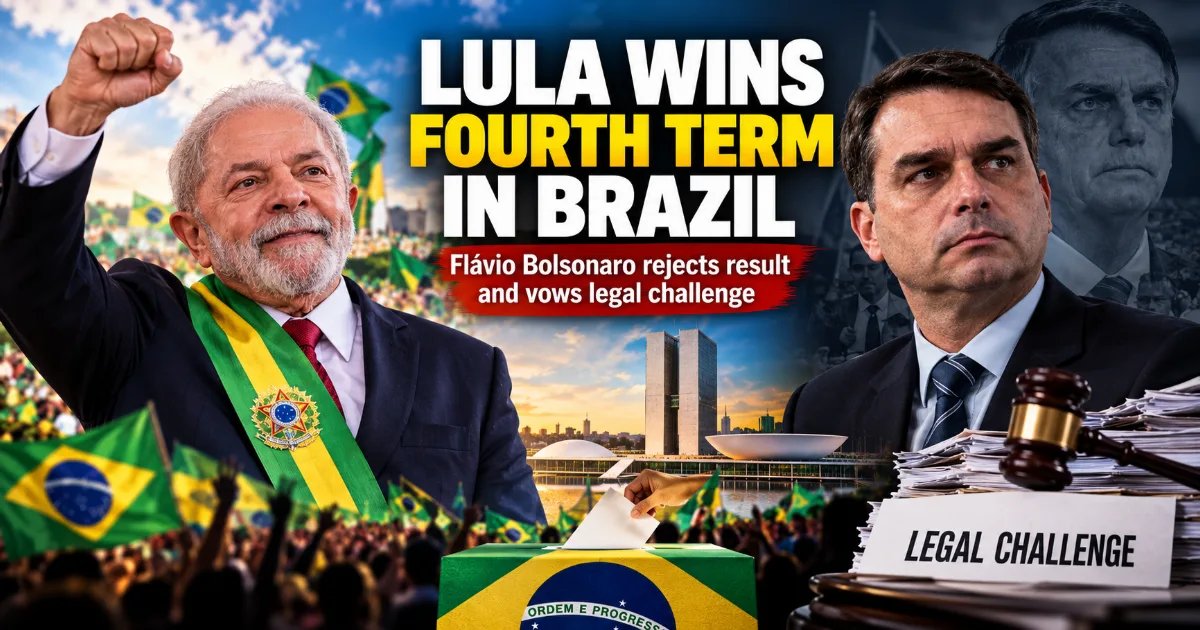
Brazil has entered a consequential new political chapter after President Luiz Inácio Lula da Silva secured an unprecedented fourth, non-consecutive presidential term, defeating right-wing Senator Flávio Bolsonaro in a closely contested runoff election held on October 25, 2026. The final results announced by Brazil's electoral authorities gave Lula approximately 51.79 percent of the valid vote, compared with 48.21 percent for Bolsonaro, a margin of more than 4.4 million votes. The victory represents a remarkable political comeback for the 80-year-old president, who faced economic concerns, public dissatisfaction and a strong challenge from a conservative movement seeking to return the Bolsonaro family to the country's highest office. However, the election result has immediately become a source of political controversy, with Bolsonaro refusing to concede defeat and announcing plans to seek the annulment of the vote.
The outcome matters far beyond the personal political fortunes of the two candidates. Brazil is Latin America's largest economy, a major agricultural exporter, an influential voice in international climate negotiations and an important member of the BRICS grouping of emerging economies. Its domestic policies affect global food markets, energy investment, environmental protection and international trade. Its diplomatic relationship with the United States also carries significant weight at a time when Washington is seeking to strengthen its influence across the Western Hemisphere.
Lula's victory suggests that a significant portion of the Brazilian electorate remains committed to his political programme, despite frustration over the cost of living, concerns about crime and criticism of the government's record. At the same time, Bolsonaro's substantial share of the vote demonstrates that the conservative movement associated with his family remains a powerful force. The result is therefore not a simple story of one political ideology defeating another. It reflects a deeply divided country in which voters have competing expectations about economic opportunity, public security, social welfare, national identity and the role of government.
The immediate challenge for Brazil will be to move from a highly polarised election campaign towards a functioning political settlement. Lula must govern a country in which nearly half of voters supported his opponent, while Bolsonaro and his allies must decide whether to pursue their objections through the established legal system or intensify a confrontation over the legitimacy of the result.
An Unprecedented Fourth Presidential Term
Lula's reelection marks an extraordinary milestone in Brazilian political history. The veteran politician previously served as president from 2003 to 2010, completing two consecutive terms before returning to office following the 2022 election. His latest victory will give him a fourth presidential term overall, although it will be his third consecutive election victory as a presidential candidate across his political career only if measured differently. More precisely, the new mandate will be his fourth non-consecutive term in the presidency, an unprecedented achievement in Brazil's democratic era.
His political journey has been shaped by dramatic changes in Brazil's economy and society. Born into a poor family in northeastern Brazil, Lula became a metalworker and trade union leader before helping establish the Workers' Party, known as the Partido dos Trabalhadores or PT. He rose to national prominence during the labour movement's opposition to military rule and became one of the country's most recognisable political figures.
When Lula first became president in 2003, Brazil was experiencing a period of economic uncertainty. His administration combined social programmes with policies intended to promote growth, increase employment and expand Brazil's international influence. During his first two terms, rising commodity prices and economic expansion helped create the conditions for reductions in poverty and improvements in living standards for many households. Social programmes, including Bolsa Família, became central elements of his political identity.
His administrations also faced serious controversies, including corruption scandals that damaged public confidence in parts of Brazil's political establishment. Lula himself was convicted in corruption cases and imprisoned, but those convictions were subsequently annulled after Brazil's Supreme Federal Court determined that the proceedings were legally flawed and that the judge responsible for the cases lacked the required impartiality. The annulment restored his political rights and enabled his return to electoral competition.
In 2022, Lula defeated then-president Jair Bolsonaro in a narrow contest that highlighted Brazil's deep ideological divisions. His return to office was widely interpreted as a restoration of the political left after several years of conservative rule. Yet the 2026 election presented a different challenge. Lula was no longer campaigning as a returning opposition leader promising a change in direction. He was an incumbent president required to defend his record while persuading voters that his administration could address the country's persistent problems.
The victory shows that Lula retained enough support to overcome those difficulties. It also illustrates the enduring importance of personal political identities in Brazil, where established leaders can maintain large constituencies despite controversy, criticism and changing economic conditions.
However, winning an election is not the same as securing broad public agreement. Lula's victory margin was decisive in electoral terms, but the result also confirms that the country remains politically divided. His next administration will need to demonstrate that its policies can deliver tangible improvements for people who supported him and those who voted for his opponent.
How Lula Turned the Election Around
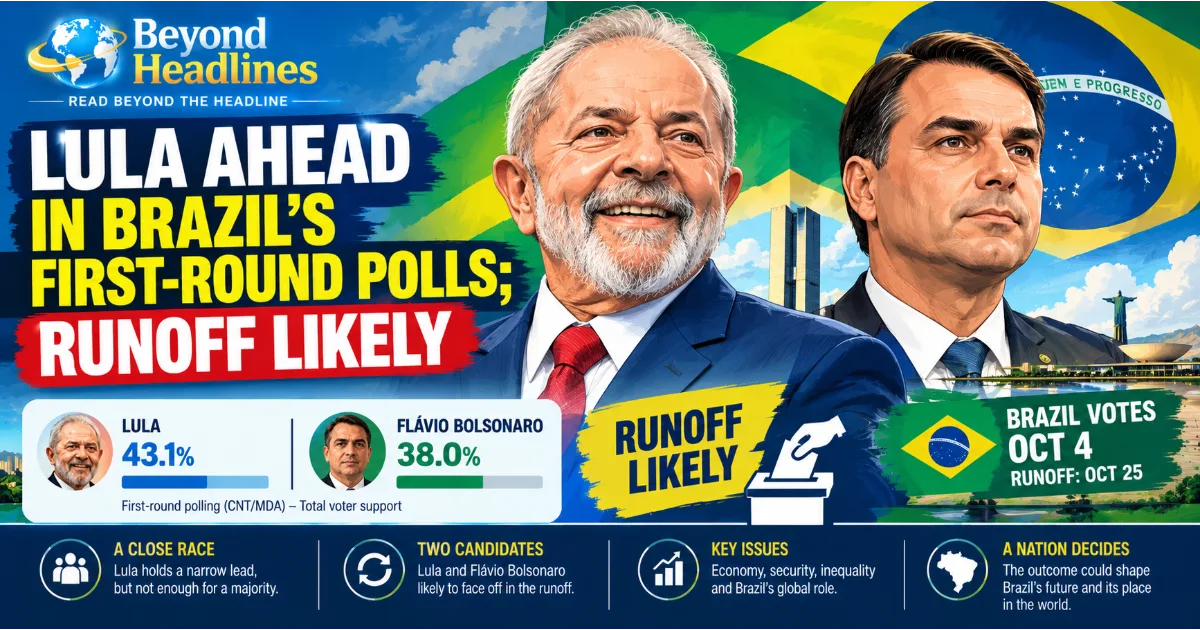
One of the most striking features of the election was the change in momentum between the first and second rounds of voting. Flávio Bolsonaro entered the runoff after finishing ahead of Lula in the first round, creating expectations that the conservative candidate might convert that advantage into a presidential victory. Lula's eventual success therefore represented a significant reversal.
The first round had demonstrated the strength of the Bolsonaro political brand. Flávio benefited from the support of voters who wanted a break from the incumbent government and who associated his family with a more conservative approach to crime, taxation, social values and the relationship between the state and the private sector. His performance showed that the movement established by his father had retained substantial electoral appeal.
Lula's campaign responded by attempting to broaden its coalition. Rather than relying exclusively on traditional party structures and established supporters, the president's political allies worked to mobilise voters through public events, digital communication and direct appeals to communities that depend on social assistance programmes. Campaign messaging placed renewed emphasis on social protection, democratic institutions, economic opportunity and the risks of returning the Bolsonaro family to power.
Digital campaigning became an important part of this effort. Social media platforms, messaging services and online video allowed political campaigns to communicate rapidly with voters, distribute short messages and mobilise supporters beyond traditional rallies. Lula's allies also sought to counter opposition narratives and make the president's case directly to younger voters and people who do not regularly follow conventional political news.
Such methods are increasingly important in elections around the world. Political parties now compete not only through television advertisements, newspaper coverage and public speeches, but also through digital communities where political identity, entertainment and information frequently overlap. Short videos, messaging groups and personalised online communication can influence how voters interpret economic performance and political controversy.
However, digital mobilisation should not be treated as the sole explanation for Lula's victory. Brazil's electorate is diverse, and voters make decisions based on a combination of economic circumstances, personal values, regional loyalties, public services and perceptions of leadership. Campaign communication may help reinforce these considerations, but it cannot fully explain the decisions of millions of individuals.
Lula's success ultimately reflected his ability to maintain support among important parts of his traditional electoral base while attracting enough additional voters to defeat his opponent. His campaign also benefited from the political risks associated with a return to power for the Bolsonaro family, whose supporters and critics remain sharply divided over its record.
The election demonstrated that first-round momentum is not always decisive. In a runoff, candidates must appeal beyond their initial constituencies and persuade voters who may have supported smaller parties or alternative candidates in the first stage. Lula's victory shows how an experienced political leader can recover from an unfavourable first-round position by consolidating support and making the second round a broader referendum on the country's future direction.
Why Flávio Bolsonaro Remains a Powerful Political Figure
Although Flávio Bolsonaro lost the election, his performance confirms that the conservative movement associated with his family remains a major force in Brazilian politics. His share of the vote was large enough to demonstrate that the opposition has a substantial national constituency and that the president will face continued resistance from voters who favour a different political and economic direction.
Flávio Bolsonaro is the son of former president Jair Bolsonaro, whose political rise transformed Brazil's conservative landscape. Jair Bolsonaro built a national following through his criticism of the political establishment, his emphasis on law and order, his socially conservative positions and his opposition to the Workers' Party. His presidency attracted support from segments of the electorate concerned about crime, corruption, taxation and the direction of Brazilian society.
The Bolsonaro political movement also developed strong links with conservative religious groups, business interests, rural constituencies and voters who viewed the political left with suspicion. These constituencies do not necessarily share identical priorities, but they found common ground in opposition to Lula and the Workers' Party.
Flávio Bolsonaro's campaign sought to maintain that coalition while presenting him as an alternative to the incumbent president. His supporters viewed the election as an opportunity to restore conservative leadership and pursue policies that would differ from Lula's approach to social spending, regulation and foreign relations.
His defeat does not eliminate those political ambitions. The conservative movement can remain influential through Congress, state governments, local administrations and public debate. A candidate who receives nearly half of the valid vote can emerge from an election with a substantial platform from which to challenge the government.
The opposition will also attempt to use economic developments during Lula's next term to strengthen its position. If households experience rising prices, weak employment growth or persistent insecurity, Bolsonaro's supporters may argue that the government has failed to deliver on its promises. If Lula improves living standards and strengthens confidence in public institutions, the opposition may find it more difficult to expand its appeal.
The future of the Bolsonaro movement will depend partly on how it responds to defeat. It could focus on legislative opposition, develop a broader policy agenda and prepare for future elections. Alternatively, it could devote much of its energy to contesting the legitimacy of the result. The two approaches would have very different consequences for Brazil's political stability.
For now, Flávio Bolsonaro's refusal to concede has ensured that the election will continue to dominate the national conversation after voting has ended.
The Election Dispute: Why Bolsonaro Wants the Results Annulled
Following the announcement of Lula's victory, Flávio Bolsonaro refused to recognise the outcome and said he would use legal channels to seek the annulment of the election. His principal objection concerns a decision to extend voting hours by two hours after reports of transportation difficulties and disruption in several locations.
The extension has become the central issue in the opposition's challenge. Bolsonaro argues that changing voting arrangements on election day undermined confidence in the process. He has characterised the decision as unacceptable and suggested that the election rules were altered in a way that should invalidate the result.
The circumstances surrounding the extension are important. According to reporting on the election, the measure followed concerns about transportation problems that could prevent some voters from reaching polling stations within the originally scheduled period. The decision was made after requests involving both campaigns, although Bolsonaro subsequently objected to the change.
Electoral authorities have announced Lula as the winner, with the final tally giving him a margin of approximately 4.4 million votes. That margin is significant, but the size of a victory does not automatically resolve every legal question surrounding an election. Equally, the existence of a procedural dispute does not establish that the result is invalid.
The legal challenge must be evaluated according to Brazil's electoral laws, the authority of the institutions responsible for managing the vote and evidence showing whether any irregularity affected the outcome. A candidate's allegation is not equivalent to a judicial finding. The fact that a campaign disagrees with an electoral decision does not, by itself, provide grounds for cancelling millions of votes.
The distinction is essential in a democratic system. Candidates must be able to challenge electoral procedures through lawful mechanisms, particularly when they believe that a decision has affected voters' ability to participate. At the same time, challenges must be supported by evidence and assessed by institutions with the authority to determine whether the law was violated.
A request to annul an election is a serious legal action. It raises questions about the rights of voters, the standards used to validate election results and the circumstances under which a national vote can be set aside. If such challenges become routine responses to political defeat, public confidence in elections can weaken even when the results are properly administered.
The immediate question is therefore not simply whether Bolsonaro accepts the result. It is whether his legal team can establish a valid basis for overturning the decision of the electoral authorities. Until a competent institution rules otherwise, Lula remains the declared winner of the presidential election.
Brazil's Democratic Institutions Face Another Test
Brazil's political system has experienced repeated disputes over elections, corruption investigations and the relationship between executive power and judicial institutions. The latest contest places renewed attention on the capacity of its democratic institutions to resolve disagreements without allowing political confrontation to undermine the electoral process.
The country's electoral authorities are responsible for administering elections, counting votes and announcing official results. The judiciary provides a mechanism for resolving legal disputes and determining whether electoral rules have been followed. These responsibilities are particularly important in a polarised political environment, where supporters of competing candidates may interpret the same event in radically different ways.
When a losing candidate challenges an election, institutions must be able to examine the complaint transparently and apply the law consistently. This requires a clear distinction between legitimate questions about procedure and unsupported allegations that undermine public confidence without adequate evidence.
Brazil's experience is significant because political polarisation can place pressure on public institutions long after voting has ended. Election disputes can become symbols of broader disagreements about the legitimacy of government, the independence of the judiciary and the rights of political opposition. Political leaders therefore have a responsibility to communicate carefully and avoid presenting unproven claims as established facts.
The opposition has the right to pursue legal remedies available under Brazilian law. Its supporters also have the right to express concerns peacefully. At the same time, the authorities must ensure that legal proceedings are based on evidence rather than political pressure.
Lula's government will face a related challenge. It must demonstrate respect for constitutional processes and avoid treating criticism of the administration as inherently illegitimate. A democratic government must be able to distinguish between lawful opposition, unfounded accusations and actions that threaten the functioning of institutions.
The coming weeks will test whether Brazil's political leadership can manage disagreement through established procedures. A transparent legal process would help clarify the status of Bolsonaro's challenge and reduce uncertainty. Continued political confrontation without credible evidence could prolong tensions and distract attention from the policy questions that will shape the country's next presidential term.
The Economy Was Central to the Election
Economic concerns played a major role in shaping the contest. For many Brazilian households, the most important political questions are not abstract ideological debates but the cost of food, access to employment, wages, housing expenses, public transport and the ability to maintain a reasonable standard of living.
Lula's political identity is closely connected to social welfare and the expansion of economic opportunities for lower-income households. His supporters argue that government assistance, public investment and employment policies can help reduce poverty and improve living standards. These priorities remain important in a country where inequality has historically limited opportunities for millions of people.
However, economic dissatisfaction can also weaken an incumbent's position. Even when employment improves or government programmes provide assistance, households may remain frustrated if essential goods become more expensive or if wage increases fail to keep pace with living costs. People can recognise the benefits of a social programme while simultaneously believing that the overall economy is not working well enough.
Flávio Bolsonaro's campaign drew on dissatisfaction with the incumbent government and presented a different approach to economic management. Conservative voters often favour lower taxes, greater private-sector flexibility and reduced regulatory burdens. They may also argue that public spending should be controlled more tightly to protect financial stability and encourage investment.
The debate is not unique to Brazil. Governments across the world face the challenge of balancing social protection with economic competitiveness. Expanding public services requires resources, while excessive or poorly targeted spending can create fiscal pressures. Reducing taxes may encourage some forms of economic activity, but it can also limit the funds available for education, healthcare, infrastructure and income support.
For Lula, the next term will require more than a successful election campaign. The government will need to demonstrate that its economic policies can produce sustainable improvements in household incomes without undermining confidence in public finances. Investors will pay attention to fiscal policy, inflation, interest rates, infrastructure investment and the government's approach to private enterprise.
The administration must also address regional differences. Brazil's economy includes highly developed urban and industrial centres, major agricultural regions and communities that remain dependent on public assistance. A policy that benefits one part of the country may have different consequences elsewhere. National economic success will depend on whether growth creates opportunities across a broad range of sectors and regions.
The election result gives Lula another opportunity to pursue his programme. It does not remove the economic constraints that confronted him during the campaign. Voters will eventually judge the government on whether it can translate political promises into measurable improvements in everyday life.
Crime and Public Security Remain Major Challenges
Public security was another important issue in the campaign. Brazil has long faced serious challenges related to violent crime, organised criminal groups, illegal firearms and the security of urban communities. These problems influence the daily lives of residents and shape how voters evaluate political leadership.
For many citizens, personal safety is one of the most immediate measures of government performance. Families want to travel safely, businesses need to operate without intimidation and communities expect the police and justice system to respond effectively to crime. When people feel unsafe, they may become more receptive to candidates who promise stronger enforcement and tougher penalties.
Conservative political movements have frequently placed law and order at the centre of their programmes. The Bolsonaro political family has benefited from voters who favour a more forceful approach to crime and who believe that existing institutions have not done enough to protect ordinary people.
Lula's political coalition has generally placed greater emphasis on social conditions, public services and the need for coordinated policy responses. However, the government cannot address security concerns through economic policy alone. It must also demonstrate that public institutions can investigate crimes, protect communities and disrupt organised criminal networks.
Effective public security requires more than rhetoric. It depends on reliable intelligence, professional policing, cooperation between federal and state authorities, functioning courts and measures to prevent vulnerable communities from becoming recruitment grounds for criminal organisations. It also requires public trust, because residents are more likely to cooperate with law enforcement when they believe institutions will treat them fairly.
The government must balance enforcement with respect for civil liberties. Heavy-handed operations that cause civilian harm or fail to address the underlying organisation of criminal networks can produce lasting damage. Conversely, policies that are perceived as ineffective can erode confidence in the state's ability to maintain order.
Lula's next term will therefore face pressure from both supporters and critics. Some voters will demand more decisive action against violent crime, while others will scrutinise the human consequences of policing strategies. The administration's ability to build a credible security policy could influence public opinion well beyond the election cycle.
What Lula's Victory Means for the United States
The Brazilian election also has implications for relations with Washington. Lula has frequently defended Brazil's independence in foreign policy and criticised attempts by powerful countries to dictate the choices of other governments. His victory suggests that Brazil is likely to continue pursuing a diplomatic approach that preserves room for engagement with multiple international partners.
Relations between Lula and US President Donald Trump have been marked by differences over trade, international influence and the political direction of the Western Hemisphere. The dispute reflects a wider disagreement about how the United States should engage with governments that resist Washington's preferred policies.
Brazil's size gives its foreign policy particular importance. It is a major agricultural producer, an important supplier of minerals and energy-related commodities, and a country with considerable influence in regional diplomacy. Its decisions can affect supply chains, climate negotiations and the international position of developing economies.
A Lula administration is likely to continue defending Brazil's right to maintain relationships with countries that have different political systems and strategic priorities. This approach includes engagement with China, which has become a major trading partner for Brazil, as well as participation in BRICS and other international forums.
Such a policy does not necessarily mean Brazil will seek confrontation with the United States. Economic interdependence creates incentives for cooperation, and both countries have interests in trade, investment, energy, technology and regional stability. The central question is whether disagreements can be managed without escalating into retaliatory measures that harm businesses and consumers.
Tariffs and trade restrictions are particularly important in this context. Brazil exports agricultural products, minerals, industrial goods and other commodities to international markets. Changes in market access can affect producers, workers and investment decisions. At the same time, US companies have commercial interests in Brazil's large consumer market and its natural resources.
Lula's reelection may reassure those who favour a more independent Brazilian foreign policy, but it also means that differences with Washington could remain unresolved. The next administration will have to balance its diplomatic principles with the practical need to maintain access to global markets and attract investment.
For the United States, the result is a reminder that Latin American voters do not necessarily follow a single regional political trend. Elections across the region are shaped by domestic circumstances, and Brazil's electorate has chosen continuity with Lula despite the strength of conservative forces elsewhere.
Why the Result Matters for Latin America
Brazil's presidential election has regional significance because the country is the largest economy in Latin America and one of its most influential political actors. Its decisions affect regional trade, infrastructure, migration, energy cooperation and diplomatic coordination.
Across Latin America, political competition has often shifted between left-wing and right-wing governments. These changes reflect frustration with economic inequality, corruption, insecurity and the performance of established political parties. Voters may support candidates promising social reform in one election and choose conservative alternatives in another.
Lula's victory complicates any attempt to describe the region as moving uniformly in one ideological direction. It demonstrates that political outcomes depend on national conditions and the ability of candidates to connect with voters. Brazil's electorate has chosen to return an experienced left-wing leader to office, even as conservative movements remain powerful.
Regional cooperation could become an important part of Lula's next term. Brazil has the economic weight to support initiatives involving trade, energy, transport and environmental protection. It can also play a role in diplomatic efforts concerning regional conflicts and the economic challenges facing neighbouring countries.
However, political differences between governments can make regional integration difficult. Leaders with contrasting ideological priorities may disagree over trade arrangements, public spending, security policy and relations with external powers. Even governments that share similar political positions can have competing economic interests.
Lula will need to decide how much emphasis to place on regional diplomacy while addressing domestic priorities. International leadership can strengthen Brazil's influence, but voters are likely to judge the government primarily on conditions at home. A foreign policy agenda that produces few visible domestic benefits may be harder to sustain.
The election also carries symbolic significance for political movements across the region. Lula's comeback demonstrates that established leaders can regain power when they maintain a loyal base and persuade voters that their opponents represent greater risks. At the same time, Flávio Bolsonaro's strong performance shows that conservative movements remain capable of mobilising large electorates.
The regional lesson is that political competition is far from settled. Economic conditions, security concerns and public confidence will continue to shape the direction of Latin American democracies.
Climate Change and the Amazon Will Remain Under Scrutiny
Brazil's environmental policies are another reason the election matters internationally. The country contains most of the Amazon rainforest, one of the world's most important ecosystems and a major component of the global climate system. Decisions about land use, deforestation, agriculture and conservation have consequences that extend well beyond Brazil's borders.
Lula has sought to position Brazil as an important participant in international climate diplomacy. His government has emphasised environmental protection and the need to combat illegal deforestation while recognising the economic importance of agriculture and resource development.
The challenge is to reconcile conservation with economic opportunity. Brazil's agricultural sector is a major contributor to exports and rural employment. At the same time, deforestation can damage biodiversity, release stored carbon and threaten the livelihoods of Indigenous communities and other populations that depend on forest ecosystems.
Environmental policy can become politically contentious when restrictions are perceived as limiting development or increasing costs for farmers and businesses. The government must therefore show that conservation can be supported by effective enforcement, economic alternatives and investment in sustainable production.
International partnerships can help provide resources and technical expertise, but they must respect Brazil's sovereignty and the rights of local communities. Foreign governments and organisations may have legitimate concerns about the Amazon's global importance, yet durable environmental policy depends on cooperation with Brazilian institutions and people.
Lula's reelection may provide continuity for existing environmental priorities. However, the administration will still face competing demands from agriculture, mining, infrastructure development and communities seeking greater economic opportunity. The results of environmental policy will depend on enforcement, funding and the government's willingness to manage conflicts between short-term economic interests and long-term ecological protection.
The election also affects climate diplomacy because Brazil can play an important role in negotiations involving developing countries. It has argued that environmental protection should be accompanied by financial support and technology transfer, particularly when countries with lower historical emissions face pressure to limit development.
The next term will provide an opportunity to demonstrate whether Brazil can combine economic growth with credible environmental protection. International observers will look for evidence that commitments translate into measurable outcomes.
Social Welfare and the Question of Inequality
Social welfare remains central to Lula's political identity and to the expectations of many voters who supported him. Brazil has made progress in reducing poverty at different points in its recent history, but inequality and unequal access to essential services remain persistent challenges.
Government assistance programmes can help households meet basic needs and reduce extreme deprivation. They can also support local economies when recipients spend money on food, transport and other necessities. For supporters, these programmes are not merely transfers of public money but mechanisms for improving social stability and expanding opportunity.
Critics raise concerns about the long-term affordability of public spending, the effectiveness of programme design and the need to encourage formal employment and productivity. These arguments are part of a wider debate over how governments should balance immediate support with policies that create sustainable economic independence.
The effectiveness of social policy depends on more than the amount of money distributed. Access to quality education, healthcare, housing, sanitation and reliable transport can determine whether families escape poverty over time. Assistance programmes are most effective when they are connected to broader improvements in public services and economic opportunity.
For Lula, the challenge is to maintain support for vulnerable households while ensuring that government programmes are financially sustainable and reach the people who need them. Better administration, transparent eligibility rules and regular evaluation can help reduce waste and improve outcomes.
The government must also consider regional inequality. The needs of rural communities may differ significantly from those of major urban centres. Some households face barriers to formal employment, while others need access to education and training to participate in changing labour markets. A uniform approach may fail to address these differences.
Lula's electoral victory gives him a mandate to continue pursuing social protection, but it also creates expectations that living standards will improve. The next term will be judged partly on whether assistance programmes deliver measurable benefits and whether those benefits are supported by broader economic progress.
Brazil's Position in a Changing Global Economy
Brazil's international economic role extends beyond its relationship with the United States. The country has deep commercial ties with China, Europe and other emerging markets, and it remains an important supplier of agricultural commodities, minerals and energy-related products.
China is a particularly significant trading partner. Demand for Brazilian soybeans, iron ore and other commodities has helped shape the country's export economy. Maintaining access to major markets is therefore essential for producers, workers and businesses that depend on international trade.
At the same time, Brazil faces the challenge of moving beyond reliance on commodity exports. Greater investment in manufacturing, technology, infrastructure and higher-value services could help diversify the economy and create more skilled employment. Achieving this requires reliable regulation, education and training, access to capital and an environment in which businesses can plan for the long term.
Lula's government will need to balance relationships with major powers while avoiding excessive dependence on any single market. A diversified diplomatic and trade strategy can provide opportunities, but it also requires careful management of competing interests.
Participation in BRICS and other multilateral forums gives Brazil a platform to advocate for changes in international economic governance. Such forums can strengthen cooperation among emerging economies, although their members do not always agree on every issue. Brazil's influence will depend on its ability to turn diplomatic engagement into practical outcomes.
Global economic uncertainty also presents risks. Changes in commodity prices, interest rates, international trade rules and geopolitical tensions can affect Brazil's growth. The government cannot control all these factors, but it can improve resilience through sound economic management, infrastructure investment and policies that encourage innovation.
The next presidential term will therefore involve choices about Brazil's place in the global economy. Lula must decide how to pursue strategic independence while preserving commercial relationships that support jobs and growth. The success of that strategy will depend on whether international engagement produces practical benefits for Brazilian citizens.
What Happens Next?
Lula is scheduled to begin his new presidential term on January 5, 2027. Between the election and inauguration, attention will focus on the transition process, the composition of the next administration and the legal response to Bolsonaro's challenge.
The opposition's request to annul the election could prolong political uncertainty, depending on the grounds presented and the decisions made by the relevant institutions. The outcome of any legal proceedings will be important for establishing whether the dispute remains a procedural challenge or develops into a wider confrontation over the legitimacy of the vote.
Lula will also need to prepare a governing agenda that responds to the priorities exposed during the campaign. Economic growth, inflation, public security, social welfare, fiscal policy and environmental protection will require sustained attention. The administration must work with Congress and other institutions to convert its electoral mandate into legislation and effective implementation.
Political negotiation will be particularly important in a divided country. Even a president who wins a national election must build support for policies through the legislative process. This may require compromise with parties and representatives who did not support the presidential campaign.
Bolsonaro's political future will depend on how he manages defeat. A legal challenge is part of the democratic process when it is grounded in evidence and pursued through the appropriate institutions. But continued rejection of the result without a successful legal basis could deepen distrust and make future political cooperation more difficult.
The public response will also matter. Peaceful demonstrations, open debate and legal scrutiny are normal features of democracy. Intimidation, violence or efforts to prevent constitutional institutions from functioning would represent a very different challenge. Political leaders have an important role in setting expectations for how disagreements should be expressed.
For international investors and diplomatic partners, clarity will be valuable. Brazil's economic scale means that uncertainty around its political institutions can affect business confidence and international relationships. A transparent resolution of the election dispute would help the country return attention to its policy agenda.
Conclusion: A Victory for Lula, but Not an End to Brazil's Political Divide
Lula's reelection represents a historic political comeback and secures him an unprecedented fourth non-consecutive presidential term. By defeating Flávio Bolsonaro with approximately 51.79 percent of the valid vote, the incumbent has demonstrated that his coalition remains capable of winning a national contest despite economic concerns and a formidable conservative challenge.
Yet the result should not be interpreted as evidence that Brazil has resolved its ideological divisions. Bolsonaro's substantial support demonstrates that the opposition remains powerful, and his refusal to concede has introduced a new dispute over the electoral process. The legal challenge must now be assessed through the country's established institutions, with evidence and the law determining the outcome rather than political declarations.
The election carries implications for economic policy, public security, social welfare, environmental protection and Brazil's position in international affairs. Lula's government will have to balance demands for immediate improvements in living standards with the need for sustainable public finances and long-term economic growth. It will also need to manage relations with the United States and other major powers while defending Brazil's ability to pursue an independent foreign policy.
For ordinary Brazilians, the most important test will be whether the next administration improves daily life. Electoral victories create expectations, but those expectations can only be met through effective governance, transparent institutions and policies that produce measurable results.
The coming presidential term will determine whether Lula can transform his political comeback into a period of greater economic opportunity and social stability. It will also test whether Brazil's political leaders can manage disagreement without allowing competition to weaken democratic institutions.
The election has delivered a clear result from the electoral authorities, but it has not ended the national debate over Brazil's future. Instead, it has opened another chapter in a political struggle that will continue to shape the country's domestic priorities and international relationships for years to come.
#BrazilElection2026 #LulaDaSilva #FlavioBolsonaro #BrazilPolitics #LatinAmerica #GlobalPolitics #Democracy #WorldNews #InternationalRelations #BeyondHeadlines