
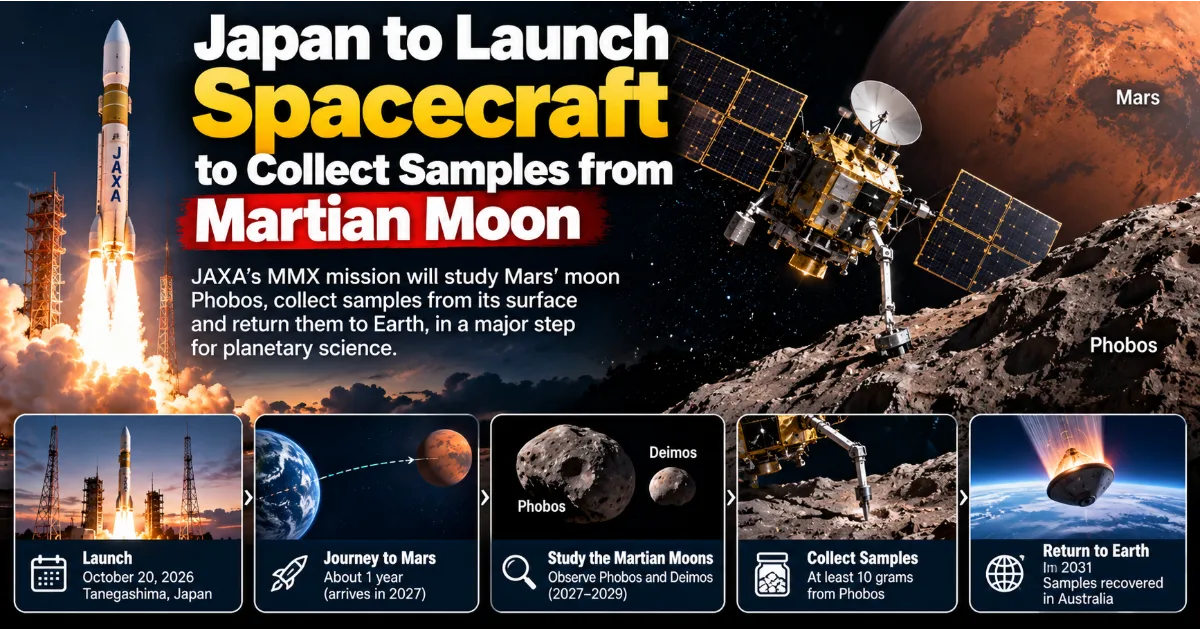
Japan is preparing for one of the most ambitious planetary science missions ever attempted. On October 20, 2026, the Japan Aerospace Exploration Agency (JAXA) is scheduled to launch its Martian Moons eXploration spacecraft, known as MMX, on a journey to Phobos, one of Mars's two small moons. The spacecraft is designed to study both Phobos and Deimos, land on Phobos, collect samples of its surface material and return those samples to Earth in 2031. If successful, the mission will achieve the first sample return from the Martian system.
The launch is scheduled for 4:41 a.m. Japan Standard Time on October 20 from the Tanegashima Space Center in southern Japan. That corresponds to 1:11 a.m. Indian Standard Time on October 20. The mission is not a short trip to a nearby destination. It involves travelling across interplanetary space, operating around a distant planetary system, navigating the unusual surface environment of a small moon, gathering material and bringing it safely back to Earth over approximately five years.
The scientific prize could be substantial. Phobos may be an asteroid captured by Mars's gravity, or it may have formed from material thrown into space when a large object struck the planet. These competing explanations tell very different stories about how Mars and its moons developed. By studying Phobos closely and analysing samples in laboratories on Earth, scientists hope to find evidence that helps distinguish between them.
The mission also represents a major test of Japan's growing capabilities in deep-space exploration. JAXA has already demonstrated that spacecraft can collect material from small celestial bodies and return it to Earth through its Hayabusa and Hayabusa2 missions. MMX builds on that experience but adds a much more complicated destination, a different gravitational environment and a sample-return journey involving the Mars system. Its success could influence how scientists investigate other moons, asteroids and planets in the decades ahead.
Why Phobos Has Become a Scientific Priority
Mars has two natural satellites, Phobos and Deimos. Both are considerably smaller than Earth's Moon, and neither resembles the large, geologically active moons found around some of the outer planets. Their modest size, irregular shapes and proximity to Mars make them fascinating objects for planetary scientists. Despite decades of robotic exploration of Mars, important questions about the origins and composition of these moons remain unresolved.
Phobos is the larger and closer of the two. It orbits Mars at an unusually short distance, completing one revolution in approximately seven hours and 39 minutes. It travels so close to the planet that it moves around Mars faster than Mars rotates. As a result, an observer on the Martian surface would see Phobos rise in the west and set in the east, unlike Earth's Moon, which appears to travel across the sky in the opposite direction.
The moon is irregular in shape, heavily marked by craters and covered by a layer of loose material produced by impacts over immense periods. Its largest visible feature is Stickney crater, a vast depression relative to the size of the moon itself. The impact that created Stickney must have been powerful, although Phobos survived the event rather than breaking apart completely.
Its surface may appear familiar to anyone who has seen images of asteroids. Yet its location beside Mars makes it more scientifically complicated than a simple rocky body drifting through space. Material on Phobos could preserve evidence of its own formation, the history of impacts in the inner Solar System and possibly fragments of Mars that were blasted into space by ancient collisions.
Scientists have already studied Phobos through telescopic observations, spacecraft flybys and remote measurements. Those observations have provided useful information about its shape, surface properties and composition. However, a spacecraft passing by or observing from a distance cannot answer every question about the material that makes up the moon.
Returning physical samples would change the level of investigation possible. Scientists could examine individual grains, measure their chemical and mineral composition, study microscopic structures and compare different components using laboratory instruments that are too large or too sensitive to be carried aboard a spacecraft. They could also preserve material for future investigations using techniques that have not yet been developed.
That is the central reason MMX matters. It is designed to turn a distant, largely unexplored object into a physical collection of scientific evidence that researchers can examine directly.
The Biggest Mystery: Where Did Mars's Moons Come From?
The origins of Phobos and Deimos remain among the major unresolved questions in planetary science. Two broad explanations have received particular attention. One proposes that the moons are asteroids captured by Mars. The other suggests that they formed from debris produced by a massive impact on the planet.
The captured-asteroid explanation begins with the early Solar System, when countless rocky bodies travelled around the Sun. Some of these objects eventually crossed the paths of planets. Under the right conditions, a passing object could lose enough orbital energy to become gravitationally bound to a planet. If Phobos and Deimos were captured in this way, they might preserve characteristics of ancient asteroids that formed elsewhere in the Solar System.
This possibility is attractive because both moons have irregular shapes and dark surfaces that appear broadly consistent with some primitive small bodies. Their properties have encouraged scientists to investigate whether they contain material rich in carbon-bearing compounds or minerals that formed under conditions different from those found on Mars.
However, capturing an asteroid into a stable orbit is not necessarily straightforward. An object approaching Mars must lose sufficient energy or undergo an interaction that allows it to remain gravitationally bound. The resulting orbit must also evolve into a configuration compatible with the moons' present positions. Explaining how two captured objects arrived in their current orbits requires more than simply observing that they look somewhat asteroid-like.
The alternative is that Phobos and Deimos formed from material ejected during a major collision involving Mars. In this scenario, an object struck the planet early in its history, launching rock and dust into orbit. Some of that debris could have assembled into one or more moons. Such a process would connect the moons directly to Mars's geological history and potentially make them repositories of material from the planet's early crust.
Impact-generated debris could contain a mixture of Martian material and material from the object that struck the planet. The proportions would depend on the impact's size, speed, angle and the physical properties of the bodies involved. If the moons formed in this way, samples from Phobos might contain minerals or chemical signatures linked to Mars itself.
Neither explanation can be accepted simply because it sounds plausible. Scientists need measurements that distinguish between competing models. Surface appearance, density, spectral signatures and orbital properties provide clues, but these clues can sometimes be interpreted in different ways. Laboratory analysis of returned samples could offer a more decisive test.
MMX will therefore investigate the moon's composition while also studying its physical structure, surface features and relationship with Mars. The mission is not built around a single instrument or one dramatic discovery. Its value lies in combining multiple kinds of evidence to construct a more complete picture of the Martian system.
Even if the results do not immediately settle the debate, they could eliminate some proposed explanations and improve the models scientists use to understand how small moons form around planets.
What Exactly Is Japan Sending Into Space?
The MMX spacecraft is a sophisticated interplanetary vehicle designed to perform several different tasks during one mission. It must travel from Earth to the vicinity of Mars, study Phobos and Deimos, conduct controlled operations near Phobos, collect surface material and return a sealed sample capsule to Earth.
Its architecture is divided into three main modules: a propulsion module, an exploration module and a return module. Each has a distinct role in the journey. The propulsion system will help the spacecraft navigate the long trip and manoeuvre around the Martian system. The exploration module will support scientific observations and sample collection, while the return module will carry the material back toward Earth.
This arrangement reflects the complexity of sample-return missions. Reaching a target is only one part of the challenge. The spacecraft must also operate reliably over several years, perform delicate manoeuvres near a small body, protect the collected material and deliver it to Earth at the correct time and trajectory.
The mission will carry a suite of scientific instruments intended to study the moons from different perspectives. These include equipment to examine surface composition, map geological features and investigate properties that can help scientists understand the bodies' internal structure and evolution. Measurements of elements on the surface are particularly important because they may help distinguish between asteroid-like material and material associated with Mars.
One of the mission's international contributions is NASA's MEGANE instrument, designed to measure gamma rays and neutrons emitted from the surface of Phobos. Such measurements can reveal information about the elements present in the moon's upper layers. The instrument's observations will help scientists construct a chemical profile of Phobos and assess what that profile implies about the moon's origins.
The spacecraft also incorporates European contributions, including a small rover developed through cooperation involving the French and German space communities. The rover is named Idefix, a name familiar to readers of the French comic series Asterix. Its role is to help investigate the surface and provide information relevant to the spacecraft's sampling operations.
The collaboration illustrates how major space missions increasingly depend on scientific and engineering contributions from several countries. Japan is leading the mission, but expertise and hardware from international partners help expand its scientific reach. The project involves JAXA alongside NASA, the European Space Agency, France's CNES and Germany's DLR.
This is not merely a collection of national instruments placed aboard one spacecraft. International participation broadens the scientific community that can use the mission's findings, helps share technical challenges and creates opportunities for researchers to work with data from a unique planetary environment.
The Journey From Earth to the Martian System
Once launched, MMX will begin a journey lasting approximately one year before reaching the vicinity of Mars. During this period, the spacecraft will travel through interplanetary space, using its propulsion system and carefully planned trajectory to reach its destination.
Deep-space navigation requires extraordinary precision. The spacecraft cannot simply point toward Mars and fly in a straight line. Its route must account for the gravitational influence of celestial bodies, its own velocity, fuel requirements and the geometry of the Solar System at the time of launch. Small errors accumulated over long distances can become significant, so navigation teams must continually track the spacecraft and refine their calculations.
The arrival phase will be another critical milestone. Reaching Mars does not automatically place a spacecraft in the right orbit to study Phobos. MMX must transition into a trajectory that allows it to operate near the moon while maintaining the ability to carry out its planned observations and eventual departure.
The mission schedule anticipates arrival in the Martian system in 2027, followed by an extended period of investigation. Rather than immediately landing and collecting a sample, the spacecraft will first study Phobos from nearby orbits and select suitable locations for surface operations.
This preparatory phase is essential because the surface of Phobos is not fully understood. A landing location that looks safe in distant images may contain unexpected slopes, loose material, boulders or other hazards. Detailed observations can help mission planners reduce uncertainty before committing the spacecraft to a landing attempt.
The spacecraft will also observe Deimos, the smaller and more distant Martian moon. Although Phobos is the main sampling target, studying both bodies provides a wider scientific context. If the two moons share an origin, their compositions and physical properties may contain related signatures. If they formed through different processes, differences between them could be equally revealing.
By examining the pair together, scientists can test theories about the formation of the Martian system rather than interpreting Phobos in isolation.
Why Landing on Phobos Is More Difficult Than It Sounds
Landing on a moon may seem routine after decades of lunar exploration, but Phobos presents a very different engineering environment from Earth's Moon. Its gravity is extremely weak, its shape is irregular and its surface conditions remain uncertain in important respects.
On Earth, gravity naturally pulls a descending vehicle toward the ground. Engineers can design a landing system to counter that pull using engines, parachutes or other mechanisms. On Phobos, the gravitational attraction is so weak that a small error in speed or contact behaviour can produce a very different result from the one expected.
A spacecraft approaching the surface must manage its motion with great care. If it touches down too quickly, it could rebound, tip over or disturb the surface in ways that complicate sampling. If it fails to make the intended contact, it could drift away from the target area. The mission must also consider how the spacecraft's own movement affects its position relative to the moon.
Phobos's irregular shape adds another layer of complexity. Its gravitational field is not as simple as that of a large, nearly spherical body. The relationship between the spacecraft's orbit, the moon's rotation and the local terrain must be modelled with considerable care. Navigation systems need reliable observations and detailed calculations to guide operations.
The surface itself may consist of loose material, fractured rock and debris generated by countless impacts. Such material can behave differently from the firm ground familiar from terrestrial construction. A landing mechanism that makes contact with one patch of terrain may respond differently when it encounters another.
For these reasons, MMX will not rely on a single moment of contact to accomplish its entire scientific mission. It is designed to carry out observations, use the rover to help assess the surface and conduct planned sampling operations with the goal of obtaining a useful quantity of material.
The mission aims to collect at least 10 grams of samples from Phobos, with collection planned from two different surface locations. Although 10 grams may sound insignificant compared with the weight of a spacecraft, it represents a substantial scientific return from a body more than 200 million kilometres away from Earth at many points in its orbit around the Sun.
The value of a sample depends on its quality, diversity and scientific context, not simply its mass. A few carefully documented grams can provide enough material for a wide range of chemical, mineralogical and microscopic investigations.
Meet Idefix, the Rover Helping Explore Phobos
One of the most distinctive features of MMX is its small surface rover, Idefix. Developed through European cooperation, the rover will support the mission's investigation of Phobos by examining the terrain and gathering information about the environment in which sampling takes place.
The rover is not intended to operate like a large Mars rover travelling for years across extensive landscapes. Phobos is a much smaller target, and the rover's job is tailored to the mission's specific requirements. It will help characterise surface conditions and demonstrate technologies for operating on a low-gravity body.
This distinction matters because the techniques used to explore a planetary surface cannot always be transferred directly from one destination to another. A rover moving across Mars must contend with substantial gravity, dust, slopes and potentially challenging weather conditions. On Phobos, gravity is extremely weak, and even small movements can have unexpected consequences.
The rover's mobility and operations must account for the possibility of slipping, bouncing or interacting with loose material in ways that would be less significant on Earth. Engineers have to consider how the wheels or other contact systems behave, how the vehicle maintains its orientation and how its observations can support decisions made by the main spacecraft.
Its data will help scientists better understand the physical environment and could improve confidence in the selection and execution of sampling operations. It will also demonstrate techniques relevant to future missions to small moons and asteroids.
The rover represents a broader trend in planetary exploration. Increasingly, spacecraft are designed as coordinated systems in which orbiters, landers, rovers and scientific instruments contribute complementary information. Each component addresses a different part of the scientific problem, reducing the limitations that arise when a mission depends on a single platform.
How Scientists Will Collect and Protect the Samples
MMX is designed to use sampling methods suited to Phobos's unusual environment. The mission plans to make two surface contacts and use different collection techniques to obtain material. These include a gas-driven sampling approach and a coring method intended to retrieve material from the surface.
The purpose of using carefully designed collection systems is to gather material while limiting the risk of losing the sample or compromising the spacecraft's ability to continue its mission. Sampling equipment must work in a low-gravity environment where material may not respond to contact in the same way it would on Earth.
After collection, the material will be stored in a return capsule. That capsule is one of the mission's most important components because the scientific value of the expedition depends on the samples surviving the journey home.
The return system must protect the contents during departure from the Martian system, the long journey through space and the final approach to Earth. It must also keep the sample container secure during atmospheric entry and landing.
Scientists will need to know where the material came from and how it was collected. Samples are much more useful when their geological and operational context is documented. A grain taken from one location may have a different history from a grain gathered several metres away, particularly if the surface contains a mixture of material from different sources.
This is why MMX's remote observations and surface operations are closely connected. The spacecraft will investigate potential sampling areas before selecting sites, and the material collected will later be interpreted alongside images, chemical measurements and other data from the mission.
Once the capsule reaches Earth, researchers will be able to use sophisticated laboratory instruments to analyse the samples in far greater detail than would be possible with spacecraft equipment alone. They will also be able to preserve portions of the material for future generations of scientists.
That long-term scientific value is a major advantage of sample-return missions. A spacecraft must operate within strict limits on mass, power, communications and instrument size. A laboratory on Earth has access to a much broader range of equipment, and new analytical methods may emerge years after the samples arrive.
What Happens When the Samples Reach Earth in 2031?
The mission is designed to return its sample capsule to Earth in 2031. After MMX completes its observations and sampling operations, the spacecraft is expected to depart the Martian system around 2030 and spend approximately another year travelling home.
The return capsule will separate from the spacecraft and enter Earth's atmosphere. Its trajectory and thermal protection must be designed to withstand the intense heating associated with atmospheric entry while preserving the sample container. Recovery operations are planned in Australia, where the capsule can be retrieved and transferred to facilities equipped to handle extraterrestrial material.
Returning material from another world is a demanding engineering task. The spacecraft must deliver the capsule to the right region of Earth with the right speed and orientation. The capsule must survive the physical stresses of entry, reach the ground safely and remain sufficiently sealed to protect the contents.
Sample handling after recovery is equally important. Researchers will need to prevent contamination from Earth's environment, document the capsule's condition and prepare the material for controlled examination. If scientists are looking for trace chemical compounds or subtle isotopic signatures, even small amounts of contamination can complicate interpretation.
The analysis process is likely to unfold over many years. Initial examinations may establish the broad composition and physical properties of the material. More specialised studies could investigate mineral formation, chemical signatures, organic compounds and relationships between the samples and known meteorites or other Solar System materials.
Not every result will arrive immediately, and not every question will be answered by the first round of testing. Scientific discoveries often emerge through comparison between different datasets, repeated experiments and independent confirmation by research teams.
The most important achievement may therefore be a collection of evidence that supports or challenges existing theories, rather than a single headline-making discovery.
Could Phobos Contain Material From Mars?
One of the mission's most exciting possibilities is that Phobos may contain fragments of Mars itself. Large impacts on the planet can eject material into space. Some fragments may escape Mars entirely, while others could remain in orbit or eventually become incorporated into nearby bodies.
If Phobos formed from impact debris, it could contain a mixture of material from Mars and the impactor. Even if it formed through a different process, its surface may have accumulated Martian ejecta over billions of years. The exact amount and distribution of such material remain questions for investigation.
Finding Martian material in Phobos samples would provide scientists with a new way to study the planet's history. Mars has a rich geological record, including evidence of ancient rivers, lakes and environments that once supported liquid water at the surface. Yet direct access to its earliest geological materials remains limited.
Samples collected from Phobos could offer clues about the planet's crust and the history of impacts that shaped its surface. However, scientists would need to establish the origin of any Martian fragments through careful analysis. A chemical similarity alone may not be sufficient to identify where a grain came from, particularly if different bodies formed from related materials in the early Solar System.
The samples could also help researchers understand how material moves between planetary bodies. Impacts can transport rock across space, meaning a moon may preserve evidence of events that occurred on the planet it orbits. Similar processes may operate elsewhere in the Solar System.
There is also a potential connection to the study of organic chemistry and the conditions necessary for life. Some primitive asteroids contain carbon-bearing compounds and water-related minerals. If Phobos preserves material from an asteroid-like body or from ancient Martian impacts, it could provide information about the distribution of these ingredients.
However, this should not be confused with evidence that life existed on Phobos. The mission is not a direct search for living organisms, and finding organic molecules would not, by itself, establish a biological origin. Such compounds can also form through non-biological processes.
The scientifically responsible expectation is that MMX may improve understanding of the materials and environments involved in the early evolution of Mars and its moons. Whether it reveals evidence relevant to the origin of life will depend on what the samples contain and what the analysis can establish.
Why This Is Not the Same as Returning Samples From Mars
The distinction between a Martian moon sample and a sample collected directly from Mars is important. MMX will collect material from Phobos, not conduct a landing on Mars itself to gather rocks from the planet's surface.
That difference affects both the scientific questions and the interpretation of the results. A sample taken directly from Mars could be selected from a known geological setting, such as an ancient lakebed or a volcanic formation. A sample from Phobos may contain material from several sources, potentially including the moon itself, impact debris and particles accumulated over time.
This mixture creates scientific opportunities, but it also introduces complexity. Researchers will have to determine which grains represent Phobos's own composition and which may have originated elsewhere. The context provided by the spacecraft's observations will be essential.
Mars sample-return efforts have also faced substantial engineering, budgetary and scheduling challenges. Bringing carefully selected Martian rocks to Earth involves coordinating spacecraft, surface operations, sample transfer and a return journey. MMX follows a different path by targeting a small moon that is close to Mars and may itself preserve material relevant to the planet's history.
A successful MMX mission would therefore complement other Mars exploration programmes rather than replace them. It would provide a new category of evidence and demonstrate technologies that could support more ambitious missions in the future.
The International Partnership Behind Japan's Mission
Although MMX is led by Japan, it is an international scientific undertaking. NASA, the European Space Agency, France's CNES and Germany's DLR contribute to the mission through instruments, technology and scientific collaboration.
This model reflects the economics and technical realities of modern planetary exploration. Interplanetary missions require specialised expertise in propulsion, navigation, communications, robotics, instrument design and sample handling. Few space agencies can develop every component independently without increasing costs or duplicating work.
International cooperation allows agencies to contribute their strongest capabilities. It also broadens the scientific participation that follows a successful mission. Teams in different countries can examine the data, test competing theories and develop new research programmes based on the findings.
For Japan, leadership of MMX is an opportunity to build on its experience with the Hayabusa missions. Those projects demonstrated the ability to travel to small celestial bodies, conduct operations near their surfaces, collect material and return it to Earth. MMX applies that experience to a much more complicated setting near Mars.
The mission also offers international partners a chance to study the Martian moons in ways that have not previously been possible. A spacecraft that returns physical samples can support research across several disciplines, from planetary geology and chemistry to impact dynamics and the history of the Solar System.
The benefits of such collaboration extend beyond one mission. Shared expertise can improve the design of future spacecraft, strengthen scientific networks and help develop procedures for handling and analysing material from other worlds.
What MMX Could Mean for Future Human Exploration of Mars
MMX is a robotic mission, but some of the technologies it tests may have implications for future human exploration. Sending people to Mars will require much more than developing a crewed spacecraft. Missions will need reliable navigation, communications, surface operations, environmental monitoring and systems capable of functioning far from Earth.
The ability to operate near small celestial bodies is relevant to a range of possible future missions. Engineers must understand how spacecraft behave in weak gravity, how surface material responds to contact and how to collect and secure material in environments where conventional terrestrial assumptions do not apply.
MMX can also help improve understanding of the Martian environment by examining the relationship between Mars and its moons. Phobos could potentially serve as a location for future robotic or human operations, although its suitability would depend on many factors, including radiation conditions, surface stability, communications and the requirements of a specific mission.
It is too early to treat Phobos as a confirmed staging point for human journeys to Mars. Such proposals would require extensive engineering and operational analysis. Nevertheless, a mission that maps the moon, studies its physical characteristics and demonstrates surface operations would provide information relevant to any future plans.
The ability to return material from the Martian system is itself a significant technical achievement if completed successfully. It requires a spacecraft to operate autonomously across long distances and execute a complex sequence of manoeuvres without direct human intervention in real time.
Because radio signals take several minutes to travel between Earth and Mars, controllers cannot operate a spacecraft in the Martian system as though it were a remote-controlled vehicle nearby. Many decisions must be prepared in advance, with onboard systems executing commands and responding to conditions according to carefully tested procedures.
These are precisely the kinds of capabilities that will matter as space agencies pursue more complex missions beyond Earth orbit.
The Challenges That Could Put the Mission at Risk
Despite its scientific promise, MMX faces significant risks. Spacecraft missions can fail because of launch problems, propulsion issues, navigation errors, instrument malfunctions, communications interruptions or unexpected conditions at the target.
The launch itself is the first major milestone. The spacecraft is scheduled to travel aboard Japan's H3 rocket, a launch vehicle developed to support the country's space programme. A successful launch must place the spacecraft on the intended trajectory and provide the conditions necessary for the mission to begin as planned.
Even after launch, the spacecraft will face a long period of travel before reaching Mars. Equipment must remain reliable during that journey, and mission controllers must manage power, thermal conditions, communications and trajectory adjustments. A malfunction that would be relatively straightforward to address on Earth could become difficult or impossible to repair millions of kilometres away.
The arrival at Mars and the transition into operations around Phobos will introduce additional challenges. The spacecraft must establish the appropriate trajectory, gather enough information about the moon and execute a sequence of observations and surface operations that preserve the opportunity to return samples.
The surface itself may create uncertainties. Phobos is a small and irregular body, and the properties of its terrain cannot be fully known in advance. Mission planners will use remote observations to select sampling locations, but there is always a gap between what instruments can establish from a distance and what a spacecraft encounters during close operations.
The sample-return stage presents a final set of risks. The material must be collected, secured, carried through the departure from the Martian system and delivered to Earth. The return capsule must then survive atmospheric entry and recovery.
These risks do not undermine the mission's value. They explain why sample-return projects are among the most demanding undertakings in planetary science. Success requires scientific ambition to be matched by careful engineering, extensive testing and the ability to respond to unexpected circumstances.
What Success Would Mean for Japan's Space Programme
Japan's space programme has developed a distinctive reputation for missions that pursue technically demanding scientific goals. The Hayabusa mission returned samples from the asteroid Itokawa, while Hayabusa2 delivered material collected from the asteroid Ryugu. Those achievements established a foundation for future sample-return missions and demonstrated the value of retrieving physical material from small bodies.
MMX extends that record into a new environment. Phobos is associated with Mars, a planet with a complex geological history and major scientific significance. Reaching the moon, operating near it, collecting samples and returning them to Earth will require capabilities beyond those demonstrated by asteroid missions alone.
A successful mission could strengthen Japan's role in international planetary science and provide a foundation for future exploration projects. It would demonstrate the country's ability to lead a complex mission involving several international partners and a return journey across interplanetary space.
The scientific benefits would also create opportunities for universities, research institutions and technology developers. Sample-return missions require specialists in spacecraft engineering, robotics, materials science, navigation, planetary geology and analytical chemistry. Their findings can inspire further research and help train scientists and engineers for future projects.
However, the value of the mission should not be judged only by national prestige. Its main purpose is to improve scientific understanding. The most important measure of success will be the quality of the observations, the safe return of the samples and the discoveries that emerge from analysing them.
A mission can also provide useful scientific results even if some of its objectives prove difficult to achieve. Remote observations, surface measurements and instrument data can improve understanding of Phobos even if the quantity of material returned is lower than planned. The primary goal remains the successful collection and return of samples, but the broader mission is designed to generate several types of scientific evidence.
Why the Mission Matters Beyond the Space Industry
At first glance, a spacecraft travelling to a tiny moon millions of kilometres away may seem remote from everyday life. Yet planetary exploration contributes to a wider body of knowledge about how the Solar System formed and how Earth came to possess its particular conditions.
Studying other worlds helps scientists understand which processes are common across planetary systems and which depend on local circumstances. The histories of Mars, Phobos and Deimos can provide clues about the impacts, chemical changes and gravitational interactions that shaped the planets and their surroundings.
The mission also demonstrates how scientific questions drive the development of technology. Precision navigation, reliable robotics, autonomous operations, communications and sample protection are all necessary for MMX. These capabilities contribute to a broader engineering ecosystem in which knowledge gained from one project can inform future scientific and technological work.
Space exploration also has educational value. A mission with a clear scientific question can help students understand the methods scientists use to investigate uncertainty. Researchers begin with competing explanations, design observations that can distinguish between them, collect evidence and revise their conclusions when results demand it.
That process is central to science, whether the subject is a Martian moon or a problem much closer to home. The mission offers a concrete example of how curiosity becomes a testable investigation through engineering, measurement and analysis.
Its international character also shows how difficult scientific questions can encourage cooperation across national boundaries. Different agencies may have distinct priorities, but a shared mission can create common goals and opportunities for researchers to work together.
The Road Ahead: From Launch in 2026 to Samples in 2031
The launch scheduled for October 20, 2026, is the beginning of a long sequence of milestones. MMX is expected to spend approximately a year travelling toward Mars, then carry out detailed observations of Phobos and Deimos after reaching the Martian system in 2027.
During the following years, the spacecraft will investigate Phobos, assess candidate sampling locations and conduct surface operations. The rover will contribute to the examination of the moon's terrain, while the spacecraft's instruments will provide information about its composition, shape and physical characteristics.
The sampling campaign is planned to collect at least 10 grams of material, with the spacecraft expected to leave the Martian system around 2030. The return journey will then bring the capsule toward Earth, with recovery targeted for 2031.
These dates represent the planned mission timeline, not guaranteed outcomes. Interplanetary missions can be affected by technical issues, operational constraints and changes to launch or flight schedules. The spacecraft must successfully complete each major stage before the next can begin.
For that reason, the launch should be understood as the start of the mission rather than the moment of scientific success. The most important results will emerge through years of observations, careful surface operations and the eventual analysis of material brought back to Earth.
If the mission proceeds as intended, the returned samples will give scientists a rare opportunity to study a world that has remained largely unexplored. The findings may clarify whether Phobos is a captured asteroid, a product of a giant impact or a body with a more complicated history than current models suggest.
They may also reveal how material has moved between Mars and its surroundings, how the planet's moons evolved and what their compositions tell us about the early Solar System.
Beyond the Headline: A Small Moon With Big Questions
Japan's MMX mission is more than an attempt to collect a few grams of dust and rock from a distant moon. It is a carefully designed investigation into one of the Solar System's persistent mysteries. Phobos is small, but its origin may be connected to the formation of Mars, the history of major impacts and the movement of material between celestial bodies.
The mission's ambition lies in the entire journey. A spacecraft must leave Earth, travel to Mars, operate near an irregular moon, gather samples, protect them and return them across interplanetary space. Each stage requires scientific planning and engineering precision, and each will test capabilities that may support future exploration.
The mission also offers an important reminder about how scientific knowledge advances. Images and remote measurements can reveal a great deal, but physical samples provide another level of evidence. When returned material is examined with laboratory instruments, researchers can test ideas that were previously difficult to distinguish using observations from a distance.
There is no guarantee that MMX will answer every question about Phobos, and the discovery of organic material, if any, would not automatically imply that life existed there. The strongest expectation is more measured: the mission should provide new evidence about the moon's composition and evolution, improve scientific models and create opportunities for discoveries that cannot yet be predicted.
If MMX successfully returns its samples in 2031, Japan will have helped open a new chapter in the exploration of the Martian system. The material collected from Phobos could become a resource for scientists for decades, enabling new experiments as analytical technology improves and fresh questions emerge.
The spacecraft's scheduled launch on October 20 is therefore an important beginning. The greater achievement will be what humanity learns when the samples finally arrive home.
#BeyondHeadlines #Japan #JAXA #MMX #Phobos #Mars #SpaceExploration #SpaceScience #MartianMoons #SampleReturnMission #NASA #EuropeanSpaceAgency #Hayabusa #SolarSystem #PlanetaryScience #SpaceTechnology #ScienceNews