
A Growing Education System With a Global Ranking Challenge
India has one of the world's largest higher education systems, producing millions of graduates every year across engineering, medicine, science, management, humanities and other disciplines. Its institutions educate a vast and diverse population, contribute to scientific research and supply skilled professionals to industries around the world. Indian graduates work in leading technology companies, research laboratories, hospitals, financial institutions and universities across continents. Yet, despite this scale and the achievements of individual researchers and alumni, Indian universities continue to face a significant challenge in major international university rankings: breaking into the global top 100.
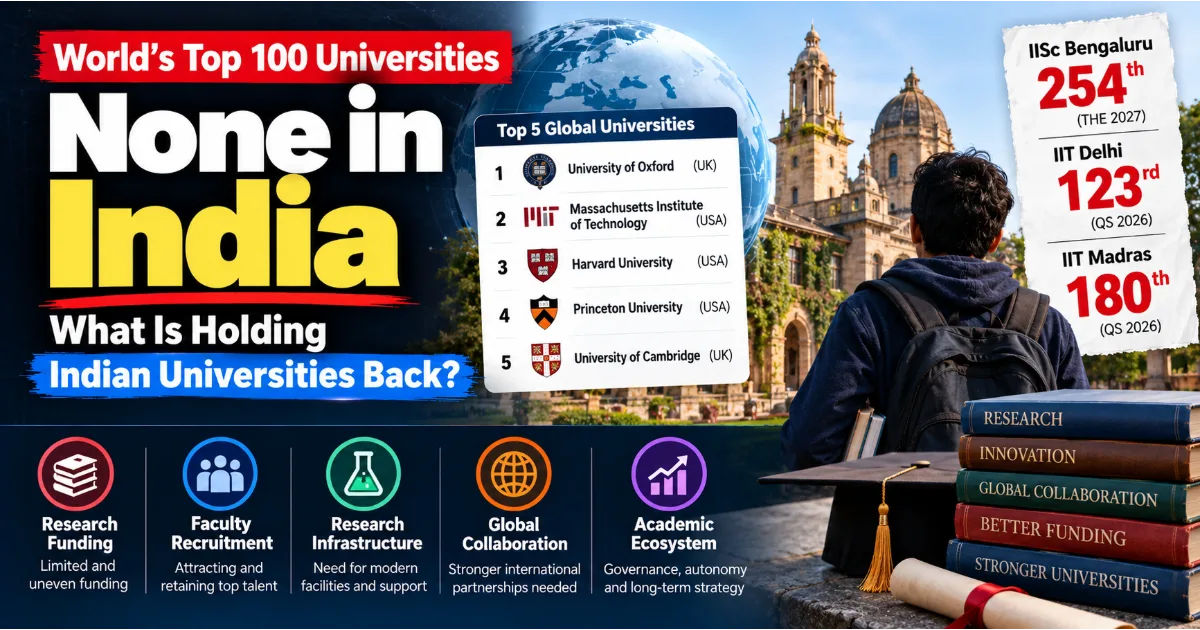
The issue returned to public attention following the release of recent international rankings. In the QS World University Rankings 2026, the Indian Institute of Technology Delhi ranked 123rd globally, while the Indian Institute of Technology Madras ranked 180th. In the Times Higher Education World University Rankings 2027, the Indian Institute of Science Bengaluru was reported at 254th. These results illustrate India's limited representation at the very top of major overall university rankings, although the exact positions differ because each ranking uses its own methodology and edition.
The headline that India has no university in the global top 100 can sound like a verdict on the entire Indian education system. It is not. International rankings are useful indicators of particular aspects of university performance, but they do not measure every dimension of teaching quality, graduate capability, affordability, public service or local impact. An institution can provide strong education in a particular field and still rank lower overall because of its research output, international reputation, citation measures or other indicators.
At the same time, the absence of an Indian institution among the top 100 in a given ranking is not something that should be dismissed simply because rankings have limitations. These lists influence how universities are perceived by international students, researchers, employers and funding organisations. They can affect institutional partnerships, academic recruitment and the visibility of research conducted in a country. A weak position at the top of global rankings therefore raises legitimate questions about research capacity, funding, academic freedom, international collaboration and the broader environment in which universities operate.
The central question is not whether Indian universities can produce talented students. Their graduates have demonstrated their capabilities in many countries and industries. The more difficult question is whether India's institutions have the resources, independence, infrastructure and academic conditions required to compete consistently with the world's leading research universities.
Answering that question requires looking beyond the headline. It means examining what global rankings actually measure, why some institutions perform better than others, what India's universities already do well and which structural changes could help them improve. It also requires recognising that a university system serving hundreds of millions of people has responsibilities that go far beyond achieving a particular position on an international table.
India's challenge is therefore twofold: to expand access to good higher education while building a stronger group of universities capable of competing at the highest levels of global research and scholarship.
What the Latest Rankings Actually Show
The first step in understanding the issue is to distinguish between the major ranking systems. QS World University Rankings and Times Higher Education World University Rankings are among the most widely discussed global university comparisons, but they do not use identical criteria. Their results cannot be treated as if they were measurements from a single common examination.
QS considers indicators such as academic reputation, employer reputation, research citations per faculty member, faculty-to-student ratio, international research networks, international student and faculty proportions, employment outcomes and sustainability. The weighting and design of these indicators shape how institutions are compared. A university with strong international visibility and employer reputation may perform differently from one that concentrates more heavily on a narrower research mission.
Times Higher Education uses a different framework, with indicators grouped around teaching, research environment, research quality, international outlook and industry. These categories are intended to assess different dimensions of institutional activity, including research influence, academic resources and links with the wider economy. The resulting scores can produce a different order from QS, even when the same institutions are assessed.
In the QS 2026 edition, IIT Delhi's position at 123rd put it relatively close to the top 100, while IIT Madras ranked 180th. The THE 2027 result placed IISc Bengaluru at 254th, according to the published coverage of that edition.
These figures should always be presented with their ranking system and edition. Saying simply that an institution is "ranked 123rd in the world" without naming the list can create confusion, especially when the same university has different positions across multiple systems. Rankings can also change from one year to the next because of changes in methodology, new data, revised institutional submissions and the performance of other universities.
There is another important distinction between an overall university ranking and a subject ranking. An institution may perform particularly well in engineering, computer science, medicine or a specialised research area without placing in the top 100 overall. Subject rankings focus on narrower fields, while overall rankings attempt to compare institutions across a broader range of activities.
For India, this distinction matters because some of its strongest institutions have highly specialised missions. IITs concentrate substantially on science, engineering and technology, while IISc has a major research focus. Their institutional strengths may not align perfectly with every indicator used in a broad international comparison.
Nevertheless, the overall rankings remain relevant because they provide one way to compare the international standing of universities across many countries. India's limited presence in the highest positions suggests that the country still has work to do in building institutions with sustained research influence, strong global academic networks and internationally competitive research environments.
The rankings do not explain every reason for that position. They provide a starting point for investigation, not a complete diagnosis of the Indian higher education system.
Why Research Strength Matters So Much
One of the most important differences between a university that mainly delivers education and a leading global research university is the scale and influence of its research. Teaching is central to every university, but institutions at the top of international rankings also tend to produce large volumes of influential research, attract experienced scholars, secure competitive grants and participate in international scientific networks.
Research can take years to produce results. A laboratory may need expensive equipment, specialised staff, reliable infrastructure and repeated experiments before a project generates a meaningful discovery. Researchers may work for years on fundamental questions without producing an immediate commercial product. Universities need stable financial support and an environment that allows such work to continue even when the results are uncertain.
Research quality is not simply a matter of publishing more papers. The influence of a paper depends on its contribution to knowledge, its methods, its relevance to other researchers and how it changes thinking or practice within a field. Rankings often use citation-related measures to assess research influence, although citations themselves have limitations and vary considerably across disciplines.
A university that produces many papers but receives relatively little international attention may not score as strongly as an institution whose work influences research across several fields. Conversely, a university that concentrates on a small number of specialised areas may produce important discoveries that are not fully reflected in its overall position.
India has a substantial scientific and technical community, but expanding research capacity across universities remains a challenge. Research activity can be concentrated in selected institutions, while many colleges primarily focus on teaching large student populations. This creates an uneven distribution of laboratories, research funding, experienced supervisors and opportunities for students to participate in original research.
The result is a system in which a relatively small number of institutions carry a large share of the responsibility for high-level research. For India to compete more effectively, research capacity needs to grow not only at the best-known institutes but also across a broader network of universities with the potential to develop specialised strengths.
That requires more than asking faculty members to publish additional papers. It requires well-equipped laboratories, access to academic journals and databases, technical support, predictable research grants and time for scholars to pursue serious projects. It also requires systems that reward careful, original work rather than encouraging researchers to maximise publication counts.
A university's research culture is built over many years. It depends on the quality of doctoral training, the availability of experienced supervisors, collaboration between departments and the freedom to pursue difficult questions. Institutions that invest consistently in these conditions are more likely to develop lasting research strengths than those that rely on short-term targets.
Funding: The Resources Behind Global Competition
Building a world-class research university is expensive. Universities need lecture halls and libraries, but leading research institutions also require specialised laboratories, high-performance computing, research hospitals, advanced instruments, well-maintained facilities and support staff. They must fund doctoral students, attract internationally respected faculty members and maintain research programmes that may take years to deliver results.
Funding also influences a university's ability to plan for the future. A research team cannot always produce meaningful work within the period covered by a short grant. Some projects require several years of experimentation, repeated trials or access to specialised equipment. Uncertainty about future funding can make it difficult to retain skilled researchers, maintain facilities and develop ambitious long-term programmes.
For universities in India, the challenge is not simply whether money is being spent on higher education. It is whether the amount, distribution and predictability of funding are sufficient for institutions to develop strong research environments. A system that serves a very large student population must divide resources between expanding access, maintaining educational quality, supporting research and improving infrastructure.
These responsibilities can compete with one another when budgets are limited. An institution facing overcrowded classrooms or a shortage of teaching staff must address those immediate needs. A research university, meanwhile, may require sustained investment in equipment, doctoral training and specialist recruitment. Both are important, but their financial requirements are not identical.
The solution is unlikely to be a single funding increase applied uniformly to every institution. Universities have different missions and levels of readiness. Some need better teaching infrastructure, while others may be prepared to expand advanced research if they receive the right support. Funding should be connected to institutional goals, demonstrated capability and credible plans for improvement.
Public investment is especially important for fundamental research, which may not generate immediate commercial returns. Private companies can contribute through research partnerships, sponsored laboratories and support for applied innovation, but they may focus on projects with clearer commercial value. Universities also need the freedom to investigate questions whose value becomes apparent only over time.
Funding must be accompanied by accountability. Universities should be able to demonstrate how grants are used, whether projects meet their objectives and what lessons emerge when research does not succeed. However, accountability should not become a system that discourages ambitious work because researchers fear that every unsuccessful experiment will be treated as a failure.
Internationally competitive research requires a balance between responsible spending and intellectual risk. Institutions need enough stability to build expertise, while funding bodies need transparent processes to ensure that resources are directed towards credible and worthwhile work.
Faculty Recruitment and the Challenge of Retaining Talent
A university's reputation depends substantially on the people who teach, supervise research and contribute to academic life. Talented faculty members help students understand difficult concepts, develop research skills and discover new directions for investigation. They also build collaborations, attract doctoral students and help create the intellectual environment that distinguishes a strong university from an ordinary teaching institution.
Recruiting and retaining such people is a complex task. Experienced researchers may compare salary and benefits, but they also consider access to research funding, the quality of laboratories, administrative burdens, academic independence, opportunities for collaboration and the availability of capable students. A competitive salary cannot compensate for every weakness in the working environment.
Indian universities compete not only with one another but also with institutions around the world. Researchers trained in India may receive offers from overseas universities that provide greater research support, access to established laboratories or more predictable funding. Some may choose to remain abroad, while others return to India or collaborate with Indian institutions from overseas. These decisions vary by individual, field and career stage.
It would be misleading to describe every researcher who works abroad as a loss to India. International mobility can strengthen academic networks, and researchers living overseas often collaborate with institutions in their home countries. The challenge is to ensure that Indian universities are attractive enough for talented people to build substantial research careers within India as well.
Recruitment is only the beginning. Universities must provide reasonable workloads, professional research support and transparent promotion processes. Faculty members who spend excessive time managing routine administration may have less time for teaching preparation, student supervision and original research. Institutions need efficient systems that allow academics to concentrate on the work for which they were hired.
Academic careers also require fair evaluation. If promotions depend too heavily on publication numbers, researchers may be encouraged to prioritise quantity over quality. A stronger system would assess the significance and reliability of research, the quality of teaching, the development of students and contributions to the wider academic community.
Doctoral students are an important part of this ecosystem. They conduct research, support laboratory work and contribute to new knowledge, but they also need adequate supervision, financial support and clear expectations. A university cannot develop a sustainable research culture if doctoral students are treated merely as inexpensive labour or are left without the resources needed to complete their work.
Building a strong faculty takes time. It involves developing young researchers, attracting experienced scholars and creating conditions that encourage people to remain. If India wants more universities to enter the highest levels of international rankings, faculty recruitment and retention must be treated as long-term priorities rather than occasional hiring exercises.
International Collaboration and the Global Academic Network
Leading universities rarely operate in isolation. Their researchers collaborate with colleagues in other countries, share data and methods, participate in international conferences and contribute to projects that require expertise from multiple institutions. These networks can improve the quality of research and help universities attract talented students and scholars.
International collaboration is particularly important for complex fields such as climate science, biotechnology, artificial intelligence, public health, materials science and astronomy. Research in these areas may require specialised equipment, large datasets or expertise that no single university can provide independently. Collaboration allows researchers to combine resources and investigate questions that would otherwise be difficult to address.
International research connections can also help early-career scholars. Working with experienced researchers abroad can expose them to new methods, improve their understanding of international standards and create opportunities for joint publications. These relationships can develop into long-term partnerships that benefit both institutions.
However, collaboration is not simply a matter of signing agreements with overseas universities. A memorandum of understanding does not automatically produce joint research, student exchanges or meaningful academic engagement. Successful partnerships require common research interests, funding, time, institutional support and clear arrangements for sharing responsibilities and results.
Indian universities can strengthen these connections by supporting joint doctoral programmes, visiting research positions, collaborative laboratories and international research projects. They can also make it easier for overseas researchers to spend time in India by improving administrative procedures, providing appropriate facilities and ensuring that visiting scholars have access to the resources they need.
International students are another part of this picture. A university that attracts students from different countries can create a more diverse academic environment and build relationships that continue after graduation. But students need good teaching, accommodation, safety, administrative support and confidence that their qualifications will be respected.
India has the potential to attract more international students, particularly from countries seeking affordable education and strong programmes in technology, medicine, science and management. Realising that potential requires consistent quality, clear admissions procedures and effective student support. Institutions must compete on the strength of their academic experience, not only on the cost of tuition.
Internationalisation should not mean copying every practice followed by universities in the United States, Britain or other countries. Indian institutions can develop their own strengths and contribute distinctive perspectives to global research. The objective is to become more connected to the international academic community while building institutions that respond to India's own educational and research priorities.
Teaching Quality, Class Sizes and the Student Experience
Global rankings often attract attention because of research output and international reputation, but teaching remains the foundation of higher education. Universities are responsible for helping students develop knowledge, critical thinking, communication skills and the ability to solve unfamiliar problems. These outcomes matter regardless of where an institution appears in an international league table.
A strong teaching environment requires qualified faculty members, updated course material, effective assessment and access to academic support. Students need opportunities to ask questions, receive feedback and participate in discussions. Practical fields require laboratories, workshops, clinical placements or other forms of hands-on learning.
Large classes can make these tasks more difficult. When an institution has to serve many students with limited faculty resources, instructors may struggle to provide individual attention. Administrative workloads can also reduce the time available for mentoring and curriculum development. These challenges are not unique to India, but they become especially important in a system that must expand access on a very large scale.
Universities also need to ensure that students learn how to apply knowledge rather than simply reproduce information during examinations. Employers increasingly value the ability to analyse problems, work in teams, communicate clearly and adapt to changing technologies. Students benefit when courses combine theoretical foundations with practical assignments, research projects and exposure to real-world problems.
The quality of teaching is not always captured fully by global rankings. An institution may deliver excellent undergraduate education to students from disadvantaged backgrounds while having a smaller international research profile than a large research university. Another institution may produce highly influential research but provide a less consistent student experience across its departments.
This is one reason why rankings should not be the sole measure of educational quality. India needs institutions with different strengths, including universities focused on teaching, research-intensive institutions, professional colleges and centres specialising in particular fields. The objective should be to ensure that each institution delivers on its mission and provides students with a high-quality education.
At the same time, strong teaching and strong research can reinforce one another. Students who participate in meaningful research gain experience in investigating questions, interpreting evidence and learning from uncertainty. Faculty members engaged in current research can bring new knowledge into the classroom. Universities that connect teaching and research effectively can create richer learning environments.
Improving teaching therefore should not be viewed as a separate task from improving research. Both require capable faculty members, appropriate resources, thoughtful institutional leadership and a culture that values learning rather than treating education as a process of obtaining credentials.
Does India's Higher Education System Need More Elite Universities or Better Universities Everywhere?
One of the biggest policy questions is whether India should concentrate resources on a small number of institutions capable of competing globally or distribute investment more widely across the higher education system. The debate is sometimes presented as a choice between excellence and access, but the two objectives do not have to be mutually exclusive.
India needs institutions that can compete at the highest levels of research. Such universities can attract international scholars, develop advanced laboratories, train doctoral researchers and contribute to discoveries with global significance. They can also support innovation by working with industries and public institutions.
However, a small group of elite universities cannot meet the educational needs of an entire country. Millions of students attend institutions beyond the best-known national institutes. If teaching quality, infrastructure and faculty availability remain weak across large parts of the system, the benefits of investment in elite universities will reach only a limited proportion of students.
The challenge is to create a system with different but complementary roles. Some institutions may focus on fundamental research and doctoral education. Others may specialise in professional training, regional development, undergraduate teaching or applied research linked to local industries. Stronger connections between these institutions can help distribute expertise and create pathways for students and researchers.
Regional universities can play an important role in addressing local challenges. An institution located in an agricultural region may develop expertise in water management, crop science and rural enterprise. A university near a manufacturing cluster may focus on materials, automation or industrial engineering. Institutions serving urban populations may develop strengths in public health, transport, housing or environmental research.
These contributions may not always translate into a top position in an overall global ranking, but they can deliver substantial public value. A well-designed higher education strategy should recognise such contributions while continuing to improve international research performance.
The policy challenge is therefore not simply to select a few universities and give them resources. It is to build a stronger ecosystem in which high-performing institutions receive support to advance further, developing universities receive the resources needed to improve and students across the country have access to reliable education.
A system with a small number of excellent institutions and a weak broader foundation will struggle to fulfil its full potential. A system that combines access, quality, specialisation and research excellence has a better chance of serving both national needs and international ambitions.
Industry, Innovation and the Commercialisation of Research
Universities can also strengthen their research capabilities by developing productive relationships with industry. Businesses need new technologies, skilled graduates and solutions to practical problems. Universities need access to research funding, real-world challenges and opportunities to test whether their discoveries can be applied outside academic settings.
When these relationships work well, the benefits can extend beyond individual companies. Research partnerships can support the development of new materials, medical technologies, software, agricultural methods and manufacturing processes. Students can gain practical experience, while researchers can learn more about the problems faced by businesses and public institutions.
India has a large industrial and technology sector that could support stronger university partnerships. Yet effective collaboration requires trust, clear intellectual property arrangements, appropriate incentives and a shared understanding of research objectives. Businesses may prioritise short-term commercial results, while universities may need longer periods to investigate fundamental questions. Both sides need arrangements that respect these different requirements.
Universities also need support for translating discoveries into useful products and services. Researchers may identify a promising technology but lack the funding, business expertise or infrastructure required to develop it further. Technology transfer offices, incubation centres, startup programmes and industry partnerships can help bridge that gap.
However, commercialisation should not become the sole purpose of academic research. Universities also investigate history, literature, philosophy, mathematics, social sciences and fundamental scientific questions whose value cannot always be measured through immediate commercial returns. A balanced research system supports both practical innovation and the pursuit of knowledge.
Industry collaboration can improve a university's resources and relevance, but it cannot replace stable public investment or academic independence. Companies should not be the only source of support for research, particularly when projects address public health, environmental protection or other issues where commercial incentives may be limited.
The objective should be a research ecosystem in which universities, businesses and public institutions contribute according to their strengths. Stronger collaboration can help India turn more of its scientific knowledge into practical outcomes while improving the visibility and influence of its research institutions.
What Should Change if India Wants to Enter the Global Top 100?
There is no single reform that will move Indian universities into the top 100. Improving international standing requires sustained progress across several areas, including research quality, faculty development, infrastructure, international collaboration and institutional governance.
First, research funding needs to be more predictable and strategically directed. Researchers require enough time and resources to complete ambitious projects, train students and build specialist teams. Funding agencies should use transparent evaluation procedures and recognise high-quality work without encouraging publication for its own sake.
Second, universities need greater capacity to recruit and retain talented faculty members. This includes competitive working conditions, access to research facilities, manageable administrative workloads and clear promotion criteria. Academic institutions should be able to attract researchers from India and abroad while giving early-career academics credible opportunities to build long-term careers.
Third, doctoral education needs continued attention. Strong doctoral programmes depend on qualified supervisors, adequate financial support, good research facilities and clear expectations. Students should have opportunities to participate in meaningful research and develop skills that prepare them for careers in universities, industry and public institutions.
Fourth, international partnerships should produce substantive academic work. Joint research, collaborative laboratories, visiting positions and student exchanges can help universities become more connected to global scholarship. Partnerships should be judged by their results rather than the number of agreements signed.
Fifth, universities need governance systems that support effective decision-making. Transparent appointments, fair evaluation, responsible financial management and stable leadership can help institutions plan over longer periods. Academic communities also need an environment in which researchers can investigate difficult questions, challenge established ideas and publish evidence-based conclusions.
Finally, progress should be measured through more than rankings. Universities should monitor research quality, graduate outcomes, teaching standards, student access, faculty development and the practical contributions they make to society. International rankings can provide one set of indicators, but national policy should also account for India's economic, social and educational needs.
These changes require patience. Universities do not build internationally recognised research cultures in a single year, and their performance cannot be transformed simply by changing targets. Sustained investment, institutional learning and consistent implementation are essential.
Conclusion: India's Challenge Is Bigger Than a Ranking
The absence of an Indian university in the global top 100 of major overall rankings is an important issue, but it should be understood in context. In the QS World University Rankings 2026, IIT Delhi ranked 123rd and IIT Madras ranked 180th. In the Times Higher Education World University Rankings 2027, IISc Bengaluru was reported at 254th. The positions differ because the ranking systems use different methods and editions.
These results highlight the distance between India's substantial higher education system and the performance of the institutions that dominate global rankings. They raise important questions about research funding, faculty recruitment, infrastructure, international collaboration and the conditions needed for academic excellence.
But they do not prove that Indian universities lack talented students, capable researchers or valuable academic programmes. Nor do they mean that every university outside the global top 100 provides a poor education. Rankings capture selected dimensions of performance and cannot represent every contribution an institution makes.
India's real challenge is to strengthen the entire higher education ecosystem. It needs world-class research institutions, but it also needs good teaching colleges, accessible universities, strong doctoral programmes and institutions that respond effectively to regional and national needs. Research excellence and broad access should be treated as complementary goals.
The country also needs to move beyond measuring success primarily through the achievements of individual graduates. The accomplishments of Indian professionals overseas demonstrate the value of the country's talent, but a stronger domestic university system should be able to develop that talent, support advanced research and create more opportunities for discovery within India itself.
Achieving that objective will require more than announcements or short-term ranking campaigns. It will require consistent investment, effective governance, academic independence, better research infrastructure and a commitment to evaluating educational quality honestly.
The goal should not be to enter the top 100 for the sake of the number alone. It should be to build universities that produce influential research, educate students well, attract talented scholars and contribute meaningfully to society. If those foundations become stronger, improved international rankings are more likely to follow.
India does not lack the potential to build globally respected universities. The challenge is to create the conditions in which that potential can become sustained institutional excellence.
#BeyondHeadlines #IndianEducation #UniversityRankings #HigherEducation #QSWorldUniversityRankings #TimesHigherEducation #IIScBengaluru #IITDelhi #IITMadras #ResearchAndDevelopment #EducationPolicy #IndianUniversities #GlobalEducation #AcademicResearch #HigherEducationReform #BeyondTheHeadline