
The Rise of Ying Zheng, the Conquest of the Rival Kingdoms, and the Birth of China's First Empire in 221 BCE
Introduction: The Man Who Ended Centuries of Division
In 221 BCE, the political history of China entered a new era. After centuries of conflict among rival kingdoms, the ruler of Qin conquered the remaining independent states and established the first unified Chinese empire. He was known as Ying Zheng before unification and later adopted the title Qin Shi Huang, meaning the First Emperor of Qin. His achievement ended the long struggle of the Warring States period and established a model of centralized imperial government that would influence Chinese civilization for more than two thousand years.
The unification of China was not an accidental event, nor was it the achievement of one man working alone. It resulted from generations of political reform, agricultural development, military expansion, diplomatic manoeuvring, and competition among the major states. Qin had gradually transformed itself into a powerful military and administrative state. Its rulers developed systems capable of collecting resources, organizing armies, rewarding service, and maintaining campaigns over long periods. By the time Ying Zheng came to the throne, Qin possessed many of the advantages required to defeat its rivals.
Nevertheless, unification was far from inevitable. The other kingdoms remained powerful, and some possessed large territories, experienced armies, and substantial resources. Qin had to overcome military resistance, exploit divisions among its enemies, and maintain its own political stability while conducting campaigns across a vast region. Its victories were the result of sustained preparation and strategic decisions rather than a single decisive battle.
The conquest of the rival kingdoms transformed the meaning of political authority in China. Earlier Zhou kings had claimed a superior position within a network of regional rulers, but their practical power had gradually weakened. By contrast, Qin Shi Huang sought to eliminate the possibility of rival kings ruling independent territories. He established a new imperial title, reorganized conquered lands, and attempted to ensure that authority flowed from the central government rather than from hereditary regional powers.
The result was a remarkable political achievement accompanied by considerable human suffering. Military campaigns caused deaths and displacement, while the new government imposed demanding systems of taxation, labour, and administration. The same centralized institutions that made unification possible also created pressures that would contribute to the dynasty's eventual collapse.
To understand how Qin Shi Huang unified China, it is necessary to examine the world he inherited, the transformation of Qin into a dominant state, the rival kingdoms he confronted, the military campaigns that brought them down, and the political vision that emerged after victory. His story is not only about conquest. It is about how a fragmented political world was transformed into an empire.
1. China Before Unification: The Legacy of the Warring States
For centuries, ancient China had been shaped by the political traditions of the Zhou dynasty. The Zhou rulers established their authority after defeating the Shang dynasty, traditionally dated to approximately 1046 BCE. They justified their rule through the Mandate of Heaven, the belief that legitimate authority depended upon the ruler's ability to govern responsibly and maintain political and social order.
The early Zhou political system relied heavily on relationships between the royal family, aristocratic lineages, and regional rulers. Land and authority were distributed among nobles who governed territories on behalf of the royal house. These regional lords were expected to maintain loyalty, provide military support, and participate in the rituals that reinforced the political order.
Over time, however, the regional rulers became increasingly independent. They developed their own armies, accumulated wealth, and established political institutions that did not depend entirely upon the Zhou court. The royal house lost its ability to enforce its authority, and powerful states began competing for territory and influence.
The Eastern Zhou period, which began after the royal court moved east in 770 BCE, witnessed growing political fragmentation. During the Spring and Autumn period, powerful states competed for leadership while continuing to recognize the Zhou king as a symbolic source of legitimacy. By the Warring States period, conventionally dated from 475 to 221 BCE, the struggle had become far more intense.
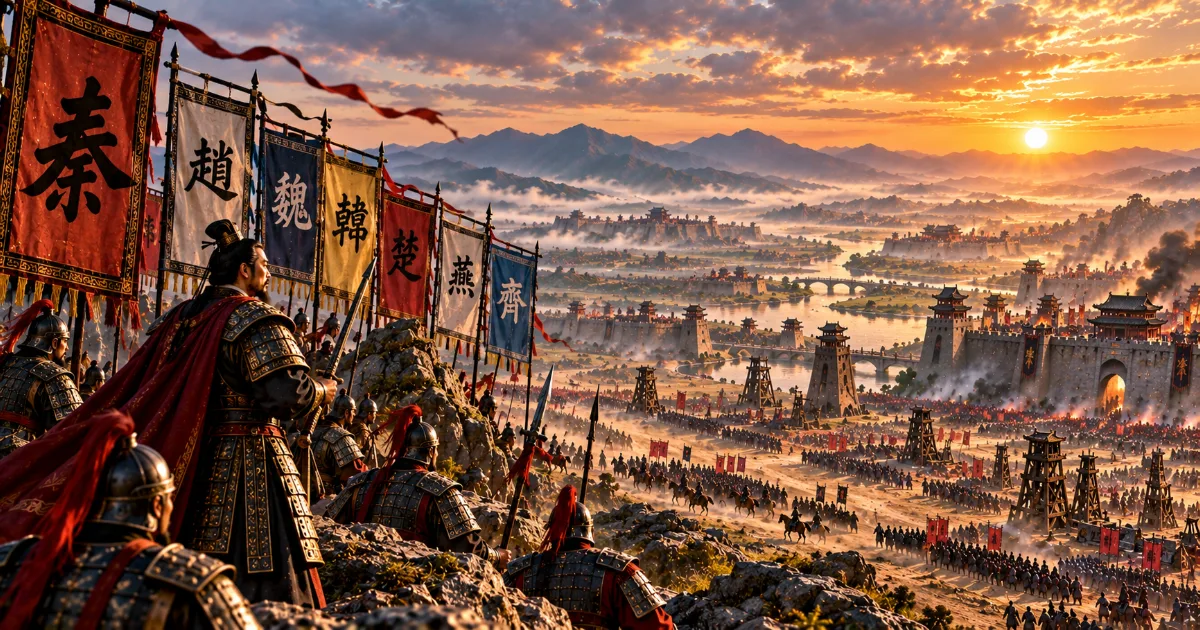
The major states, including Qin, Chu, Qi, Yan, Han, Zhao, and Wei, developed increasingly sophisticated military and administrative systems. They competed for farmland, population, strategic routes, and access to resources. Their rulers introduced reforms to increase agricultural production, recruit soldiers, collect taxes, and weaken aristocratic families that might challenge royal authority.
The consequences were profound. Warfare expanded in scale, infantry armies became more important, and governments developed new methods of organizing populations. States were no longer relying solely on traditional aristocratic relationships. They were building more centralized systems capable of mobilizing society for military competition.
The intellectual world changed as well. Confucian, Daoist, Mohist, and Legalist thinkers debated how political disorder could be overcome. Some emphasized moral leadership and education, while others argued for strict laws, administrative discipline, or a reduction in excessive government intervention.
By the third century BCE, the old Zhou order had effectively disappeared. The question was no longer whether the Zhou king could restore his authority. The question was which of the competing states would defeat the others and establish a new political order.
Qin eventually answered that question. Its success emerged from the long transformation of the Warring States period, during which military competition rewarded governments that could organize resources, implement reforms, and maintain strategic discipline.
2. The Rise of Qin: From Western Kingdom to Dominant Power
The state of Qin occupied a strategically important position in western China. Its political centre lay in the Wei River valley, an agricultural region surrounded by mountains and other natural barriers. These geographical features provided defensive advantages and helped Qin maintain a relatively secure base from which it could expand.
Qin had once been regarded by some eastern states as a peripheral power, but its position changed substantially during the Warring States period. Its rulers invested in agriculture, military organization, territorial expansion, and administrative reform. The state became increasingly capable of mobilizing its population and using resources efficiently.
One of the most important figures in Qin's transformation was Shang Yang, a reformer who served Duke Xiao during the fourth century BCE. His reforms are associated with the development of centralized administration, household registration, legal discipline, agricultural incentives, and military rewards based on service.
The reforms weakened the independent position of powerful hereditary aristocrats and strengthened the ruler's ability to direct state policy. They also connected military advancement more closely with demonstrated achievement. Soldiers could receive recognition and rewards for service, giving them incentives to participate in campaigns.
Agriculture was central to this system. A powerful army required food, equipment, transport, and a steady supply of recruits. Qin's government therefore encouraged cultivation and developed methods for collecting agricultural output. The expansion of productive land and improvements in water management strengthened the state's economic foundation.
Qin's geographical position also mattered. The state could defend its western base while gradually expanding toward the central plains. Its rulers could choose campaigns carefully and exploit weaknesses among neighbouring kingdoms. Once Qin had secured strategically valuable territory, it could use that territory to support further expansion.
These advantages did not eliminate political challenges. Reformers could face opposition, military campaigns could fail, and powerful rivals could coordinate against Qin. Yet the state developed institutions that made sustained expansion increasingly possible.
By the time Ying Zheng became king in 246 BCE, Qin had already established itself as one of the most formidable states in China. Its military and administrative capabilities had been built over generations. The young king inherited a state prepared for expansion, although he still needed to overcome powerful rivals and establish his own authority.
3. Ying Zheng: The Future First Emperor
Ying Zheng was born in 259 BCE, during the Warring States period. His early life unfolded in a world of diplomatic competition, political intrigue, and military rivalry. His father was associated with the royal house of Qin, while his family connections linked him to the complex political relationships among the competing states.
Traditional accounts describe Ying Zheng's childhood as politically uncertain. He spent part of his early life in the state of Zhao, where his family had connections during a period of tension between Qin and Zhao. Later narratives present these circumstances as dangerous and formative, although individual stories about his early experiences must be considered in light of the limitations of ancient historical evidence.
Ying Zheng became king of Qin in 246 BCE, when he was still a child. Because of his age, experienced officials and advisers initially exercised considerable influence in government. Among the important figures associated with the early years of his reign was Lü Buwei, a powerful statesman who played a major role in Qin politics.
The young king's accession did not immediately make him the unquestioned master of the state. Court factions, powerful officials, and political networks could all influence decisions. The challenge was to consolidate royal authority while preserving the administrative and military strength that had made Qin powerful.
As Ying Zheng grew older, he increasingly took control of government. By the early 230s BCE, Qin had entered the final phase of its expansion against the rival kingdoms. The ruler's personal authority became closely associated with the campaign to unify China.
It is important, however, not to attribute every achievement of Qin solely to Ying Zheng. The state's rise had begun long before his reign. Its military institutions, agricultural foundation, administrative practices, and strategic position were products of earlier generations. The king's achievement lay in using these advantages to complete the conquest of the remaining states and then attempting to reorganize the conquered territories under a new imperial system.
Ying Zheng's personality and ambitions became central to later accounts of his reign. He was remembered as determined, authoritative, and willing to impose far-reaching changes. Yet the historical record was shaped by later writers, including historians who examined the Qin dynasty after its collapse. A careful understanding must therefore distinguish between documented political developments and stories influenced by later judgments about the First Emperor.
What is clear is that Ying Zheng presided over one of the most consequential transformations in Chinese history. Under his leadership, Qin moved from being the strongest of several rival kingdoms to becoming the centre of a unified empire.
4. The Rival Kingdoms: Seven States Competing for Survival
Before Qin could unify China, it had to overcome the remaining major states. Each kingdom had its own geographical advantages, political traditions, and military capabilities. Their strengths and weaknesses shaped the sequence of Qin's campaigns.
Han occupied a strategically important area in central China. Its position placed it near major routes and made it vulnerable to pressure from stronger neighbours. Although Han could not match Qin's overall resources, its territory mattered because it stood between Qin and other regions that Qin hoped to control.
Zhao was one of Qin's most serious military rivals. It occupied northern territories and had developed strong military traditions. Its forces had experience in fighting both rival Chinese states and peoples along the northern frontier. The defeat of Zhao at the Battle of Changping in 260 BCE had already weakened its military position, although Zhao continued to resist Qin for decades afterward.
Wei had once been a major power during the earlier Warring States period. Its central position provided access to important agricultural and commercial regions, but it also exposed the state to pressure from multiple directions. Its changing fortunes demonstrated how quickly a kingdom could lose its advantage when stronger rivals expanded.
Chu controlled extensive territories in the south. Its large geographical area, fertile regions, and access to river systems gave it considerable resources. However, its size also created administrative challenges, and its military strength could not be measured simply by the area it controlled.
Yan occupied the northeast. It had its own strategic interests and faced pressures associated with its northern position. Its rulers sometimes sought alliances to counter Qin, but its ability to resist Qin's growing power was limited.
Qi controlled eastern territories around the Shandong region and possessed productive agricultural and commercial centres. It had benefited from a long history of political influence and intellectual activity. However, its relative distance from some earlier campaigns did not guarantee safety once Qin began eliminating the remaining states.
Finally, Qin itself had transformed into the most capable military and administrative power. Its western position, productive agricultural base, and centralized institutions gave it advantages in sustaining long campaigns.
These states were not simply isolated enemies. Their relationships changed through treaties, alliances, rivalries, and negotiations. Some rulers attempted to coordinate resistance against Qin, while others pursued short-term agreements to protect their own territories. Such shifting relationships made diplomacy a major part of the struggle.
Qin's strategy benefited from the fact that its rivals did not always act collectively. A coordinated alliance might have made Qin's expansion more difficult, but mistrust and competing interests repeatedly weakened attempts at joint resistance.
The conquest of China was therefore both a military process and a diplomatic contest. Qin needed to defeat enemy armies, but it also needed to prevent the remaining states from combining their strength at the most dangerous moment.
5. Qin's Strategy: Conquer One State at a Time
Qin's eventual victory depended upon sustained preparation and the ability to take advantage of changing circumstances. Its rulers did not simply launch one enormous campaign against all their enemies simultaneously. Instead, Qin gradually reduced the number of independent states through a sequence of military operations, diplomatic initiatives, and territorial advances.
The principle of defeating opponents one by one was especially important. If several rival kingdoms could combine their armies and resources, Qin might face a much more difficult struggle. By encouraging divisions among its enemies, negotiating with some while attacking others, and exploiting local weaknesses, Qin reduced the risk of confronting every rival at once.
The state also benefited from careful attention to logistics. Armies operating across large distances needed food, weapons, equipment, transport, and communication. Military campaigns depended upon the administrative capacity to organize supplies and maintain forces over time. Qin's increasingly centralized institutions supported these requirements.
Commanders also had to adapt to the geography and military traditions of different states. A campaign in the central plains did not present exactly the same challenges as an operation in the extensive territories of Chu. Fortified cities, river crossings, mountain routes, and supply lines could determine whether an army advanced quickly or became trapped in a prolonged struggle.
Qin's rulers and advisers used military force alongside political pressure. A state facing imminent defeat might surrender territory, lose its ruler's independence, or become vulnerable to internal divisions. These outcomes could make conquest easier than a prolonged war of attrition.
Nevertheless, Qin's progress was not always smooth. The rival kingdoms resisted, and some campaigns required considerable effort. The conquest of a large territory did not automatically mean that every part of it was immediately secure. Armies had to occupy important locations, suppress resistance, and establish the administrative arrangements needed to maintain control.
The strategy succeeded because Qin combined military strength with the ability to exploit the political fragmentation of its opponents. Each victory reduced the number of independent powers that could challenge Qin, while additional territory and resources strengthened the state for the next campaign.
The gradual nature of this process is important. The unification of China was not a single moment of conquest but the conclusion of a long sequence of struggles. By 221 BCE, Qin had eliminated the remaining independent kingdoms and established a new imperial order.
6. The Conquest of Han in 230 BCE
Han was the first of the major states to fall during Qin's final unification campaign. Its position made it strategically important because it occupied territory between Qin and other kingdoms in central China. Removing Han would give Qin greater freedom of movement and reduce the possibility that its rivals could use Han territory as a defensive barrier.
By the late third century BCE, Han was under severe pressure. Its resources were limited compared with those of Qin, and its position exposed it to the expansion of a powerful neighbour. Diplomatic efforts and military preparations could delay defeat, but they could not easily overcome the widening imbalance between the two states.
In 230 BCE, Qin conquered Han. The fall of the kingdom marked the beginning of the final sequence of victories that would culminate in unification. Qin incorporated Han territory into its expanding system of administration, increasing its strategic reach and weakening the remaining states.
The conquest was significant beyond its immediate territorial result. It demonstrated that Qin had moved from preparing for unification to carrying it out. Other rulers could no longer assume that the competition would continue indefinitely without one state achieving decisive superiority.
Han's defeat also illustrates how geography influenced the order of conquest. Controlling central routes and strategically positioned territories could make later campaigns easier. Each conquered state could provide access, supplies, and staging areas for operations against the next rival.
For the people of Han, the transition meant the end of independent rule. Local political institutions were brought under Qin authority, and the population became subject to the administrative and military requirements of the expanding state. The long-term effects of conquest varied among communities, but the general direction was toward greater central control.
The fall of Han therefore marked the opening of a decisive phase in Chinese history. Qin had demonstrated that the old system of competing kingdoms was approaching its end, and the remaining rulers faced the growing possibility that their own states would soon disappear.
7. The Fall of Zhao: A Former Rival Finally Defeated
Zhao had long been one of Qin's most important rivals. Its military reputation had been strengthened by its ability to defend northern territories and adapt to the challenges of frontier warfare. However, the catastrophic defeat at Changping in 260 BCE had weakened Zhao's military capacity and damaged its ability to resist Qin's continued expansion.
The Battle of Changping remains one of the most famous conflicts of the Warring States period. It involved a prolonged struggle between Qin and Zhao, ending in a decisive Qin victory. Ancient sources describe enormous losses among Zhao's forces, although the exact casualty figures are uncertain and should not be accepted uncritically.
Despite this defeat, Zhao did not disappear immediately. It continued to function as an independent state and remained a significant obstacle to Qin's plans. Its rulers and commanders attempted to preserve their territory, rebuild their strength, and respond to the changing military balance.
In 228 BCE, Qin captured the Zhao capital, Handan, bringing the kingdom's independent political existence to an end in the main course of the unification campaign. Resistance and military operations continued in parts of the former Zhao territory, illustrating that the capture of a capital did not automatically settle every question of control.
The defeat of Zhao had strategic consequences for the remaining states. Qin had removed another major opponent and strengthened its position in northern and central China. The loss also demonstrated the limitations of military reputation when a rival possessed superior resources and could sustain repeated campaigns.
Zhao's fall was particularly important because it reduced the number of states capable of organizing large-scale resistance. Qin's victory did not mean that the remaining kingdoms were powerless, but it made the possibility of coordinated opposition increasingly difficult.
The conquest also reflected the long-term effects of the Warring States system. Zhao had once been a formidable competitor, but years of warfare had consumed resources and exposed it to repeated military pressure. Qin's expanding administrative and military capacity allowed it to exploit those weaknesses.
The defeat of Zhao brought Qin closer to unification and confirmed that the balance of power had shifted decisively in its favour.
8. The Yan Assassination Plot and the Limits of Resistance
Yan was one of the northeastern kingdoms that sought to resist Qin's growing power. By the late third century BCE, the fall of Han and Zhao had made Qin's intentions increasingly clear. Yan's leaders understood that the kingdom might soon face a direct campaign, and they explored ways to prevent or delay the advance.
One of the most famous stories associated with this struggle concerns an attempted assassination of Ying Zheng. According to the traditional account, a man named Jing Ke was selected to carry out the mission. He travelled to the Qin court under the appearance of a diplomatic envoy, carrying a map and other items intended to provide access to the ruler.
The plan failed. Jing Ke attempted to attack Ying Zheng but did not kill him. The episode became one of the most dramatic stories in Chinese historical literature, celebrated for its themes of loyalty, courage, desperation, and political sacrifice.
However, the assassination attempt did not stop Qin's expansion. Instead, the conflict intensified, and Qin launched further military operations against Yan. In 226 BCE, Qin captured the Yan capital, forcing the kingdom into a severe crisis. Yan's political leadership continued to struggle, but the state could no longer prevent Qin from advancing.
The story of Jing Ke has remained influential because it captures the desperation of a weaker kingdom facing a much stronger rival. When conventional military resistance appeared unlikely to succeed, Yan's leaders turned to an extraordinary plan. Its failure demonstrated the limits of individual action against a powerful state with substantial military resources.
The episode should also be understood in its historical context. Ancient narratives often emphasized dramatic personal encounters, sometimes shaping events into moral stories about loyalty and courage. The precise details of the assassination attempt have been transmitted through historical accounts written after the events, so historians must consider both their factual content and their literary significance.
For Qin, the defeat of Yan removed another obstacle to unification. For later generations, the story of Jing Ke became a reminder that political resistance could persist even when the prospect of victory seemed remote.
9. The Fall of Wei in 225 BCE
Wei had been an influential state during the earlier Warring States period. Its central position provided access to important agricultural lands and strategic routes, but that same location exposed it to pressure from powerful neighbours. As Qin expanded, Wei's position became increasingly difficult to defend.
In 225 BCE, Qin launched a campaign that brought about the fall of Wei. Ancient accounts associate the conquest with the use of water to overwhelm the fortified capital, Daliang. The story describes Qin forces diverting river water against the city's defences, causing extensive damage and forcing its surrender.
The details of ancient siege accounts should be interpreted carefully, but the episode illustrates the importance of engineering and logistical planning in Warring States warfare. Armies did not rely only on direct assaults. They used methods intended to weaken fortifications, disrupt supplies, and force defenders to surrender without requiring a conventional battle at every stage.
The conquest of Wei further reduced the number of independent kingdoms capable of challenging Qin. Its territory provided additional strategic advantages and helped strengthen Qin's position for the campaigns that remained.
Wei's fall also demonstrates how a state's earlier achievements could not guarantee its survival. A kingdom might once have been powerful, wealthy, and politically influential, yet become vulnerable when a rival developed superior military and administrative systems.
By 225 BCE, Qin had eliminated several major rivals in rapid succession. Han had fallen, Zhao's independence had ended, Yan had suffered a major defeat, and Wei had been conquered. The remaining states still possessed considerable resources, especially Chu, but the political balance had changed dramatically.
The final phase of unification was now approaching. Qin's armies would soon confront the largest remaining rival, and the outcome would determine whether the First Emperor's ambition could become a political reality.
10. The Conquest of Chu: Qin Faces Its Greatest Challenge
Chu was one of the largest and most powerful states in ancient China. Its territories extended across broad regions of southern China, including fertile agricultural areas and important river systems. Its population and geographical scale gave it substantial resources, making it a formidable opponent even as Qin defeated other kingdoms.
The conquest of Chu was therefore one of the most challenging campaigns in the unification process. Its territory was extensive, and its military forces could draw upon a large population and varied regional resources. Defeating Chu required more than a rapid advance into a small neighbouring state.
Traditional accounts describe disagreement among Qin commanders about the scale of force required. One famous narrative contrasts the cautious recommendation of Wang Jian, who argued that a very large army was necessary, with a more optimistic assessment associated with another commander. The story has become part of the historical tradition surrounding the campaign, although the exact conversations cannot be independently verified.
The central point is that Chu demanded serious military preparation. Its territory was too extensive to be conquered reliably through an under-resourced operation. Qin needed enough soldiers, supplies, and strategic patience to sustain a difficult campaign.
Qin's forces eventually defeated Chu in 223 BCE. The conquest removed one of the most substantial remaining obstacles to unification and expanded Qin's control across important southern territories.
The victory was particularly significant because it demonstrated that Qin's military system could overcome not only smaller or weakened kingdoms but also a large rival with considerable geographical and demographic advantages.
The conquest of Chu also highlights the role of commanders within the Qin system. Military leaders needed to make decisions about troop numbers, supply arrangements, timing, and the balance between caution and aggression. Even a strong state could fail if its commanders underestimated the challenges of a campaign.
Chu's defeat transformed the strategic situation. With the largest remaining rival eliminated, the path toward the final conquest became much clearer. Only Qi remained as a major independent kingdom in the final sequence of unification.
11. The Fall of Qi and the Unification of 221 BCE
Qi occupied the eastern part of the Chinese world and had a long history of political and cultural importance. Its productive lands, commercial activity, and intellectual traditions had made it a significant state during earlier phases of the Warring States period.
Unlike some of the other kingdoms, Qi had not experienced the same level of direct military destruction during the earlier stages of Qin's final campaigns. Its rulers had sometimes pursued diplomatic strategies intended to preserve the state's position while avoiding immediate confrontation.
However, the collapse of the other kingdoms left Qi increasingly isolated. With Han, Zhao, Yan, Wei, and Chu defeated, Qi faced a Qin state that controlled extensive territory and possessed the military resources needed to continue its advance.
In 221 BCE, Qin conquered Qi. The defeat ended the existence of the last major independent kingdom in the unification struggle. Ying Zheng had now brought the principal rival states under Qin control.
The significance of the achievement was enormous. For centuries, the Chinese political world had been divided among competing rulers. The Zhou kings had once claimed a superior position, but their authority had weakened and the regional states had become independent powers. Qin's victory replaced that system with a single imperial government.
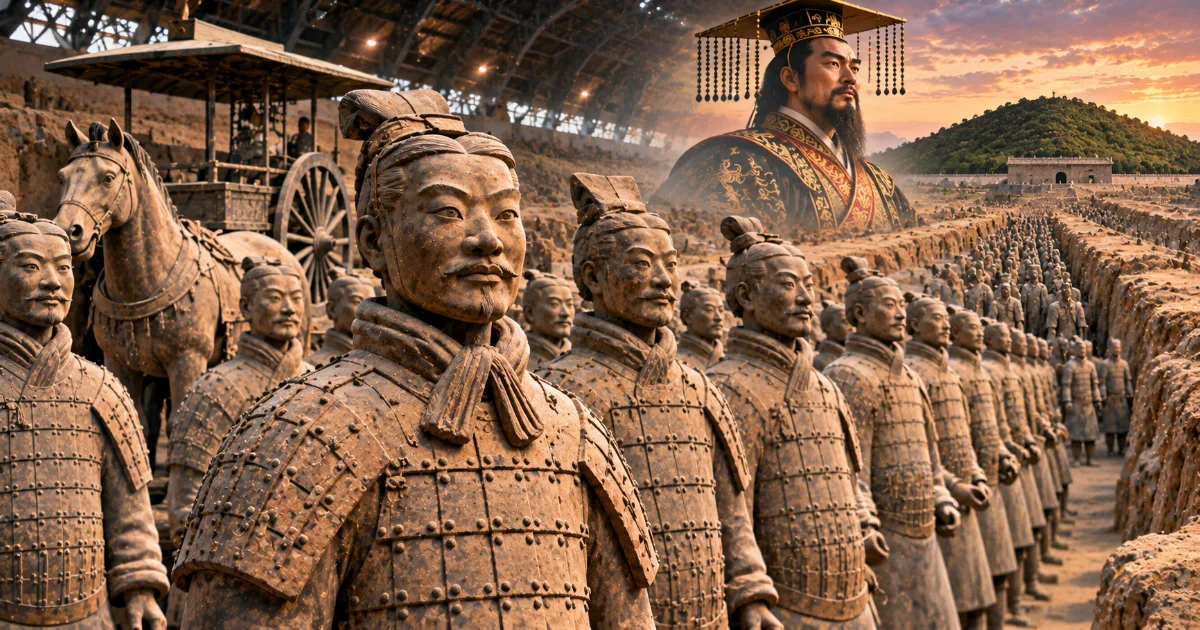
Ying Zheng adopted the title Qin Shi Huang, commonly translated as the First Emperor of Qin. The new title expressed his claim to have established a political order greater than that of the earlier kings. He sought to define a new era in which the empire would be governed through central authority rather than through a collection of independent hereditary kingdoms.
The unification of 221 BCE did not erase regional differences overnight. The conquered territories retained diverse local customs, languages, economic conditions, and social traditions. The new government faced the difficult task of bringing these regions under a common administrative framework while preventing the restoration of rival political authorities.
Nevertheless, the basic political transformation had occurred. The Warring States period was over, and the first Chinese empire had been established.
12. What Unification Meant for Ordinary People
The unification of China is often described through the achievements of rulers, generals, and advisers. Yet the process also affected millions of people whose lives were shaped by taxation, agricultural obligations, military recruitment, and changes in political authority.
For many communities, the end of warfare between rival states may have offered the possibility of greater stability. Prolonged campaigns had disrupted agricultural production, damaged settlements, and forced populations to live under the constant threat of military movement. A unified government could potentially reduce the number of wars fought between independent Chinese kingdoms.
However, unification did not immediately bring freedom from compulsory service or state demands. The Qin government continued to require labour for construction, transportation, military operations, and administrative projects. Taxes and obligations supported the machinery of the empire, but they could place severe pressure on households.
The consequences varied by region. Some areas experienced changes in land administration, official appointments, and the organization of local government. Communities that had once belonged to separate kingdoms now became part of a larger political structure. Officials appointed by the central government were expected to enforce imperial policies and maintain order.
The disappearance of independent kings also changed the relationship between local elites and political power. Some former aristocratic families lost influence, while officials connected to the new administration gained opportunities. Yet social hierarchy did not disappear. Wealth, family connections, education, and political access continued to shape people's lives.
The empire's infrastructure projects could create practical benefits by improving transportation and communication. Roads helped officials and armies move across the territory, while water-management projects supported agriculture in certain regions. But the costs of construction were often high, particularly when labour was compulsory and projects were organized on a demanding schedule.
The unification of China should therefore be understood as both a reduction in political fragmentation and an expansion of centralized power. It created the possibility of a more integrated political system, but it also gave the government greater capacity to demand resources from the population.
This tension became one of the central problems of the Qin dynasty. The state had proved capable of conquering its rivals, yet maintaining the empire required a balance between administrative control and the needs of ordinary people. The failure to sustain that balance would contribute to the dynasty's rapid collapse.
13. The Political Vision of Qin Shi Huang
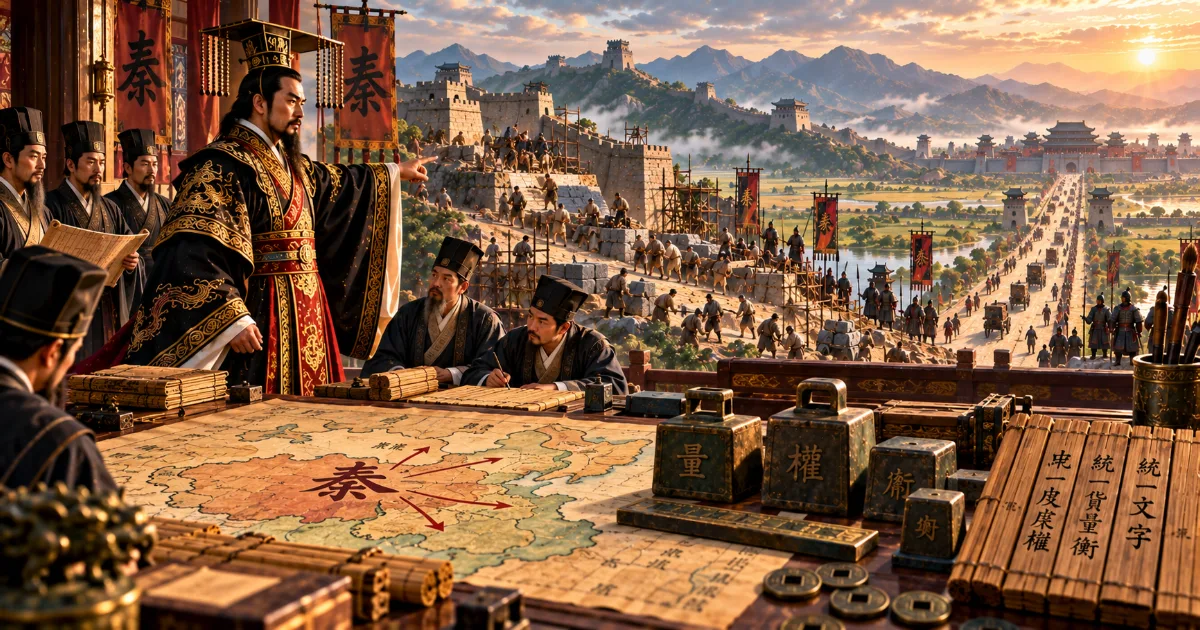
Qin Shi Huang did not regard unification as the final stage of his ambition. He sought to create a new political system that would prevent the return of the old pattern of rival kingdoms. His government attempted to establish consistent standards, reorganize territory, and strengthen the central authority of the emperor.
One of the most important changes was the move away from hereditary regional kings. Rather than restoring the old system of powerful lords, the Qin government organized the empire into administrative units governed by appointed officials. This arrangement was intended to make local authority dependent upon the central state rather than upon independent hereditary families.
The emperor also pursued standardization. Measures of length, weight, and capacity were brought under common standards, while coinage and written forms were subject to imperial policies. These measures helped facilitate administration, taxation, trade, and communication across the newly unified territories.
The government promoted a standardized system of writing based on forms associated with Qin practice. This did not mean that all regional linguistic differences disappeared, nor did it create universal literacy. However, a more consistent written system could help officials communicate and maintain records across a vast territory.
Roads and other infrastructure linked important regions, allowing armies, officials, and goods to move more efficiently. The central government also undertook projects intended to strengthen defence and maintain control over newly conquered lands.
These reforms reflected the political logic of the Qin state. Unification could not be secured merely by defeating rival armies. The government needed institutions capable of maintaining authority after the campaigns ended. Standardization and central administration were intended to make the empire more coherent and reduce the likelihood that regional powers could re-establish independence.
Yet the political vision also relied upon strict discipline and extensive state intervention. The government placed heavy demands upon labour and resources, while harsh penalties were associated with the legal system. The result was an empire with considerable administrative capacity but limited tolerance for opposition.
Qin Shi Huang's political achievement was therefore deeply contradictory. He created institutions that influenced later Chinese governments, but the methods used to enforce them contributed to resentment and instability. His reign demonstrates the difference between establishing control and creating a political order capable of surviving across generations.
14. The Limits of Conquest
The unification of China in 221 BCE was a major military and political achievement, but conquest presented only the beginning of the challenge. Defeating the rival states required concentrated force, careful planning, and the mobilization of resources. Governing the empire required a different set of skills.
The new government had to maintain order across extensive territories with different local conditions. It needed officials who could administer law, collect revenue, manage infrastructure, and respond to local problems. It also had to prevent former political elites from rebuilding independent power bases.
The centralization of authority offered a solution to some of these challenges. By appointing officials and organizing territory through administrative units, the government could reduce dependence upon hereditary rulers. However, the system also made the empire heavily dependent upon the competence of its central leadership.
When a government concentrates authority at the top, mistakes made by the ruler or the court can affect the entire political system. Officials may become reluctant to report problems, local grievances may be overlooked, and policies that work in one region may create difficulties elsewhere.
The Qin government also had to manage the consequences of its own success. The campaigns that unified China had consumed resources and disrupted communities. After victory, the state continued to undertake major projects and maintain military obligations. The population could therefore experience the end of interstate warfare without receiving a sufficient reduction in its burdens.
The rapid collapse of the Qin dynasty showed that military and administrative superiority did not automatically create lasting legitimacy. A government could impose uniform standards, defeat its rivals, and control a vast territory, yet remain vulnerable if its policies generated widespread resentment.
Later Chinese rulers learned from both sides of the Qin experience. They adopted elements of its centralized administration while seeking to avoid the most destabilizing aspects of its harsh rule. The Han dynasty, which followed Qin, preserved the idea of imperial unity but developed a different political balance between central authority, moral legitimacy, and practical administration.
The First Emperor's greatest achievement was therefore also the foundation of a continuing historical debate. How much authority should a ruler possess? How can a large territory be governed effectively? What obligations does the state have toward the people? And how can political unity be maintained without making the demands of government unbearable?
These questions emerged from the experience of Qin and remained central to Chinese political thought for centuries.
Conclusion: The Birth of Imperial China
Qin Shi Huang's unification of China in 221 BCE was one of the defining events in the history of East Asia. It ended the Warring States period, eliminated the principal independent kingdoms, and established the first unified Chinese empire. The achievement was made possible by generations of reform within Qin, the development of a powerful agricultural and military system, and the inability of its rivals to coordinate an effective response.
The campaigns against Han, Zhao, Yan, Wei, Chu, and Qi progressively transformed the political map. Each victory strengthened Qin's position and reduced the number of states capable of resisting its expansion. By the time Qi fell in 221 BCE, Ying Zheng had achieved the unification that earlier rulers had sought but failed to complete.
The First Emperor then attempted to turn military victory into a permanent political order. His government strengthened central authority, reorganized territory, standardized important systems, and sought to prevent the return of independent regional kings. These policies helped establish the institutional foundations of imperial China.
Yet the achievement came at a significant human cost. Military campaigns, compulsory labour, heavy demands on resources, and strict government policies placed pressure on the population. Qin's centralized system proved effective at conquest, but its severity contributed to the resentment and instability that followed the emperor's death.
The Qin dynasty collapsed in 206 BCE, only fifteen years after unification. Nevertheless, the empire it created left a legacy that outlasted the dynasty itself. The Han rulers preserved the principle of imperial unity and adapted many of the administrative structures developed under Qin. Later dynasties repeatedly drew upon the idea that China should be governed as a unified empire, even when political division temporarily returned.
Qin Shi Huang should therefore be remembered neither only as a heroic unifier nor only as a harsh ruler. His reign brought together extraordinary political innovation, military achievement, centralized administration, and coercive government. The lasting importance of his achievement lies in the transformation he set in motion.
Before Qin, the major states competed for supremacy within a fragmented political world. After Qin, the idea of a unified empire became a powerful model for Chinese political life. That transformation changed the course of Chinese history.
The next article in the History of China series will examine Article 12: The First Emperor's Reforms and Centralized Government, exploring how Qin Shi Huang reorganized the empire, standardized systems of measurement and writing, strengthened imperial administration, and attempted to create a common political order across the conquered territories.
#HistoryOfChina #QinShiHuang #FirstEmperor #QinDynasty #AncientChina #ChineseHistory #UnificationOfChina #WarringStatesPeriod #ImperialChina #ChineseCivilization #AncientEmpires #HistoryEducation