
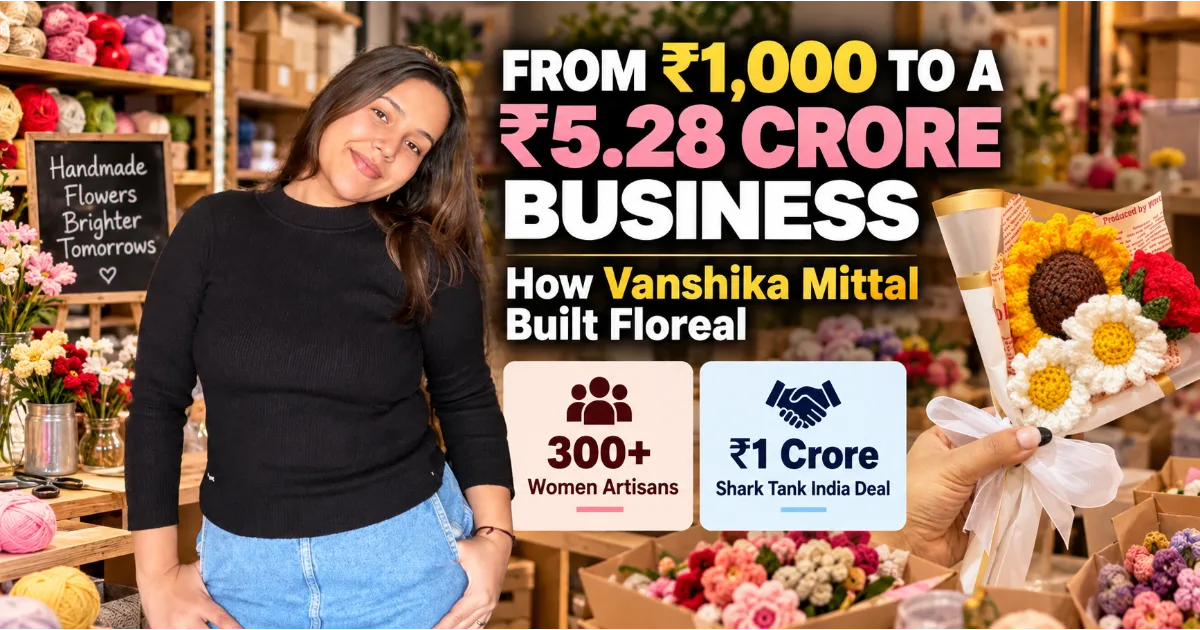
A Handmade Idea That Found a National Market
A crochet flower may look like a small decorative object, but behind it can be an opportunity to build a business, create employment and bring a traditional craft into the modern marketplace. In Ludhiana, Punjab, a young entrepreneur named Vanshika Mittal has demonstrated how a simple idea inspired by family tradition can become a fast-growing gifting brand.
Vanshika founded Floreal in 2024, when she was 18. The business specialises in handmade crochet flowers, bouquets and other gifting products that combine traditional craftsmanship with contemporary designs. By early 2026, media reports were highlighting a reported ₹5.28 crore business milestone within roughly two years of its launch. Later reports described turnover exceeding ₹7 crore, illustrating how quickly the business was growing and why the figures need to be understood in their respective reporting periods.
The story attracted wider attention when Vanshika appeared on Shark Tank India and secured an investment of ₹1 crore for an 8% equity stake, according to reports published in March 2026. The deal valued the business at ₹12.5 crore at the agreed investment terms.
But the most interesting part of this story is not simply the revenue figure or the television appearance. It is the way an ordinary craft was converted into a product that customers could discover online, purchase for special occasions and order through modern retail channels. Floreal also works with more than 300 women artisans, connecting the growth of a consumer brand with income opportunities for people who make its products by hand.
Vanshika's journey raises several important questions. How can a handmade product compete in a market filled with mass-produced gifts? Why would customers choose crochet flowers instead of fresh bouquets? How can a small business turn social media attention into repeat orders? And what can other aspiring entrepreneurs learn from a company that combines traditional skills with online selling?
These questions make Floreal more than an individual success story. It offers a useful case study in product differentiation, digital distribution, customer experience and the commercial potential of India's handicraft sector.
At the same time, the story needs to be understood realistically. Revenue is not the same as profit, and a business that grows quickly must still manage production capacity, quality, delivery, customer expectations and cash flow. A reported investment deal does not automatically guarantee future success.
Floreal's journey is therefore worth examining not as a promise that every small idea can become a multi-crore business overnight, but as an example of how a clear product concept, consistent execution and access to customers can create opportunities that might initially seem much smaller than the business they eventually become.
The Inspiration Behind Floreal: A Craft Passed Through Generations
Vanshika's business idea was influenced by something she had seen at home. In interviews reported by Startup Pedia, she spoke about watching her grandmother make knitted and crocheted items such as sweaters and table mats. She recognised the skill involved in transforming yarn into useful and decorative objects, and she wondered why such work could not reach more customers.
That detail provides an important starting point for understanding the business. Many successful product ideas begin with familiarity rather than a dramatic technological breakthrough. People observe something in their surroundings, notice an unmet need or imagine a different way of presenting an existing product.
In this case, crochet was not a new invention. It was a traditional technique already practised by people in homes and artisan communities. The opportunity lay in how that technique could be used to create products that suited modern gifting preferences.
Traditional crochet is a form of handwork in which yarn is interlaced using a hooked tool to produce fabric, patterns or three-dimensional objects. Depending on the design, it can be used to make clothing, accessories, toys, decorative pieces and flowers. The process requires patience, consistency and practical skill. A handmade flower must be shaped carefully, and a bouquet may require several individual pieces to be assembled into a visually coherent arrangement.
The challenge for a business is to turn that craftsmanship into a product customers understand and want to buy. A skill that is appreciated within a family or local community may not automatically become a commercially viable product. The seller must identify the right customer, create appealing designs, determine a workable price and establish a reliable way to reach buyers.
Vanshika's idea was to position crochet flowers as gifts rather than simply as handicrafts. That decision changed the context in which customers could view the product. A crochet rose could become a birthday gift, an anniversary present, a decorative item for a desk or a keepsake for someone who wanted a flower arrangement that would last.
This is a useful lesson for entrepreneurs working with traditional skills. The commercial opportunity may not always lie in changing the craft itself. It may lie in understanding how customers want to use the finished product and presenting it in a way that fits their lives.
Floreal's growth suggests that a familiar craft can find a wider audience when its design, packaging, distribution and purpose are adapted to contemporary buying habits.
From a Small Beginning to a Business Called Floreal
Vanshika launched Floreal in 2024, at a time when she was still very young and deciding how to approach her future. Reports describe her as having received admission to Thapar University in Patiala, but she ultimately chose to focus on building her own venture in Ludhiana. Her family's role in encouraging her to start from home was part of the circumstances that led her towards entrepreneurship.
Starting a business at 18 can be difficult for several reasons. A young founder may have limited capital, little experience with suppliers, no established customer base and only a basic understanding of business operations. Even when the product is good, the founder still has to learn how to price it, market it, fulfil orders and respond when customers have questions or complaints.
Floreal began with a relatively small financial commitment. Indian Retailer reported that the business started with an initial investment of ₹1,000. That figure is useful as an illustration of the modest scale at which the venture reportedly began, although it should not be interpreted as the total cost of building the business over two years.
The early idea was straightforward: make crochet flowers and bouquets that could be sold as gifts. But even a simple idea requires a series of practical decisions. Which flower designs are attractive enough to sell? How long does each item take to make? What price will customers accept? How can a bouquet be packed so that it reaches the buyer in good condition? How can the business handle more orders without compromising the handmade quality?
These questions are central to turning a craft into a commercial operation. A person making one bouquet as a hobby can spend as much time as necessary on a single piece. A business receiving hundreds or thousands of orders must organise production, standardise parts of the process and ensure that customers receive what they ordered.
Floreal's growth also required a way to reach buyers beyond personal contacts. The business developed a digital presence, allowing customers to discover its products online. It later expanded its distribution through quick-commerce channels, including Blinkit, alongside its own website.
This shift from making products to building a system around them is often where small ventures face their biggest challenge. The founder must move from doing everything personally to creating processes that other people can follow. The business must manage orders, stock, production schedules, packaging, customer service and delivery, often while demand is changing rapidly.
Floreal's story illustrates how a small initial idea can evolve into a more structured business when the founder treats production and distribution as seriously as the product itself.
Why Crochet Flowers Appeal to Modern Buyers
Fresh flowers remain a popular choice for celebrations, romantic occasions, congratulations and expressions of affection. Yet they have one obvious limitation: they are perishable. A fresh bouquet can look beautiful when it is delivered, but its appearance changes over time, and it eventually wilts.
Crochet flowers offer a different proposition. They are handmade from yarn and can be kept for a long time when cared for properly. They do not need water, and they can serve as a decorative keepsake long after the occasion for which they were purchased. This does not make them a replacement for fresh flowers in every situation, but it gives customers another option.
For a buyer choosing a gift, longevity can be an important feature. A crochet bouquet may be displayed on a desk, placed on a shelf or kept as a reminder of a birthday, anniversary or special event. The gift is not limited to a few days of visual appeal.
Personalisation can add another layer of value. Customers often want gifts that feel selected for a particular person rather than chosen from a generic shelf. Colours, flower combinations, packaging and the overall presentation can help create a sense that the gift has been chosen with care. Handmade products can be particularly suitable for this purpose because their appearance is connected to the time and skill involved in making them.
The category also fits the growing role of visual discovery in online shopping. A well-photographed bouquet can communicate its colours, shape and decorative style quickly. Social media images and product videos allow potential buyers to imagine how the product might look in a room or as a gift.
However, a visually appealing product still has to meet practical expectations. Customers need to know what size they are buying, which materials are used, how the item will be packaged and when it will arrive. Product photographs should represent the item accurately, especially when a handmade product may have small variations.
There is also a difference between a product that attracts attention and one that generates repeat business. A customer may purchase a crochet bouquet once because it is unusual, but a sustainable business needs to offer dependable quality and a buying experience that encourages recommendations or future purchases.
Floreal's reported growth suggests that the idea has found a market. Its wider lesson is that businesses can create new commercial opportunities by rethinking the purpose of a familiar product and presenting it to customers in a way that matches current preferences.
Turning Traditional Craftsmanship Into a Scalable Product
Handmade products are often associated with individual artisans, small workshops or local markets. Scaling such products presents a challenge because the process depends on human skill rather than a fully automated production line.
A business must find a way to increase output while preserving the features that make the product desirable. For crochet flowers, this means maintaining consistency in shape, size, colour and finishing. If a customer orders a bouquet that appears very different from the advertised product, the business risks losing trust.
One way to manage this challenge is to develop clear product specifications. Artisans can follow agreed designs, material requirements and finishing standards while retaining the handwork that gives each item its character. Quality checks can identify pieces that need adjustment before they are packaged and shipped.
Planning also matters. Some products may take longer to make than others, and certain colours or designs may become more popular during particular seasons. A business that understands production time can estimate how many orders it can fulfil without overpromising.
Inventory creates another challenge. Holding too much finished stock can tie up cash and create the risk that certain designs will not sell. Producing too little can lead to delays when demand rises. Businesses therefore need to balance ready-made products with the capacity to produce items after orders arrive.
Floreal's reported expansion to a network of more than 300 women artisans suggests that production is no longer simply a personal activity undertaken by the founder. It involves a wider group of people contributing their craft skills to the business.
Such a model can create opportunities for artisans who have the relevant skills but may not have the resources to establish their own brands or reach a large customer base. A business can help connect their work with customers, coordinate orders and handle marketing and distribution.
At the same time, scaling a handmade business requires fair and transparent working arrangements. The way artisans are paid, the time required to make each item, the predictability of orders and the standards expected from each piece all influence whether the model is sustainable for the people producing the goods.
Traditional craftsmanship can become commercially successful when the business respects both sides of the process: the customer who expects a reliable product and the artisan whose skill makes that product possible.
More Than 300 Women Artisans: The Human Side of Floreal's Growth
One of the most significant aspects of Floreal's story is its reported network of more than 300 women artisans. News coverage has described the business as creating income opportunities for women who produce crochet flowers and related handmade products.
This element gives the business a social dimension beyond its sales figures. A growing consumer brand can create demand for skills that might otherwise remain limited to domestic use, informal work or small local markets. When that demand is organised consistently, artisans may be able to earn money from their craft while contributing to a larger commercial operation.
For some women, home-based work can offer practical flexibility. Family responsibilities, travel limitations or the absence of nearby employment opportunities can make conventional full-time jobs difficult to access. Work that can be completed from home may provide an alternative, depending on the nature of the work and the arrangements offered by the business.
However, home-based work is not automatically empowering simply because it is flexible. The actual benefit depends on whether payment is fair, whether orders are regular, whether production expectations are reasonable and whether workers have a clear understanding of the terms. A business that relies on a network of artisans should pay attention to these issues as it grows.
Reports about Floreal describe its artisans as being paid per piece for the products they make. That arrangement can connect earnings to completed output, but the fairness of the system depends on how much time each item requires, the rate paid and the consistency of available orders.
A crochet flower that takes considerable time to make cannot be evaluated solely by its retail price. The price must cover the materials, labour, packaging, marketing, logistics, payment processing, customer service and other operating expenses. The business must also earn enough to continue operating and investing in growth.
This is where commercial success and social impact meet. A growing brand can create more opportunities for artisans if it generates sustained demand and manages its operations responsibly. But the number of people connected to a business does not, by itself, tell us how much each person earns or how stable that income is.
The more useful measure of impact is whether the work provides meaningful and dependable economic opportunity. Transparent payment terms, predictable communication and reasonable quality standards can help build a healthier relationship between the brand and the people making its products.
Floreal's model raises an important possibility for India's handicraft economy. Traditional skills do not have to remain confined to local sales or occasional orders. With access to product design, branding, digital distribution and a wider customer base, those skills may become part of a larger commercial market.
The opportunity is not limited to crochet. Similar approaches may be relevant to embroidery, weaving, handmade accessories, decorative crafts and other products that combine skilled labour with contemporary design.
How Online Selling Helped Floreal Reach More Customers
A handmade business can produce excellent products and still struggle if potential customers cannot find them. Distribution is therefore as important as craftsmanship. Floreal's digital-first approach helped the brand present its products to buyers beyond its immediate geographical area.
Indian Retailer reported that approximately 80% of Floreal's sales came through its own website and 20% through quick-commerce channels at the time of its report. The same coverage said the brand expanded onto Blinkit in January 2026, extending its reach across India. These figures describe the business at that reporting point and should not be assumed to represent its current sales mix indefinitely.
Selling through its own website gives a brand greater control over how products are presented. It can explain the materials, display different designs, communicate its story and establish a direct relationship with customers. It can also collect information about which products attract interest and how customers respond to different offers.
A website, however, does not automatically generate sales. People need to discover it, trust it and feel confident enough to place an order. This requires marketing, attractive product photography, accurate descriptions, secure checkout, dependable fulfilment and responsive customer support.
Social media can help create initial awareness. Images of colourful bouquets are naturally suited to visual platforms because customers can understand the product at a glance. Short videos can show the details of the crochet work, the process of arranging flowers or the difference between a handmade bouquet and a fresh one.
But attention is only the first stage of the customer journey. A business must turn interest into purchases and purchases into a positive experience. If the product arrives late, is poorly packaged or does not match the listing, the customer may not return even if the original advertisement was attractive.
Quick commerce adds another dimension. These platforms can make products available through a distribution network that customers already use for everyday purchases. For suitable products, the convenience of browsing and ordering through a familiar application can help reduce friction in the buying process.
Yet distribution through a third-party platform also involves trade-offs. The business may face platform fees, promotional requirements, stock-management demands and less direct control over the customer relationship. A company must evaluate whether the additional reach produces enough sales and margin to justify those costs.
Floreal's reported expansion across its website and quick-commerce channels illustrates the importance of choosing distribution methods that fit the product. The broader lesson is that a small business can use digital tools to reach customers far beyond its home city, but it still needs to understand the economics and operational requirements of every channel.
From ₹5.28 Crore to Later Turnover Reports: Understanding the Numbers
The headline figure of ₹5.28 crore helped bring attention to Floreal's growth. Reports in early 2026 described the company as reaching that business milestone within roughly two years. Later reporting, including coverage by The Tribune in March 2026, referred to turnover exceeding ₹7 crore.
These figures should be handled carefully. They relate to different reports and potentially different periods or measures. Revenue, turnover, profit, cash flow and company valuation are not interchangeable terms.
Revenue or turnover generally refers to sales generated by a business over a specified period. Profit is what remains after the relevant expenses have been deducted. A company can report high revenue while earning a much smaller profit if it spends heavily on materials, labour, advertising, fulfilment, staff and expansion.
Cash flow is different again. A business may record sales but still face cash pressure if customers or platforms pay later, inventory has to be purchased in advance or suppliers require prompt payment. A fast-growing company can experience this problem because expansion often requires money before the associated revenue is received.
Valuation is also separate. It represents the value attributed to a business under a particular transaction or assessment. A company can be valued at ₹12.5 crore even though it has generated a different amount in sales. The valuation reflects expectations about future performance, growth prospects, risk and the terms negotiated by investors.
The reported ₹1,000 initial investment is another figure that needs context. It describes the small starting point highlighted in coverage of the business. It does not establish that the company was built entirely with ₹1,000, nor does it capture the value of later spending on production, staff, inventory, marketing, technology or logistics.
The responsible way to report the story is to explain what each number represents and identify its source and period. The reported ₹5.28 crore milestone shows the scale the business had reached in early coverage. Later reports of turnover exceeding ₹7 crore indicate further growth as described by the publications. Neither figure, on its own, tells us the company's net profit or the founder's personal wealth.
This distinction does not diminish the achievement. It helps readers understand the business more accurately and prevents a success story from becoming a misleading claim about how much money the founder personally earned.
The Shark Tank India Deal That Brought Floreal Into the Spotlight
Floreal received national attention when Vanshika Mittal presented the business on Shark Tank India. The programme gave her an opportunity to explain the product, discuss the company's growth and seek investment from entrepreneurs who evaluate businesses for their commercial potential.
According to reports published in March 2026, Vanshika initially sought ₹1 crore for 3% equity, implying a valuation of approximately ₹33.33 crore. Following negotiations, she secured a deal of ₹1 crore for an 8% stake from Pratham Mittal and Mohit Yadav, valuing the company at ₹12.5 crore under the agreed terms.
The difference between the initial ask and the final deal illustrates an important part of fundraising. Entrepreneurs may enter negotiations with a particular valuation in mind, but investors assess the business based on its financial performance, growth potential, risks, competitive position and the return they expect from their investment.
A founder may see a rapidly growing brand and place a high value on its future possibilities. An investor may agree that the business has potential while believing that the valuation needs to reflect uncertainties around profit margins, customer acquisition, production capacity and future competition.
The final deal therefore involves more than receiving money. Equity investment gives investors an ownership stake in the business, along with whatever rights and conditions are included in the agreement. Founders must consider the value of the capital and support they receive against the ownership they give up.
For Floreal, the reported investment was an important milestone because it brought external backing to a business that had grown from a small product idea. It also placed the brand before a national audience, potentially increasing awareness among customers, suppliers and future business partners.
However, appearing on a television investment programme does not guarantee that a business will continue growing. The company must still deliver products, manage expenses, maintain customer trust and make effective use of any new capital. The long-term value of the investment will depend on the business's subsequent performance.
The larger lesson for aspiring founders is that fundraising is a tool, not the final objective. Investment is most useful when it helps a company strengthen its operations, expand responsibly and build a business capable of surviving beyond its initial period of rapid growth.
The Challenges Ahead for Floreal
Rapid growth can be exciting, but it also introduces problems that a small business may not have faced during its early stages. A founder who once handled a few orders personally may eventually have to coordinate artisans, manage inventory, supervise a team, respond to customer issues and plan production across multiple sales channels.
Quality control becomes more complicated as production expands. Handmade products naturally contain small variations, but customers still expect the item they receive to resemble the product they selected. Floreal must maintain consistent standards while preserving the handcrafted character that distinguishes its offerings.
Supply management is another challenge. Yarn, packaging materials and other inputs must be available when required. If a popular product suddenly attracts more orders than expected, the business needs enough production capacity to meet demand without excessive delays. If it produces too much in anticipation of sales that do not materialise, money can become tied up in unsold stock.
Marketing costs also require attention. Digital advertising and platform promotions may help a business attract new buyers, but the cost of acquiring each customer must be considered alongside the amount the business earns from the sale. Strong sales growth is not necessarily sustainable if every additional order requires expensive promotion.
Floreal must also manage the balance between its own website and third-party distribution channels. Each channel offers different benefits, costs and operational demands. A business needs to understand which products perform well in each channel and whether the associated fees leave sufficient margin.
Competition is inevitable as a product category becomes more visible. Other sellers may introduce similar crochet flowers, bouquets and personalised gifts. Floreal will need to differentiate itself through product quality, distinctive designs, customer service, reliable fulfilment and a recognisable brand.
The company must also ensure that its growth creates worthwhile opportunities for the artisans involved. A larger order book is valuable only when the production system can handle it responsibly and workers have clear payment arrangements and realistic expectations.
These challenges are not unique to Floreal. They are common to growing consumer businesses. The transition from a small venture to a more established company requires systems, delegation and financial discipline, not just a product that attracts attention.
What Aspiring Entrepreneurs Can Learn From Vanshika Mittal
The first lesson is to look for opportunities in familiar surroundings. Vanshika's idea was connected to a craft she had seen within her family. Entrepreneurs do not always need to invent an entirely new technology. Sometimes the opportunity is to find a new customer, use an existing skill differently or make a traditional product more accessible.
The second lesson is to begin with a specific product and a clear reason for customers to buy it. Crochet flowers have a distinct selling point: they offer a long-lasting alternative to fresh bouquets. That benefit helps explain the product to customers and gives the business a clear position in the gifting market.
The third lesson is that distribution matters. A product cannot grow beyond a small circle of buyers unless people can discover it and purchase it conveniently. Online channels can help small businesses reach a national audience, but they must be supported by accurate product information, dependable delivery and responsive customer service.
The fourth lesson is to treat production as seriously as marketing. Handmade products require skill and time. Businesses must understand how long items take to make, what materials cost, how quality is maintained and how orders can be fulfilled when demand increases.
The fifth lesson is to measure the business properly. Revenue can show that customers are buying, but it does not reveal whether the business is profitable. Entrepreneurs should track expenses, margins, cash flow, repeat purchases and customer acquisition costs rather than focusing only on a headline sales figure.
The sixth lesson is to build a business that can function beyond the founder's personal effort. Delegation, documented processes and clear responsibilities become essential as the operation expands. A founder who continues doing everything alone may become the main constraint on the company's growth.
Finally, social impact should be supported by practical business arrangements. If a company works with hundreds of artisans, the quality of those relationships matters. Fair compensation, dependable communication and sustainable production practices can help ensure that growth benefits the people whose skills make the products possible.
Conclusion: A Traditional Craft, a Modern Business and a Wider Opportunity
Vanshika Mittal's journey with Floreal shows how a traditional craft can be adapted for a modern consumer market. Starting in Ludhiana in 2024, the business developed a range of handmade crochet flowers and gifting products, reached customers through digital channels and built a network of more than 300 women artisans, according to published reports. The reported ₹5.28 crore milestone and subsequent coverage of turnover exceeding ₹7 crore demonstrate the scale the business had reached in a relatively short period.
Her ₹1 crore investment deal on Shark Tank India brought further attention to the venture, but the real test will be what happens next. Floreal must maintain quality, control costs, compete with similar products and turn initial customer interest into sustainable demand.
The story also highlights a wider opportunity for India's handicraft sector. Traditional skills can reach new markets when businesses combine craftsmanship with thoughtful product design, modern branding and reliable distribution. Such models can help artisans connect with customers beyond their immediate communities, provided the resulting work offers fair and sustainable economic opportunities.
Floreal's growth should not be interpreted as proof that every small business can generate crores in a short period. Business outcomes depend on many factors, including demand, execution, capital, competition and timing. But the journey offers a useful reminder that commercially valuable ideas can emerge from ordinary experiences and familiar skills.
A handmade flower may seem like a small product. With the right customer proposition, dependable production and effective distribution, it can become the foundation of a much larger business.
The lasting lesson from Vanshika Mittal's story is that traditional skills do not have to remain small. When craftsmanship meets customer understanding and disciplined execution, a local idea can find a market far beyond its place of origin.
#BeyondHeadlines #VanshikaMittal #Floreal #Entrepreneurship #WomenEntrepreneurs #StartupIndia #Ludhiana #SharkTankIndia #CrochetBusiness #HandmadeProducts #WomenInBusiness #IndianStartups #SmallBusinessGrowth #DigitalCommerce #MadeInIndia #BeyondTheHeadline