A Global AI Company Turns Its Attention to India
India's artificial intelligence industry is entering a new phase, with global technology companies increasingly looking beyond English-language applications to build products for the country's diverse linguistic landscape. From customer service and digital payments to education, healthcare and government services, voice-based technology could change how millions of people interact with digital platforms. A person may not be comfortable typing a question into an application, but they may be able to explain the same problem naturally in their own language. This is the opportunity that voice artificial intelligence companies are attempting to address.
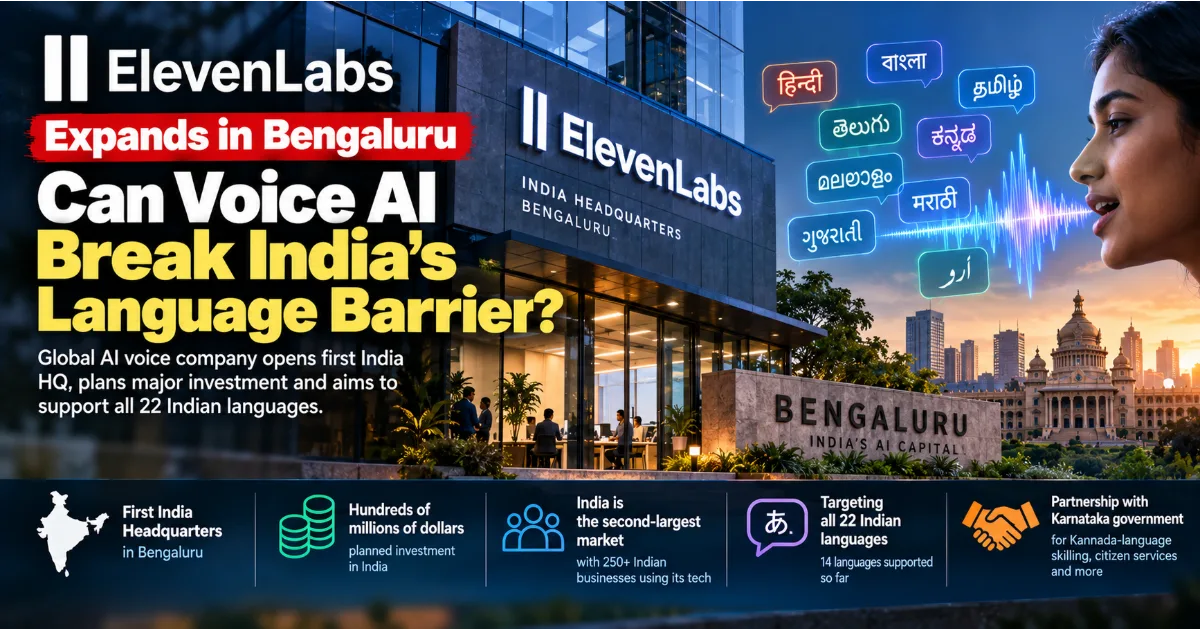
Against this backdrop, ElevenLabs, a company known for AI-powered voice generation and conversational voice technology, is expanding its presence in India, with Bengaluru emerging as an important part of its plans. Reports published in October 2026 said the company had opened its first India headquarters in Bengaluru. The development follows a broader expansion strategy that includes investment plans, partnerships and an effort to extend AI voice capabilities across Indian languages.
The reported headquarters opening is part of a larger story about India's growing importance to the global AI industry. India offers a large technology workforce, a substantial enterprise market and a population that communicates across many languages. Businesses increasingly want digital assistants that can speak naturally with customers, understand requests and provide useful responses without forcing people to navigate complicated menus or interact exclusively in English.
ElevenLabs has built its reputation around technologies that generate realistic synthetic voices, convert text into speech and support conversational AI applications. These capabilities can be used in areas such as digital content, customer support, accessibility, interactive learning and automated communication. As companies look for ways to make AI more natural and accessible, voice is becoming an increasingly important interface between people and software.
The Indian opportunity, however, is not simply about producing a voice that sounds human. A useful voice assistant must understand different languages, accents, regional expressions and conversational patterns. It must recognise what a person means, respond accurately and operate reliably in real-world conditions. India also presents challenges involving code-switching, background noise, varying levels of digital literacy and the wide differences between spoken and formal written language.
At an October 2026 India event, ElevenLabs said India had become its second-largest market and that more than 250 Indian businesses and enterprises were using its technology. The company also described plans to invest hundreds of millions of dollars in India, although the exact amount was not disclosed in the cited reporting. These statements indicate that the country is already an important commercial market rather than merely a future expansion opportunity.
The company's expansion also connects with a broader question facing India's technology sector: can AI help make digital services accessible to people who have historically been underserved by English-first products? If voice systems become accurate and affordable across Indian languages, they could reduce some of the barriers that prevent people from using digital tools effectively.
Yet the promise should not be confused with a completed transformation. Building reliable voice AI across India's linguistic diversity requires extensive language data, careful testing, cultural understanding and strong safeguards against misuse. The technology must also provide value to businesses without compromising user privacy or misleading people about whether they are interacting with a human or an AI system.
ElevenLabs' Bengaluru expansion therefore deserves attention not only as a business development, but also as a test of whether global AI companies can adapt their technology to India's linguistic and economic realities. The outcome could influence how businesses communicate with customers, how creators produce digital content and how millions of people interact with the next generation of AI-powered services.
What Is ElevenLabs and Why Is Its Technology Important?
ElevenLabs is an artificial intelligence company specialising in voice technology. Its products include text-to-speech systems, voice generation, speech-related tools and conversational AI that allows developers and businesses to create applications capable of interacting with people through spoken language.
Traditional text-to-speech software often produced voices that sounded mechanical, with limited variation in tone, rhythm and expression. Advances in AI have made it possible to generate speech that sounds more natural, including changes in emphasis, pacing and emotional delivery. These developments have expanded the potential uses of synthetic voices, from narrating digital content to powering interactive customer experiences.
For example, a company could use AI-generated speech to produce audio versions of educational material, create voiceovers for videos or provide spoken information to customers. A software developer could integrate conversational AI into an application so users can ask questions aloud rather than navigating a series of menus. Media organisations could experiment with audio formats, while businesses could automate certain routine interactions.
ElevenLabs' technology is relevant because voice is one of the most familiar forms of human communication. People do not need to learn a complicated interface to speak a question. For users who struggle with small text, complex forms or unfamiliar applications, a well-designed voice interface can make technology easier to access.
However, speaking naturally is only one part of the problem. A voice assistant must also recognise the words correctly, understand the user's intent, retrieve reliable information and respond appropriately. Generating convincing speech is different from providing accurate answers. A system may sound fluent while still misunderstanding a question or producing incorrect information.
This distinction becomes particularly important when AI is used in banking, healthcare, education or government services. In such settings, the quality of the voice alone is not enough. The system must also protect sensitive information, explain limitations and allow people to reach a human representative when necessary.
ElevenLabs operates in a competitive market that includes major technology platforms, specialised speech companies and developers building their own conversational systems. Its opportunity in India will depend on whether its technology can deliver reliable results across local languages and business environments, while offering advantages in quality, integration or cost.
The Bengaluru expansion could help the company understand those requirements more closely. A local presence can make it easier to work with Indian enterprises, developers and institutions, although the precise size and structure of the reported headquarters and its operations should not be assumed without further company disclosure.
Why India Is Becoming an Important Market for Voice AI
India's linguistic diversity creates a distinctive opportunity for voice-based technology. English is widely used in business and higher education, but it is not the preferred language for every interaction. Millions of people communicate primarily in languages such as Hindi, Bengali, Tamil, Telugu, Marathi, Kannada, Malayalam and Gujarati, among many others.
Digital services have expanded rapidly, but language can still create a barrier between users and the products available to them. A person may have access to a smartphone and an internet connection but struggle to complete an online process because the interface uses unfamiliar terminology or assumes strong English proficiency. Voice technology could help bridge that gap by allowing users to explain what they need in a more familiar way.
Consider a customer trying to understand an insurance policy. Instead of navigating several pages of technical language, the customer might ask a voice assistant to explain the key terms in a preferred language. A farmer could seek information about agricultural services, while a small business owner could ask for help understanding an online form. These are potential applications rather than guarantees of what any single AI product can currently deliver.
The value of voice AI could also extend to people who have difficulty reading long passages, users with certain disabilities and individuals who find conventional digital interfaces inconvenient. Spoken interaction can make some services easier to use, although voice alone will not meet every accessibility need. People must still have alternatives such as text, visual interfaces and human assistance.
For businesses, multilingual voice systems could reduce friction in customer interactions. A company serving customers across several states may need support teams capable of communicating in different languages. AI could assist with routine enquiries, provide information outside normal business hours and help route complex cases to the appropriate employee.
The opportunity is especially relevant for companies handling large volumes of repetitive questions. Customers may frequently ask about delivery status, account procedures, appointment timings, product details or service availability. If an AI system can answer such questions accurately, human employees can devote more time to unusual cases that require judgement or personal attention.
However, the economics will vary by business. Voice AI requires integration with existing systems, testing, monitoring and ongoing maintenance. A company must also account for mistakes, escalation to human agents and the cost of supporting multiple languages. Automation is valuable only when it improves the overall service rather than simply shifting expenses or creating new problems.
India's size makes it an attractive market, but its diversity means that a single language model cannot automatically serve everyone equally well. Different languages have their own grammar, pronunciation patterns, idioms and regional variations. Even within the same language, people may speak differently depending on their region, age, profession and social context.
For ElevenLabs, the opportunity is therefore both commercial and technical. Success requires products that can serve businesses at scale while adapting to the linguistic realities of the people those businesses serve.
Bengaluru's Role in India's AI Expansion
Bengaluru has developed into one of India's most important technology centres. The city hosts software companies, multinational research teams, startups, engineering offices and a large pool of professionals working in artificial intelligence, cloud computing, data science and enterprise software. This concentration of talent and commercial activity makes it a natural location for companies seeking to expand their presence in India.
An India headquarters can offer a company more than a physical office. It can provide a base for building relationships with customers, hiring employees, developing partnerships and understanding local market requirements. A team working closer to Indian businesses may be better positioned to identify the problems that customers want AI to solve and the practical constraints that affect adoption.
For a voice AI company, proximity to the local market can be particularly useful. Building products for Indian languages requires more than translating an existing interface. It involves understanding how people actually speak, including code-switching, regional accents, informal expressions and the ways language changes across different situations.
A Bengaluru-based team could potentially work with developers, enterprises and research organisations to test applications in real conditions. It could also help the company engage with businesses that need technical support, custom integrations or guidance on using voice AI responsibly. The extent of these activities will depend on the company's staffing, investment and operational plans.
The city also offers access to India's startup ecosystem. Young companies often experiment with new interfaces and business models more quickly than large organisations, creating opportunities for technology providers to test products and develop partnerships. Voice AI could be incorporated into educational platforms, productivity tools, entertainment products and customer-facing applications.
Yet Bengaluru's advantages should not obscure the importance of activity beyond the city. If voice AI is to serve India effectively, its development and evaluation need to reflect users from different regions and backgrounds. A system tested only among urban professionals may perform differently when used by people with distinct accents, older devices, slower internet connections or different communication habits.
A successful national strategy would therefore combine a strong technology base in Bengaluru with partnerships, testing and adoption across other parts of India. The objective should not simply be to establish an office in a major technology hub, but to build products that work for users throughout the country.
The reported headquarters opening is a useful indicator of the company's local ambitions. Its long-term significance will depend on whether that presence translates into sustained hiring, meaningful research and development, local partnerships and products that address real Indian needs.
The Push to Support All 22 Indian Languages
One of the most ambitious elements of ElevenLabs' India strategy is its stated goal of expanding voice AI capabilities to all 22 languages listed in the Eighth Schedule of the Indian Constitution. At its October 6, 2026, India summit, the company said its technology supported 14 Indian languages at that time. The goal of reaching all 22 reflects the scale of the linguistic challenge it is attempting to address.
The distinction between supporting a language and supporting it well is important. A system may be able to generate speech in a language without reliably understanding every dialect or producing consistently natural pronunciation. Likewise, speech recognition may work well for carefully spoken sentences but struggle with background noise, informal conversation or a mix of languages.
Many Indians switch between languages during a single conversation. Someone may speak Kannada while using English words for technology, finance or workplace terminology. A Hindi speaker may use English product names, regional expressions or local slang. Systems trained primarily on formal speech may find such conversations difficult to interpret.
Regional accents create another challenge. A language spoken in one region can sound noticeably different from the same language spoken elsewhere. Pronunciation, rhythm, vocabulary and expressions may vary. A voice system that performs well for one group of speakers may deliver less reliable results for another.
There is also a difference between written and spoken language. People do not always speak in complete sentences, and conversations often contain repetitions, interruptions and unfinished thoughts. Speech technology must handle these patterns if it is to be useful outside controlled demonstrations.
High-quality language support requires suitable training and evaluation data. Developers need recordings that reflect how people actually speak, along with reliable ways to measure whether systems recognise and generate speech accurately. Collecting and using such data must be done responsibly, with attention to consent, privacy and representation.
Languages with smaller digital footprints may face additional difficulties. If less high-quality audio data is available, developers may have to invest more effort in data collection, model adaptation and testing. This can make language expansion slower and more expensive, particularly when regional dialects and specialised vocabulary must also be considered.
ElevenLabs' stated goal is significant because it recognises that the Indian market cannot be served adequately through English and Hindi alone. Nevertheless, the target should be evaluated through actual performance, not only the number of languages listed as supported. Users need to know whether a system can understand their speech, respond clearly and handle common local expressions reliably.
For India, the larger objective should be to ensure that language technology expands access rather than creating another digital divide. If the most widely spoken languages receive the strongest support while smaller language communities receive weaker service, AI could reproduce existing inequalities. Broader language coverage must therefore be accompanied by consistent quality and meaningful testing.
How Voice AI Could Transform Customer Service
Customer service is one of the most immediate commercial applications for conversational voice AI. Businesses receive large numbers of calls and messages every day, and many enquiries involve routine questions that follow predictable patterns. A voice assistant that can answer these questions accurately may help companies improve response times and offer support beyond conventional business hours.
For example, an online retailer could use an AI assistant to explain delivery procedures, help customers locate information about returns or guide them through common account questions. A travel company could provide information about bookings and schedules. A utility provider might use voice systems to explain billing procedures or direct customers to the right department.
In India, multilingual support could be especially valuable for companies serving customers across several states. A business may not have enough human agents fluent in every language to provide immediate assistance at all times. AI could potentially handle straightforward requests in supported languages while escalating more complicated matters to employees.
However, automation must be designed around customer needs rather than the desire to reduce staffing at any cost. Customers become frustrated when automated systems cannot understand their problem, repeatedly offer irrelevant options or make it difficult to speak to a human being. A voice assistant that saves a company money but leaves customers unable to resolve important issues can damage trust.
Accuracy is particularly important when the conversation involves money, identity, legal obligations or personal information. A customer who receives incorrect financial information or misunderstands a policy may suffer real consequences. Businesses need systems that can recognise uncertainty, avoid unsupported answers and transfer sensitive or complex cases to trained employees.
Companies must also make clear when a customer is interacting with AI. A natural-sounding voice should not be used to create the false impression that a person is speaking when that distinction matters. Transparency can help people understand the limitations of the system and make informed decisions about what information they share.
The most effective approach may be a hybrid model. AI can manage routine questions, collect basic information and assist with common tasks, while human employees handle disputes, emotionally sensitive conversations and cases requiring discretion. In such a model, voice AI becomes a tool for supporting customer service rather than a complete substitute for human judgement.
For ElevenLabs, enterprise adoption will depend on demonstrating that its systems can deliver reliable service at a reasonable cost. Companies will want evidence that the technology improves customer outcomes, works with existing software and can be monitored when something goes wrong.
Education, Accessibility and Digital Inclusion
Education is another area where voice AI could have a meaningful impact. Students may use spoken interfaces to practise languages, listen to explanations, explore learning material or interact with digital tutors. Teachers and educational publishers could use generated speech to produce audio lessons, learning resources and accessible versions of written content.
For students who are more comfortable learning in a regional language, voice-based tools may help make certain subjects easier to approach. A learner could ask a question in a familiar language and receive an explanation in spoken form. This could be particularly useful when access to specialist teachers or additional learning resources is limited.
However, AI-generated explanations must be checked for accuracy. A fluent voice can make incorrect information sound convincing, and students may not always have the knowledge needed to identify mistakes. Educational applications should be designed to support learning, encourage verification and make it possible for teachers or other qualified people to review important material.
Voice AI can also improve accessibility. People with visual impairments may benefit from spoken navigation and audio descriptions. Users who have difficulty typing can dictate questions or interact through speech. Older adults who find complicated menus challenging may prefer simple voice commands for some everyday tasks.
Accessibility, however, is not achieved by adding a microphone alone. People with speech disabilities, hearing impairments or certain cognitive conditions may need different interfaces. Background noise, unreliable connectivity and unfamiliar accents can also make voice interaction difficult. A genuinely inclusive product should offer multiple ways to interact and allow users to choose the method that works best for them.
There are potential benefits for public services as well. Voice interfaces could help people find information about government schemes, understand application procedures or navigate service portals. Karnataka's reported partnership with ElevenLabs is relevant in this context. The company signed a memorandum of understanding with the Karnataka Innovation and Technology Society to explore voice AI for Kannada-language skilling, citizen services and grievance redressal.
An MoU indicates an intention to explore cooperation, not proof that a system has already been deployed successfully across public services. Any implementation would need clear goals, reliable information, accessibility testing and safeguards for personal data. Citizens must also retain alternative routes to assistance, especially when an automated system cannot resolve their concern.
If these conditions are met, voice AI could help make digital services easier to navigate. But its contribution should be measured by whether people can complete tasks more successfully, not simply by how many AI features an organisation introduces.
The Risks: Deepfakes, Privacy and the Misuse of Synthetic Voices
The same technology that makes voice AI useful also creates serious risks. Systems capable of generating realistic speech can help creators produce audio content, but they can also be misused to imitate real people, create fraudulent calls or manufacture recordings that appear authentic.
Voice cloning is particularly sensitive because a person's voice can be closely associated with their identity. If a malicious actor obtains suitable audio samples, synthetic speech may be used in attempts to impersonate an employee, relative, executive or public figure. In a country where phone-based communication and digital payments are widely used, convincing voice impersonation could create additional opportunities for fraud.
The danger is not limited to financial scams. Synthetic audio can be used to spread misinformation, falsely attribute statements to individuals or create misleading recordings during politically sensitive events. As voice generation becomes more accessible, distinguishing authentic recordings from manipulated content may become increasingly difficult.
Companies developing voice technology therefore need safeguards against unauthorised cloning and impersonation. These can include consent requirements, identity verification for sensitive uses, restrictions on abusive applications, monitoring for misuse and mechanisms for reporting harmful content. No single safeguard can prevent every form of abuse, so technical controls must be supported by responsible product policies and effective enforcement.
Privacy is equally important. Voice recordings may reveal names, locations, health concerns, financial details and other personal information. Businesses that deploy conversational AI need to understand what information is collected, how long it is retained, who can access it and whether it is used to improve models. Customers should receive clear explanations rather than having to infer these practices from complicated terms.
India's data protection framework and other applicable laws will also matter as voice AI expands. Organisations must assess their legal obligations, especially when handling sensitive information or using automated systems in important services. Compliance should be part of product design from the beginning rather than an afterthought.
Transparency is another essential requirement. People should be able to recognise when they are listening to synthetic speech or interacting with an AI assistant, particularly in situations where identity and trust are important. The more natural these systems become, the more important it is to establish clear expectations about what the technology can and cannot do.
For ElevenLabs, building a sustainable business in India will require demonstrating not only that its voices sound convincing, but also that its technology can be used responsibly. Trust will be a commercial advantage only if the company can support it with meaningful protections and reliable practices.
What the Bengaluru Expansion Could Mean for Jobs and Investment
The reported Bengaluru headquarters and ElevenLabs' wider India investment plans could create opportunities for local technology professionals, although the scale of the employment impact remains uncertain. The Times of India reported that the company was considering building an India team of around 100 people. That figure should be treated as a reported target rather than confirmation that all those positions have been created or filled.
An expanding voice AI company may need software engineers, machine-learning specialists, infrastructure experts, product managers, language specialists, enterprise sales professionals and customer support teams. Some roles may focus on adapting technology to Indian languages, while others may help businesses integrate voice AI into existing applications and workflows.
The local presence could also create opportunities for Indian startups and developers. Businesses building educational applications, productivity software, customer service platforms and media products may find new ways to incorporate conversational voice capabilities. Universities and research groups could potentially explore related problems involving speech recognition, language evaluation, accessibility and responsible AI.
However, the presence of a global company does not automatically guarantee a large number of jobs or substantial local research activity. The long-term contribution will depend on the actual investment, the functions established in India, the level of local hiring and the extent to which teams build capabilities that serve the Indian market.
The company's stated intention to invest hundreds of millions of dollars is significant, but the exact financial commitment was not disclosed in the cited reporting. It would therefore be premature to describe the figure as a confirmed investment amount or to assume that all the planned spending will be directed towards Bengaluru.
India's broader ambition should be to attract investment while building domestic expertise. Local businesses need the skills to design, evaluate and deploy AI systems rather than becoming dependent entirely on imported technology. Strong partnerships, research opportunities and training can help Indian professionals contribute to the development of voice AI, not merely its implementation.
Bengaluru could play an important role in this process because of its concentration of technical talent and technology businesses. But the lasting measure of success will be whether the expansion produces useful products, skilled employment, stronger research and better access to technology for Indian users.
Conclusion: Can Voice AI Become India's Next Digital Bridge?
ElevenLabs' expansion into India, including the reported opening of its first India headquarters in Bengaluru, reflects the growing importance of voice AI in the global technology market. The company has identified India as a major commercial opportunity, reported adoption by more than 250 Indian businesses and described plans to invest hundreds of millions of dollars in the country. It has also set an ambition to extend its voice AI capabilities across all 22 constitutionally scheduled Indian languages.
These developments matter because voice could become one of the most accessible ways for people to interact with digital services. If AI can understand local languages reliably, businesses may be able to serve customers more effectively, educators may be able to create more accessible learning material, and public institutions may find new ways to communicate with citizens.
But India's linguistic diversity is not a problem that can be solved simply by adding more languages to a product list. High-quality voice AI requires accurate recognition, natural speech generation, sensitivity to regional differences and reliable performance in everyday conditions. It also requires strong privacy protections and safeguards against voice impersonation and fraud.
The Bengaluru expansion offers an opportunity to build closer relationships with Indian businesses, developers and institutions. Its significance will depend on whether those relationships lead to practical applications that improve services and create lasting value. The same is true of the company's investment plans: their impact should be judged by measurable outcomes rather than announcements alone.
India also needs to ensure that the benefits of voice AI reach people beyond major cities and technology companies. Regional language users, small businesses, students and people with accessibility needs should be considered from the beginning of product development. A system that works only for a narrow group of users will fall short of the wider promise of inclusive digital technology.
The challenge is to balance innovation with reliability, commercial growth with public value, and convenience with responsible use. Voice AI could make digital services more approachable, but it cannot replace good information, human accountability or accessible alternatives for people who cannot or do not wish to use voice interfaces.
ElevenLabs' Bengaluru expansion is an important development to watch, but the real test will be whether its technology can help India speak to the digital world in its own languages, with accuracy, trust and meaningful access for everyone.
#BeyondHeadlines #ElevenLabs #Bengaluru #ArtificialIntelligence #VoiceAI #IndiaAI #KannadaAI #IndianLanguages #ConversationalAI #GenerativeAI #TechnologyNews #DigitalIndia #AIStartups #FutureOfTechnology #BeyondTheHeadline