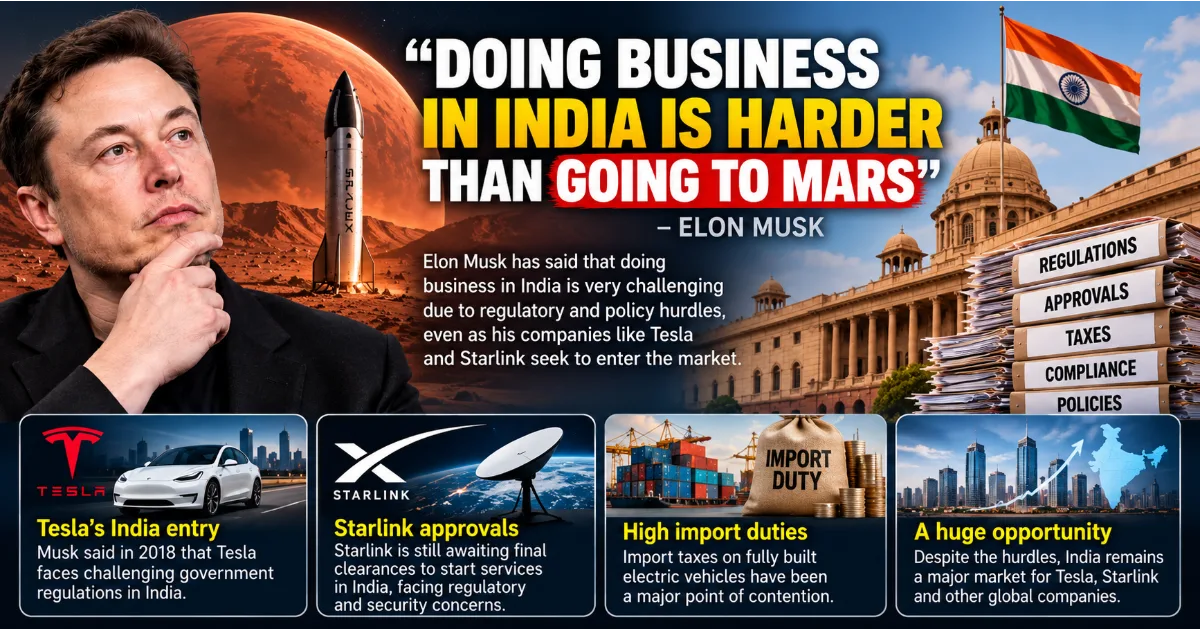
The idea that doing business in India can be harder than going to Mars has circulated online for years, often alongside the name of Elon Musk, the billionaire entrepreneur behind Tesla and SpaceX. The comparison sounds like a perfect headline: a businessman building rockets for interplanetary travel faces a different kind of challenge when trying to enter one of the world's largest consumer markets. But there is an important distinction between what Musk actually said and how the internet turned the episode into a memorable line.
The original controversy dates back to May 2018, when Musk said Tesla would like to enter India but faced challenging government regulations. His comments prompted a wave of reactions on social media. Among them was a widely reported quip from Indian comedian Sorabh Pant, who asked whether India's regulations were “more challenging than Mars.” The line was a reaction to Musk's remarks, not a verified direct quote from Musk himself.
That difference matters. The viral formulation captures a genuine debate about the difficulties foreign companies can face when entering India, but attributing the exact comparison to Musk would misrepresent the original exchange. The underlying question, however, remains relevant: why can a company capable of developing electric cars, reusable rockets and satellite networks still find market entry, regulatory approvals and local business conditions difficult to navigate?
The answer is not simply that India is hostile to foreign business, nor that every regulation is unnecessary. India is a large, diverse and strategically important economy with legitimate public interests in manufacturing, employment, consumer protection, taxation, security and domestic industrial development. At the same time, companies often seek predictable rules, faster approvals, consistent policy and a clear path from investment to commercial operation.
Tesla's experience, along with the regulatory questions surrounding SpaceX's Starlink satellite internet service, provides a useful lens through which to examine this tension. The story is not merely about Elon Musk. It is about the difficult balance between attracting global investment and protecting national priorities, between making rules and implementing them efficiently, and between opening markets and building domestic capabilities.
What Elon Musk Actually Said About India in 2018
In May 2018, Tesla was already an internationally recognised electric vehicle company, but its plans for India remained uncertain. Indian consumers had shown interest in Tesla's vehicles, and the company had a global reputation for challenging established automotive manufacturers. Yet it had not begun selling its cars in India.
The issue came into public view when Musk responded to questions about Tesla's absence from the Indian market. On May 30, 2018, he posted that Tesla would love to be in India but faced what he described as challenging government regulations. He also referred to Tesla's then chief financial officer, Deepak Ahuja, who was Indian, saying the company would enter the market when Ahuja believed it was the right decision.
The comment quickly became a subject of discussion. For supporters of Tesla, it suggested that regulatory hurdles were delaying the availability of a desirable electric vehicle brand. For others, the episode raised questions about whether an international company should expect a country to change its policies simply because the company wanted access to its consumers.
The comparison with Mars emerged from the reactions that followed. Sorabh Pant's quip about Indian regulations being more challenging than Mars became part of the wider online conversation. It was a joke about the contrast between Musk's ambitions in space and the practical difficulties of entering the Indian market. It was not evidence that Musk himself had formally compared Indian business regulations with interplanetary travel.
This distinction is especially important in an era when social media compresses a long discussion into a single sentence. A humorous reply can be detached from its original context, shared thousands of times and eventually attributed to the person who inspired it. Over time, a reaction can become mistaken for a quotation.
The broader point remains worth examining. India can be an attractive market and still be difficult to enter. A company may see enormous consumer potential but face questions about import duties, local manufacturing, product standards, taxation, distribution, service infrastructure and long-term profitability. Those questions can be challenging even for businesses with significant financial resources and technical expertise.
Why Tesla Wanted to Enter India
India represents an important opportunity for international automotive companies. It has a large population, a growing middle class, major urban centres and a vehicle market that includes everything from affordable two-wheelers to luxury cars. The country also has a policy interest in reducing pollution, encouraging electric mobility and expanding domestic manufacturing.
For Tesla, entering India offered the possibility of reaching customers who were interested in premium electric vehicles. It could also have helped the company establish a presence in a market that would become increasingly important as electric mobility expanded. The long-term opportunity was not limited to selling cars. A larger presence could potentially involve charging infrastructure, software services, supply chains and manufacturing partnerships.
However, Tesla's vehicles were positioned at the premium end of the market. Imported cars face additional costs, and those costs can become particularly significant when a vehicle is already expensive before duties and taxes are applied. The resulting retail price can limit demand to a relatively small group of buyers.
Tesla's business model also depends on more than the initial sale of a vehicle. Customers need service support, spare parts, software assistance and confidence that the company will remain available in the market. A manufacturer cannot build a sustainable business simply by delivering a few cars and leaving owners to manage the rest themselves.
This created a commercial dilemma. Importing vehicles could allow Tesla to test demand without immediately committing to a factory. But if imported cars became too expensive, sales might remain limited. Local manufacturing could potentially lower costs over time, but building a factory requires substantial investment, supply-chain development, workforce planning and confidence in future demand.
The company therefore had to consider the order in which it should enter the market. Should it first import cars to establish the brand, then build manufacturing capacity if demand grew? Or should it commit to local production before launching, demonstrating a willingness to invest in India's industrial ecosystem?
These are familiar questions for automakers expanding into new countries. The answer depends on the company's strategy, the size of the potential market, the regulatory environment and the expected return on investment. For Tesla, India's market potential was attractive, but the commercial route to entry was not straightforward.
The Import Duty Dispute: A Central Part of the Tesla Debate
One of the most visible disagreements between Tesla and Indian policymakers concerned import duties on fully built vehicles. India has historically used customs duties to protect domestic manufacturing, encourage local value addition and support an automotive industry that employs large numbers of people across factories, dealerships, logistics and component suppliers.
Tesla wanted the opportunity to sell imported vehicles before making a major manufacturing commitment. Musk argued that high import duties made the company's cars expensive and made it difficult to assess real consumer demand. The company wanted to establish a foothold first, with local manufacturing potentially following if the business developed successfully.
Indian policymakers, meanwhile, had reasons to resist offering broad concessions without a corresponding commitment to local production. If a company could import vehicles at a lower duty rate simply because it planned to invest in the future, the government would need to decide how to verify that promise and how to treat competing manufacturers.
The disagreement reflected two different approaches to industrial development. From Tesla's perspective, reducing duties could provide a practical way to test demand and establish the brand. From the government's perspective, lowering barriers without clear local investment commitments could undermine the policy objective of building domestic manufacturing capacity.
Neither position can be understood solely through slogans. Companies seek to reduce the cost and risk of entering new markets, while governments seek to capture more of the economic benefits that come from domestic demand. The challenge is to design a framework that encourages genuine investment without creating unfair advantages or open-ended promises.
The Indian automotive industry already includes established manufacturers with local factories, supplier networks, engineering teams and dealer infrastructure. These companies have invested over many years under India's existing policy environment. A new entrant asking for concessions therefore raises questions about competitive fairness as well as consumer choice.
At the same time, a market that becomes too expensive for imported technology may delay access to products that consumers want. A government must weigh the immediate benefits of cheaper imports against the longer-term advantages of domestic production, jobs and industrial capabilities.
The Tesla debate became a shorthand for this broader policy tension. The issue was not simply whether a foreign carmaker should be allowed to sell its products. It was about the conditions under which international companies should enter India and what they should contribute in return for access to the market.
Why Building a Factory Is Not a Simple Solution
It may seem that Tesla could have resolved the dispute by building a factory in India immediately. In reality, manufacturing decisions involve far more than constructing a building and installing production equipment.
An automotive plant requires a dependable supply chain, trained employees, quality-control systems, logistics infrastructure and a market large enough to justify the investment. Modern vehicles contain thousands of components, and an electric vehicle depends on specialised systems involving batteries, power electronics, motors, software and safety equipment.
A company must also decide how much of the vehicle to manufacture locally and how much to source from elsewhere. Local sourcing can reduce costs and support domestic industry, but suppliers must meet the required technical standards, production volumes and delivery schedules. Developing that network takes time.
The economics of a factory depend on expected sales. If demand is uncertain, the company risks investing billions of dollars in capacity that remains underused. If it imports vehicles first, however, duties may make them too expensive to sell in meaningful numbers. The company can find itself caught between two expensive choices.
Governments face a related challenge. They want factories to create jobs, transfer technology and support local suppliers, but they also want investments to be commercially viable. A factory that is announced with great publicity but operates below capacity will not deliver the expected benefits. Durable industrial development requires both policy support and a credible business case.
The issue becomes more complicated when a company has a global production strategy. Tesla must allocate capital among markets, factories and technologies. An investment in India must be compared with alternatives elsewhere, including expanding production where the company already has established facilities and suppliers.
That means regulatory predictability matters as much as the headline rate of a tax or duty. Investors need to know what rules will apply, how long approvals will take and whether policy commitments will remain stable enough to support long-term planning.
A factory cannot be evaluated in isolation from the business environment around it. Land, electricity, transportation, workforce availability, regulatory compliance and access to suppliers all influence the final cost. The more uncertainty a company faces, the more cautious it may become about committing capital.
India's challenge is to create conditions under which manufacturers see local production as commercially attractive rather than as a costly obligation undertaken only to obtain market access. Tesla's experience brought that challenge into public view.
From Tesla to Starlink: The Debate Returns
The debate did not end with electric cars. Musk's satellite internet company, Starlink, has faced its own challenges in establishing commercial services in India. This time, the central issues involve telecommunications licensing, spectrum arrangements, security requirements and the rules governing satellite-based connectivity.
Starlink uses a constellation of satellites in low Earth orbit to provide internet connectivity. The service can be particularly useful in places where laying fibre-optic cables or building conventional broadband infrastructure is difficult. Remote communities, isolated businesses, ships and other locations may benefit from connectivity that does not depend entirely on nearby terrestrial networks.
India is a potentially significant market for such a service. Although the country has made substantial progress in expanding mobile connectivity, some remote and underserved areas still face limitations in reliable high-speed internet access. Satellite connectivity could complement existing infrastructure and provide another option for households, businesses and public institutions in locations where terrestrial networks are less practical.
But satellite internet is not simply a consumer product that can be switched on once a company has launched its satellites. Operators must meet national requirements concerning licensing, spectrum, security, lawful access and the use of telecommunications infrastructure. These rules are especially important because communications networks are connected to national security and public infrastructure.
In October 2026, Musk publicly questioned why Starlink had not yet received final clearance to begin commercial operations in India, despite the company saying it had spent years working to meet the country's requirements. The dispute escalated when Musk suggested that powerful domestic business interests were preventing Starlink from entering the market. The Indian government rejected the suggestion that its framework was designed to favour particular companies and said satellite operators had to meet the applicable security and regulatory conditions.
The exchange revived the earlier question about the difficulty of doing business in India. Once again, Musk's company was technically capable of delivering a service around the world, but its Indian launch depended on satisfying a separate set of national requirements.
The comparison with Tesla is useful, although the regulatory issues are different. Selling imported cars involves customs duties, manufacturing policy and consumer-market strategy. Satellite internet involves telecommunications licensing, spectrum and security. Treating both as a single example of bureaucracy would overlook the different public interests at stake.
The common question is whether a company can understand the rules, comply with them and obtain a timely, predictable decision. That is where a country's regulatory design can have a major effect on investment.
Why India Cannot Be Treated Like Every Other Market
India is not simply a smaller version of the United States or Europe. It has its own industrial priorities, economic conditions, infrastructure needs and political responsibilities. Regulations that appear burdensome to an international company may reflect domestic concerns about employment, affordability, security or market concentration.
In the automotive sector, the government has an interest in encouraging local manufacturing because vehicles support a large network of suppliers, factories and service providers. A policy that makes imported cars cheaper may benefit some consumers in the short term, but it could also reduce the incentive for manufacturers to produce vehicles locally.
In telecommunications, authorities have responsibilities that extend beyond encouraging competition. Satellite networks must operate within a coordinated spectrum environment, comply with security requirements and meet the rules governing communications services. Governments must consider how a service can operate safely and legally within national jurisdiction.
These concerns are not unique to India. Countries around the world regulate vehicle imports, manufacturing, telecommunications and critical infrastructure. The differences lie in how rules are designed, how consistently they are applied and how quickly companies can establish what is required.
For businesses, the greatest problem is often not regulation itself but uncertainty. A company can plan around a clear requirement, even if meeting it is expensive. It is much harder to plan when the applicable process is unclear, decisions take an unpredictable amount of time or different authorities appear to interpret requirements differently.
Predictability allows a company to estimate costs, prepare documentation, allocate staff and make investment decisions. Uncertainty can lead it to delay projects, reduce its initial commitment or prioritise another market where the route to operation is clearer.
This is why the debate over doing business in India should not be reduced to whether there are too many rules. The more useful questions concern the quality of those rules, their public purpose, the clarity of the process and the consistency of implementation.
Is Indian Bureaucracy Really More Difficult Than Going to Mars?
The comparison is memorable because it puts two very different kinds of difficulty beside each other. Space exploration involves physics, propulsion, navigation, materials science and immense engineering challenges. Entering a foreign market involves law, economics, logistics, politics, infrastructure and customer behaviour.
There is no meaningful way to calculate whether one is objectively harder than the other. The two challenges require different capabilities and are measured by different outcomes. Building a rocket that reaches Mars does not automatically make a company expert in customs procedures, local consumer preferences or telecommunications licensing.
SpaceX and Tesla are also not the same kind of organisation. SpaceX's capabilities are concentrated in aerospace, launch services and satellite systems, while Tesla operates in automotive manufacturing, energy storage and related technology. Musk's association with both companies makes the comparison compelling, but the operational demands are distinct.
A technically sophisticated company can still struggle with market entry because technical excellence is only one component of commercial success. A product must fit local demand, pricing, regulations, infrastructure and customer expectations. A company also needs a sustainable route to production, distribution and after-sales service.
India's complexity is partly a reflection of its size and diversity. Consumer preferences, purchasing power, infrastructure and business conditions can vary widely across regions. A company that succeeds in one large market cannot assume that its pricing and distribution model will work everywhere else.
The Mars comparison works best as satire about the contrast between technological ambition and administrative friction. It captures the frustration businesses sometimes express when they believe that approvals and procedures are slowing down a project. It should not be treated as a literal assessment of India's entire business environment or as a verified statement made by Musk.
The Case for Simpler and More Predictable Regulation
Businesses generally benefit when regulations are clear, processes are transparent and decisions arrive within a reasonable timeframe. This does not require governments to abandon oversight. It means designing systems that allow legitimate businesses to understand their obligations and comply without unnecessary confusion.
For example, a company applying for permission to operate in a regulated sector should be able to identify the documents it needs, the technical standards it must meet, the authorities responsible for review and the expected sequence of decisions. Where an application is incomplete, the applicant should receive clear information about what needs to be corrected.
Digital systems can help by allowing applications to be submitted and tracked electronically. Standardised forms can reduce repeated paperwork, while coordination between government departments can prevent applicants from having to provide the same information several times. Transparent timelines can also help companies plan their investment decisions.
However, speed should not be the only measure of regulatory quality. A rapid approval that overlooks safety or security requirements can create serious problems later. The objective is not to approve every application automatically but to make the process efficient, consistent and accountable.
Governments also need mechanisms for resolving disagreements. When a company believes a rule has been interpreted incorrectly, there should be a clear way to seek clarification or appeal a decision. Predictable dispute resolution helps both investors and public authorities understand their rights and responsibilities.
For India, improving regulatory execution could support investment without requiring the removal of legitimate protections. Better coordination, clearer requirements and more consistent implementation can reduce unnecessary costs while preserving public-interest safeguards.
The challenge is to distinguish between regulation that achieves a meaningful purpose and administrative complexity that adds little value. The former can support a healthy market. The latter can discourage investment without necessarily improving outcomes for consumers or society.
What India Gains From Attracting Global Companies
Foreign investment can bring more than money. It may introduce new technologies, create employment, develop local suppliers, increase competition and give domestic businesses access to international markets. In sectors such as electric vehicles and satellite communications, the potential benefits can extend to infrastructure, research and technical expertise.
A company that manufactures locally may train workers, establish supplier relationships and contribute to the development of an industrial ecosystem. Those benefits can continue beyond the original investment if local firms develop the capability to supply components or provide specialised services to other manufacturers.
Competition can also push existing companies to improve products, reduce costs and innovate. Consumers may gain access to a wider range of choices, while domestic firms may learn from international practices and expand their own capabilities.
However, the benefits are not automatic. An investment that creates few local jobs, relies heavily on imported components or has limited links to domestic suppliers may deliver less economic value than a more deeply integrated operation. Governments therefore have a legitimate interest in understanding what an investment will contribute.
The challenge is to negotiate terms that are realistic. If expectations are too demanding or the conditions are unpredictable, a company may decide not to invest. If incentives are too generous without sufficient public benefit, the government may give away revenue or competitive advantages unnecessarily.
The best policy framework aligns the interests of investors and the host economy. Companies need a viable commercial opportunity, while governments want investment that contributes to development, employment and technological progress. Both sides benefit when commitments are clear and achievable.
Tesla and Starlink represent different versions of this challenge. Tesla's potential contribution would involve vehicles, manufacturing and related infrastructure. Starlink's possible contribution would involve connectivity, particularly in places where traditional networks are less practical. In both cases, the policy discussion should focus on the concrete benefits, risks and obligations rather than on personalities alone.
The Risks of Turning a Regulatory Dispute Into a Nationality Debate
Whenever a prominent foreign entrepreneur criticises a country's business environment, the discussion can quickly become emotional. Supporters may argue that the government should make concessions to attract investment, while critics may say that international companies must accept the country's rules without complaint.
Neither position fully addresses the problem. A foreign company should not expect automatic privileges simply because it is globally successful. Equally, a government should be willing to examine whether its policies are delivering the intended results or creating unnecessary barriers.
The nationality of the investor should not determine whether a regulatory concern deserves attention. If a process is unclear or inefficient, it should be improved for all legitimate businesses, whether they are Indian or foreign. If a security requirement is necessary, it should be enforced consistently rather than relaxed for a company with greater influence.
The same principle applies to domestic businesses. Local companies should compete under clear and fair rules, while foreign entrants should have a transparent route to market. A system perceived as favouring particular companies can undermine confidence and discourage investment, even when its formal regulations appear reasonable.
The Starlink debate illustrates the sensitivity of these questions. Musk's allegations about powerful domestic business interests were contested by the Indian government, which said the regulatory framework applied to satellite operators and that required security and other approvals remained necessary. The public dispute does not, by itself, establish that a competitor was responsible for delaying Starlink's launch.
It is important to distinguish a company's allegation from an independently established fact. Regulatory disputes often involve incomplete information, commercial interests and competing interpretations of events. Responsible analysis should explain what each side has said without presenting an accusation as a proven conclusion.
Ultimately, a fair business environment depends on transparent rules, consistent enforcement and credible ways to challenge decisions. Those principles matter more than whether the company involved is owned by a billionaire, a domestic industrial group or a small entrepreneur.
What Entrepreneurs Can Learn From the Musk Debate
For entrepreneurs considering expansion into India, the story offers a practical lesson: a large market is not necessarily an easy market. Demand, competition, regulation and execution all matter, and a company must understand the relationship between them before committing substantial capital.
The first lesson is to study the regulatory environment early. Businesses should identify the licences, taxes, standards, approvals and operating requirements relevant to their sector before making public commitments or setting launch dates. Regulatory work should be part of market research rather than an afterthought.
The second lesson is to test the business model against local conditions. A product that succeeds elsewhere may be too expensive for the intended customer segment in India. Distribution costs, after-sales support, regional differences and the strength of existing competitors can all affect profitability.
The third lesson is to build relationships with relevant stakeholders while maintaining clear compliance standards. Local suppliers, service providers, legal advisers and industry experts can help a company understand the market and avoid preventable mistakes. Such relationships should support legitimate business operations, not replace formal approval processes.
The fourth lesson is to plan for uncertainty. A launch may be delayed by an approval, a supply-chain problem or a change in commercial conditions. Companies should account for these possibilities in their budgets and schedules rather than assuming that a global brand will automatically overcome local barriers.
The final lesson is to distinguish between a difficult process and an impossible opportunity. Some obstacles can be resolved through better planning, local partnerships and a revised business model. Others may make the expected return too low to justify the investment. Knowing the difference is part of sound business judgement.
These lessons apply not only to multinational companies but also to Indian startups expanding into new states or entering regulated sectors. Market access is rarely determined by the quality of a product alone. Successful businesses must understand the systems in which they operate.
Conclusion: India Is a Major Opportunity, but Predictability Matters
The viral idea that doing business in India is harder than going to Mars has a clear origin in the online reactions to Elon Musk's 2018 comments about challenging government regulations. The memorable comparison was a social media quip, notably associated with comedian Sorabh Pant, rather than a verified direct quotation from Musk.
The joke survived because it expressed a frustration that many businesses recognise: technological capability and commercial ambition do not guarantee a smooth route into a new market. Tesla's disagreements over import duties and manufacturing strategy, followed years later by Starlink's struggle to obtain final operating clearances, show how different regulatory issues can influence the plans of a global entrepreneur.
But the lesson is not that India should remove every barrier to foreign investment. Countries have legitimate reasons to regulate imports, manufacturing, telecommunications and critical infrastructure. The challenge is to ensure that those regulations are clear, proportionate, consistently applied and administered within a predictable framework.
India has substantial advantages as an investment destination, including a large consumer market, a growing technology ecosystem, industrial capabilities and a workforce with diverse skills. Those advantages can attract international companies, but their full potential depends partly on the ease with which businesses can understand and comply with the rules.
For policymakers, the opportunity is to improve regulatory processes without compromising public interests. For companies, the responsibility is to understand local requirements, develop realistic plans and contribute meaningfully to the economy in which they want to operate.
The Mars comparison may be funny, but the underlying issue is serious. A country does not need to abandon its regulations to attract global business. It needs regulations that achieve their purpose without creating unnecessary uncertainty.
That is the real question behind the viral headline: not whether India is harder to navigate than Mars, but whether India can make the path from investment proposal to successful operation clearer, fairer and more predictable for businesses of every size.
#BeyondHeadlines #ElonMusk #Tesla #Starlink #IndiaBusiness #DoingBusinessInIndia #IndianEconomy #BusinessRegulations #ForeignInvestment #MakeInIndia #ElectricVehicles #SpaceX #StartupIndia #EaseOfDoingBusiness #BusinessNews #GlobalBusiness #IndianManufacturing #TechnologyNews