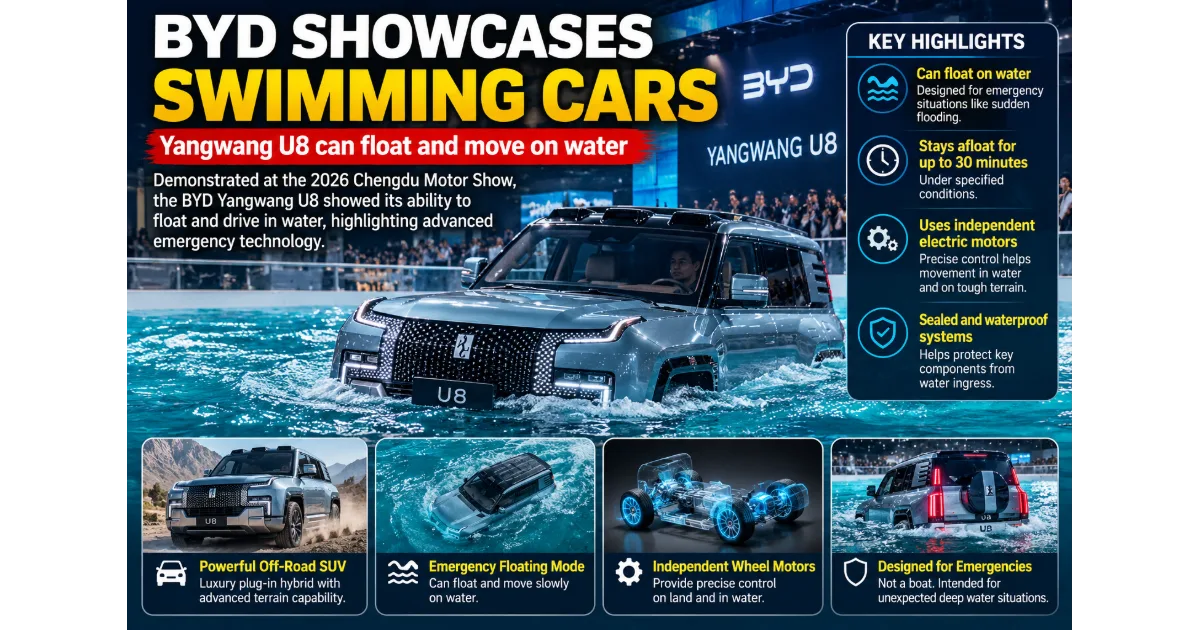
Imagine an SUV driving into a pool, floating on the surface and moving slowly through the water before returning to dry land. It sounds like something from a science-fiction film, but China's BYD has already demonstrated this capability with its luxury off-road vehicle, the Yangwang U8. The feature returned to the spotlight after demonstrations at the 2026 Chengdu Motor Show showed the vehicle floating and moving in a pool of water.
The demonstration has attracted attention because cars are normally designed to remain on roads, not operate on water. The Yangwang U8 challenges that expectation through a combination of sealed vehicle systems, independently controlled electric motors and an emergency floating mode designed for extreme situations. BYD says the vehicle can remain afloat for up to 30 minutes under its specified emergency operating conditions.
The most important detail, however, is that the Yangwang U8 is not an ordinary car that has suddenly become a boat. It is a specialised luxury plug-in hybrid SUV with engineering designed to help it handle certain emergencies involving deep water. Its floating capability is intended as an emergency safety feature, not as permission for drivers to enter flooded streets, rivers or lakes.
The technology raises an interesting question for the automotive industry: as electric motors, battery systems and vehicle controls become more sophisticated, could future vehicles be designed to cope with a wider range of extreme conditions? BYD's demonstration offers one striking example of how automakers are exploring that possibility.
What Is the Yangwang U8?


The Yangwang U8 is a premium SUV developed under Yangwang, BYD's high-end automotive brand. It combines off-road capability with advanced vehicle control systems and a plug-in hybrid powertrain. Unlike a conventional battery-electric SUV, it uses electric drive technology alongside a petrol engine that helps extend its overall driving range.
The U8 was introduced in 2023 and gained international attention when BYD showcased it at the Geneva International Motor Show in February 2024. At the time, the vehicle's ability to float during certain water-related emergencies was one of its most unusual selling points. The model was also presented as a demonstration of BYD's ambition to compete in the luxury vehicle segment, where engineering features and technology can be as important as price and performance.
The SUV is large and heavy, weighing approximately 3.5 tonnes in reported configurations. Its design combines a substantial body, high ground clearance and systems intended for challenging terrain. BYD has also promoted its ability to turn on the spot and move sideways in certain situations, features made possible by independently controlled electric motors.
These capabilities illustrate how electric drive systems can change vehicle design. In a conventional vehicle, the engine and transmission deliver power through a more mechanically interconnected drivetrain. With independently controlled electric motors, software can adjust torque at individual wheels much more precisely. That flexibility can be useful on uneven terrain and during specialised manoeuvres.
The floating function is an extension of this engineering philosophy. It does not mean the vehicle has become a fully amphibious car intended for regular journeys through lakes or rivers. Instead, it is designed to provide a limited ability to float and move slowly in water during specific emergency situations.
How Can a Heavy SUV Float?
The first question many people ask is straightforward: how can a vehicle weighing several tonnes remain on the surface of water?
The basic principle is buoyancy. An object floats when it displaces enough water for the upward force generated by that displaced water to balance its weight. Boats are designed around this principle, using hull shapes and sealed spaces to keep the vessel afloat while carrying people, equipment and fuel.
Cars are not normally built like boats. They contain openings, air passages, mechanical components and other structures that are designed for operation on land. If water enters important areas, the vehicle can lose electrical function, suffer mechanical damage or become unstable. Water can also enter the passenger compartment, increasing the risk to occupants.
The Yangwang U8's emergency floating capability depends on the vehicle being designed to resist water ingress and manage its behaviour during a limited period in water. BYD has described its system as combining waterproofing and sealing with electronic drive control. These measures are intended to help the vehicle remain afloat and maintain controlled movement under specified conditions.
The vehicle is not simply relying on the tyres to act like paddles in the way a person might imagine. Its wheel motors and electronic controls are part of a wider system that allows movement to be managed when the vehicle is afloat. The exact behaviour depends on the operating mode and environmental conditions.
The distinction between floating and swimming is important. In everyday language, videos may describe the U8 as a car that swims, but the demonstrated capability is closer to emergency flotation with limited, controlled movement. The vehicle is not designed to travel across water at normal road speeds, navigate open seas or replace a boat.
Water depth, current, waves, the condition of the vehicle and other factors can affect what is possible. The system's advertised operating window should therefore not be interpreted as a guarantee that the vehicle will remain safe in every flood or water crossing.
What Happens When Emergency Floating Mode Is Activated?
BYD describes the U8's floating capability as an emergency mode intended for situations such as sudden flooding or an unexpected encounter with deep water. The system is designed to prepare the vehicle for the unusual conditions it faces when ordinary road operation is no longer possible.
The vehicle's controls can change how it behaves, while sealing and waterproofing measures help protect important systems. BYD has also described actions such as shutting down the engine, raising the suspension, sealing windows and using the vehicle's sunroof as part of the emergency response sequence. The exact functions depend on the vehicle configuration and system instructions.
Once the mode is engaged, the aim is to keep the vehicle afloat for a limited period and permit slow movement. The manufacturer states that the U8 can remain afloat for up to 30 minutes under the specified conditions. That period is intended to provide a potential escape opportunity, not to support extended travel on water.
A key challenge is that a vehicle designed for land must maintain stability when its usual contact with the road disappears. Tyres can no longer provide conventional grip, and the vehicle's orientation may change as water moves around it. Electronic controls can help manage movement, but they cannot eliminate the physical effects of currents, waves or unstable conditions.
This is why an emergency floating mode should be understood as a specialised safety measure with limitations. It may offer an additional option in certain extreme circumstances, but it cannot make floodwater predictable or guarantee a safe outcome.
Drivers should not attempt to activate such a mode as a recreational experiment or use it to enter water deliberately. Even when a vehicle is designed with advanced sealing, water can be dangerous to occupants, and conditions can change more quickly than a driver can respond.
Why the Chengdu Motor Show Demonstration Matters
The feature received renewed attention during the 2026 Chengdu International Auto Show in China. At the event, BYD presented outdoor demonstrations that included the Yangwang U8's emergency floating capability and an extreme hill-climbing exercise. Visitors could see the vehicle enter a water display area, float and move through the water under controlled conditions.
Automotive exhibitions traditionally focus on static displays. Visitors walk around vehicles, inspect interiors, sit in the driver's seat and compare specifications. Dynamic demonstrations offer a different kind of experience because they allow audiences to see a technology operating rather than relying only on a presentation or promotional description.
For a feature as unusual as emergency flotation, a live demonstration is particularly effective. The audience can observe the vehicle's transition from land to water and see how it behaves while afloat. It provides a more tangible impression of the capability than a photograph or specification sheet alone.
The demonstration also reflects a broader change in the way manufacturers present advanced vehicles. Carmakers increasingly use technology showcases to communicate the capabilities of their platforms, especially when a feature is difficult to explain through conventional performance figures such as acceleration, power output or driving range.
However, a controlled demonstration is not the same as a comprehensive safety test under every possible condition. A purpose-built display environment allows the manufacturer to select the setting, prepare the vehicle and manage the demonstration. Natural floods, rivers and coastal waters present far less predictable circumstances.
The footage can establish that the vehicle demonstrated floating and controlled movement in the conditions shown. It cannot prove that the same result would be achieved in every real-world emergency. That distinction is essential when evaluating spectacular automotive technology.
The Technology Behind Its Independent Electric Motors
One of the U8's defining engineering features is its e⁴ platform, which uses independent control of the wheels to manage how power is delivered. The platform is designed to support precise torque distribution and vehicle movement across different conditions.
In a conventional four-wheel-drive SUV, the engine's output is distributed through mechanical systems that may include differentials, driveshafts and transfer mechanisms. Modern systems can be highly sophisticated, but the drivetrain still has to translate the engine's output into wheel movement through a network of mechanical components.
An independently controlled electric drive system offers another approach. Electric motors can respond quickly to control signals, and the amount of torque delivered to each wheel can be adjusted according to the vehicle's needs. This can improve control during certain manoeuvres and help manage traction on uneven surfaces.
The same broad principle can support features such as a tank turn, in which the vehicle rotates within a very small area, or a sideways manoeuvre sometimes described as crab walking. These functions depend on how the motors are configured and controlled. They are not simply cosmetic tricks, although they can also be effective ways to demonstrate the technology to an audience.
For off-road driving, precise wheel control can help the vehicle respond to changes in grip and terrain. A wheel encountering a slippery surface may require a different torque response from one with strong traction. Electronic control can adjust the distribution of power in an attempt to maintain progress and stability.
During emergency flotation, the challenge changes because the vehicle is no longer operating on a conventional road surface. The system must account for a different physical environment while controlling movement at low speed. The U8's flotation capability is therefore connected to the broader vehicle-control architecture rather than being an isolated feature.
Is It Really an Amphibious Car?
The word amphibious is often used to describe the U8 in headlines, but the term can create an inaccurate impression if it suggests that the vehicle is designed for routine travel both on land and on water.
Traditional amphibious vehicles are built to operate across both environments as part of their intended use. Some military vehicles can drive into water, float and propel themselves through it. Purpose-built amphibious cars and recreational vehicles may also use specialised hulls, propulsion systems and steering arrangements.
The Yangwang U8 is primarily a luxury off-road SUV. Its floating function is intended for emergencies, particularly situations involving unexpected deep water. It is not designed to serve as a regular boat, and its stated flotation period is limited.
That distinction matters because a vehicle's ability to remain afloat does not automatically mean it can safely navigate every body of water. Water movement can push a heavy vehicle away from a safe exit, while debris, hidden obstacles and changing depth can create additional hazards. A driver may also have limited visibility and limited ability to assess what lies beneath the surface.
The U8's demonstration is impressive precisely because ordinary SUVs are not expected to do this. But the correct description is an SUV with an emergency floating mode, rather than an all-purpose amphibious vehicle capable of unrestricted water travel.
Clear terminology helps audiences understand what the technology can and cannot do. It also prevents a promotional demonstration from being interpreted as a promise that the vehicle can replace established safety practices during floods.
Can the Technology Help During Floods?
Flooding is one of the most obvious situations in which emergency flotation could potentially matter. Sudden floods can cover roads, sweep away barriers and trap vehicles in places where drivers did not expect deep water. Even relatively shallow-looking water can be dangerous if the road beneath it has been damaged or the current is strong.
A vehicle that can remain afloat for a limited period may offer an additional layer of protection in some circumstances. If occupants find themselves in water unexpectedly, the ability to keep the vehicle afloat could create time for an escape or rescue. The technology is intended to reduce certain risks, not to eliminate the danger of flooding.
There are important limits. The vehicle may be carried by a current, and it may not be possible to steer toward a safe exit. Water can rise faster than expected, debris can strike the body and waves can affect stability. A floating vehicle can also become difficult to recover if it drifts away from accessible ground.
Floodwater may conceal damaged road surfaces, open drains, electrical hazards or other obstacles. Even if the vehicle's electrical systems are protected against specified water exposure, occupants remain vulnerable to the surrounding environment.
For these reasons, the safest advice remains to avoid driving into floodwater whenever possible. Drivers should follow local emergency instructions, turn around when roads are flooded and seek higher ground when necessary. A special vehicle feature should not encourage people to take risks they would otherwise avoid.
The U8's capability is best viewed as a contingency measure for an unexpected emergency, rather than a strategy for travelling through floods. The distinction is particularly important in regions where heavy monsoon rainfall can produce dangerous conditions in a short time.
What Are the Safety Limitations?
The most important limitation is the advertised time window. BYD says the U8 can remain afloat for up to 30 minutes under the specified emergency conditions. That figure should not be interpreted as a guaranteed duration in every situation, nor does it mean the vehicle can remain submerged for half an hour without consequences.
The operating conditions matter. A calm, controlled demonstration is different from a fast-moving flood or a river with strong currents. The shape of the waterway, the depth, the amount of debris and the condition of the vehicle can all influence the outcome.
A second limitation is that the system is designed around a particular emergency scenario. It is not intended for prolonged travel, deep-sea use or regular crossing of lakes and rivers. The vehicle's movement while afloat is limited, and its performance depends on the circumstances.
A third concern is human behaviour. When manufacturers demonstrate unusual technology, audiences may interpret the capability as an invitation to experiment. Drivers might assume that a vehicle designed to float can safely enter floodwater or that the system will rescue them from any water-related emergency. Such assumptions can be dangerous.
The vehicle's ability to remain afloat does not remove the need for seat belts, safe driving, emergency planning or compliance with local warnings. Nor does it guarantee that a driver can reach a safe location once the vehicle is in water.
The feature should therefore be evaluated as one component of a larger safety strategy. It may provide an additional option when an unexpected situation occurs, but prevention remains more reliable than attempting to manage a flood after entering it.
A Luxury SUV Designed to Showcase Engineering
The Yangwang U8 is also significant because of its position in the luxury market. It was introduced with a reported starting price of around 1.098 million yuan in China, placing it well above mainstream family SUVs. Its target audience is interested not only in transportation but also in premium equipment, performance and distinctive technology.
Luxury automakers have long competed by introducing features that are unusual, technologically complex or difficult to replicate. In the past, these could include advanced suspension systems, specialised transmissions, powerful engines, sophisticated interiors or innovative safety equipment. The U8's flotation mode adds an unconventional capability to that tradition.
The vehicle's other features reinforce the same strategy. Independent wheel control, off-road systems and specialised manoeuvres show how software and electric drive technology can create capabilities that are difficult to deliver through conventional mechanical systems alone.
Such demonstrations also help BYD distinguish its premium brand from the broader market. Electric and hybrid vehicles are increasingly common, and range, charging speed and acceleration are no longer the only ways manufacturers can differentiate themselves. Some brands are now competing through advanced control systems, unusual mobility features and highly integrated vehicle platforms.
The commercial question is whether these features persuade buyers to pay a premium. A capability may attract attention at an auto show, but customers also consider price, reliability, comfort, service support, long-term maintenance and resale value. A striking demonstration does not automatically translate into broad demand.
The U8's floating capability may be most valuable as part of a wider package of engineering and luxury features. It gives the vehicle a distinctive identity, while the overall ownership experience determines whether that identity translates into lasting market appeal.
BYD's Broader Strategy: More Than Electric Cars
BYD is widely associated with battery technology and electric vehicles, but its business spans several connected areas, including vehicle manufacturing, batteries and power electronics. The company has invested heavily in developing components and systems in-house, giving it greater control over the integration of hardware and software.
The Yangwang U8 illustrates the company's effort to apply that technical capability to a high-end product. Instead of competing only on affordability or driving range, the vehicle showcases advanced chassis control, powertrain integration and specialised functions.
This approach also reflects a wider trend in the Chinese automotive industry. Several manufacturers are attempting to compete through a combination of competitive pricing, rapid product development and technology-rich vehicles. Features once associated with expensive niche products are increasingly being explored across different price segments.
The challenge is to make the technology dependable and useful rather than simply impressive. A complicated feature can add cost, increase engineering demands and create new questions about servicing. Manufacturers must determine which innovations provide real customer value and which mainly serve as demonstrations of technical capability.
For BYD, the U8 offers a platform to present its premium engineering ambitions. The vehicle's unusual features can attract attention to the brand and demonstrate how integrated electric drive systems may be used in applications beyond conventional road driving.
Its long-term success will depend on more than a viral demonstration. Buyers need to trust the vehicle's reliability, understand its limitations and have access to appropriate support. The same is true of any advanced automotive system, regardless of how impressive it appears in a video.
Will BYD Bring the Yangwang U8 to India?
The U8 has attracted attention in India before. BYD India showcased the luxury SUV at the Bharat Mobility Global Expo in 2025, presenting it as an example of the technology available within the company's wider portfolio. The display highlighted its water-steering capability and specialised turning manoeuvres.
However, showcasing a vehicle at an exhibition does not necessarily mean that a manufacturer plans to sell it locally. Premium models can be displayed to demonstrate engineering capabilities, measure audience interest or strengthen the brand's image without an immediate commercial launch.
India's market conditions would present several considerations for a vehicle such as the U8. Its premium price positioning, size, powertrain configuration, import costs, service requirements and target audience would all influence the business case. A model developed primarily for China may also need adjustments to meet the requirements of other markets.
The company would need to consider how many customers are likely to buy such a specialised luxury SUV and whether it could provide suitable service and parts support. A rare vehicle with complex technology requires a different ownership infrastructure from a mass-market electric car.
The flotation feature may be especially attention-grabbing in India because many regions experience seasonal flooding. But that alone would not determine demand. Most customers choose vehicles based on daily usability, affordability, comfort, safety, charging or fuel costs and the availability of service.
As of the information reviewed for this article, there is no confirmed basis to claim that the Yangwang U8 is launching for regular sale in India. Its appearance at an exhibition should not be mistaken for an official launch announcement. Consumers interested in the model should look for a formal statement from BYD before assuming it will be available locally.
Could Other Automakers Follow the Same Direction?
BYD is not the only Chinese automaker exploring vehicles with unusual water-related capabilities. Other manufacturers have also begun promoting specialised SUVs designed to float or move slowly through water under particular conditions. Recent coverage has discussed models from Geely and Jetour alongside the Yangwang U8, suggesting that this capability is becoming part of a wider competition around high-tech off-road vehicles.
The underlying idea is not entirely new. Amphibious vehicles have existed for decades, especially in military, rescue and specialised recreational applications. What is different is the attempt to incorporate limited floating capability into a luxury SUV that is otherwise intended for ordinary road use.
This could encourage more manufacturers to explore advanced sealing, electronic control and emergency-response features. As vehicles become more software-driven, functions that were previously difficult to integrate may become easier to manage through coordinated control systems.
However, the fact that a technology is possible does not mean it will become common. The cost of development, additional weight, packaging requirements and complexity all influence whether a feature is appropriate for a mass-market vehicle. Manufacturers must also consider how consumers will use it and whether its safety benefits justify the added expense.
A limited emergency capability may be suitable for certain premium off-road vehicles, but it may not make economic sense for a small city car or a conventional family hatchback. Different vehicle categories have different priorities.
The future of this technology will depend on real-world performance, customer demand and the ability to demonstrate meaningful safety benefits. If manufacturers can show that emergency flotation provides a reliable advantage in defined circumstances, it may influence the design of some future specialist vehicles. If it remains expensive and rarely useful, it may continue to be a niche feature.
The Difference Between a Demonstration and Everyday Driving
One of the biggest risks associated with viral automotive videos is that they can make extraordinary capabilities appear routine. A vehicle floats in a pool, climbs a steep slope or spins in a narrow space, and viewers may conclude that it can perform the same manoeuvre anywhere.
Real-world driving is rarely that controlled. Road conditions change, water moves unpredictably and vehicle performance depends on the environment. Even technologies designed for difficult circumstances have operating limits.
A demonstration can show what a system is capable of under particular conditions. It cannot establish that the same performance is available in every setting. To understand the real value of a feature, viewers need to know the conditions under which it was tested, the limitations identified by the manufacturer and the safety guidance that accompanies it.
This principle applies beyond floating cars. Advanced driver-assistance systems, off-road modes, autonomous parking features and high-speed charging all depend on conditions that can influence performance. A vehicle's advertised capability should never be interpreted as a promise that no risk remains.
For the Yangwang U8, the most responsible message is that emergency flotation is a specialised technology that may help in a narrow set of circumstances. It is not an alternative to flood avoidance or professional rescue services, and it should not encourage drivers to test the system in dangerous water.
Conclusion: An Impressive Innovation, but Not a Boat on Four Wheels
BYD's Yangwang U8 has captured attention because it demonstrates something most drivers would never expect from a luxury SUV. Through a combination of sealing, waterproofing and independently controlled electric drive systems, the vehicle can enter an emergency floating mode, remain afloat for a limited period and move slowly under specified conditions.
The 2026 Chengdu Motor Show demonstration brought the technology back into public view, showing how automotive exhibitions are increasingly becoming live showcases for engineering rather than simply places to display new models. The demonstration also reinforced BYD's ambition to compete in the premium segment through technology that makes its vehicles distinctive.
Yet the most important point is the distinction between capability and safety. The U8's floating function is designed for emergencies, not routine water travel. Its stated 30-minute flotation period is a manufacturer specification under defined conditions, not a guarantee that the vehicle can survive every flood or navigate any river.
The technology is interesting because it expands what a road vehicle may be able to do when faced with an unexpected situation. It also shows how electric motors and integrated control systems can create functions that would be difficult to achieve with conventional drivetrains.
Whether emergency flotation becomes a common feature in the automotive industry remains uncertain. Its adoption will depend on cost, reliability, safety validation and whether buyers consider the capability worth paying for. For now, it is a striking example of how manufacturers are exploring the boundaries of vehicle design.
The Yangwang U8 may look as though it can swim, but its real significance is more precise. It is a luxury SUV engineered to handle a narrow and difficult emergency scenario in a way ordinary vehicles cannot. That is impressive enough without overstating what the technology can do.
#BeyondHeadlines #BYD #YangwangU8 #FloatingCar #SwimmingCar #ElectricVehicles #HybridSUV #AutomotiveInnovation #ChinaEV #CarTechnology #LuxurySUV #EmergencySafety #FloodSafety #FutureOfMobility #AutoNews #EVTechnology