When the World's Biggest Technology Companies Start Cutting Jobs
The technology industry has spent years promising that innovation would create new opportunities, improve productivity and transform the way people work. From cloud computing and smartphones to artificial intelligence, each major technological shift has opened new markets and created demand for specialised skills. Yet 2026 has brought another uncomfortable reality into focus: some of the world's largest technology companies are reducing their workforces even as they invest heavily in new technologies and continue to generate enormous business activity.
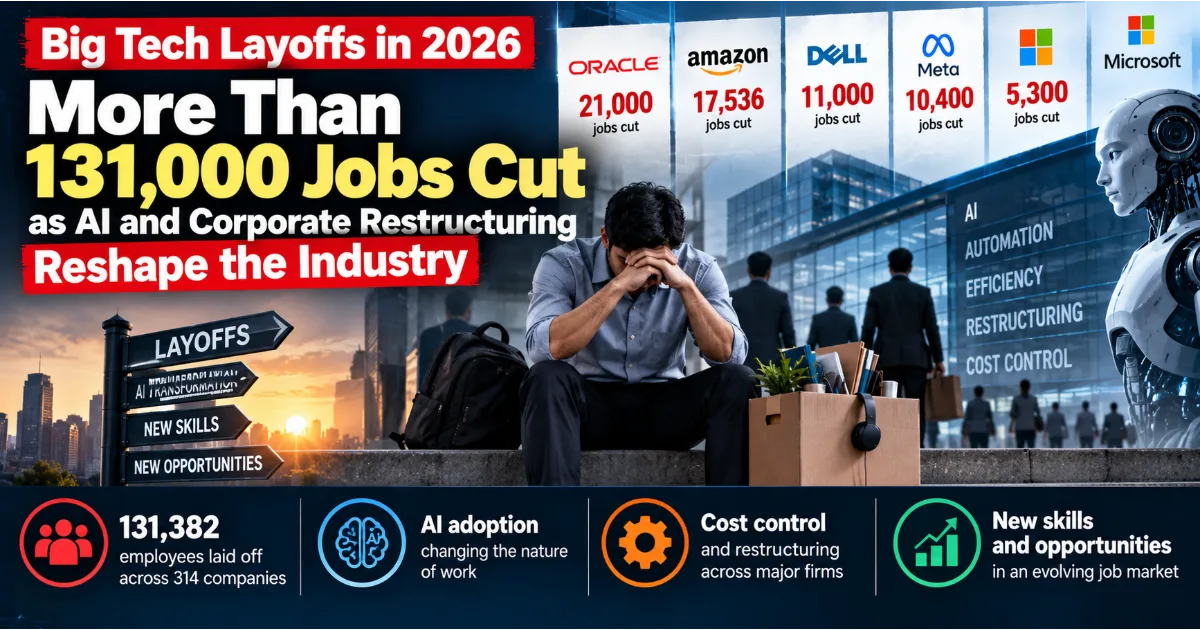
According to Layoffs.fyi, a public tracker of technology-sector job cuts, 131,382 employees had been recorded as laid off across 314 companies and 354 layoff events in its 2026 tracker as of the latest available update in October. These figures are based on reported events and should be treated as tracker estimates rather than a comprehensive official count of every technology job lost worldwide. Nevertheless, they provide a clear indication of the scale of the disruption.
The names appearing on the list make the trend particularly significant. Oracle, Amazon, Dell, Meta, Microsoft, Block, Cisco, Uber and other well-known companies have recorded substantial workforce reductions this year. Some have eliminated thousands of positions, while others have announced smaller cuts affecting particular teams, departments or locations. The reasons differ, but the broader pattern points towards a technology industry that is reconsidering how many people it needs, where it needs them and what work it expects them to perform.
The latest developments also show that this is not simply a story about struggling startups running out of money. Established corporations with extensive customer bases and major technology operations are also reorganising. Amazon, for example, announced another round of cuts in October, with fewer than 1,000 white-collar positions affected in its Stores division, according to Reuters. The company said the changes were intended to align its organisation more closely with business priorities.
Artificial intelligence has become a central part of the discussion. Technology companies are spending heavily on AI models, computing infrastructure, data centres and products that promise to automate more tasks. At the same time, executives are reviewing existing teams and looking for ways to increase output without expanding headcount at the same pace as in previous years.
However, it would be inaccurate to say that artificial intelligence alone is responsible for every layoff. Many companies are also responding to earlier overhiring, pressure to control costs, organisational overlap, changing customer demand and the need to improve profitability. AI can influence these decisions, but it exists alongside other business pressures.
For employees, the consequences are immediate. Losing a job can mean months of uncertainty, financial pressure and a difficult search for another position in a market where many experienced professionals are competing for fewer openings. For students and fresh graduates, the situation raises questions about which skills will remain valuable and whether traditional routes into technology careers will continue to provide the same opportunities.
The story is especially important for India, where technology services, global capability centres, software development and startup employment support millions of workers directly and indirectly. Changes in hiring and staffing decisions at multinational companies can influence opportunities in Bengaluru, Hyderabad, Pune, Chennai, Gurugram and other technology hubs.
The central question is therefore bigger than the number of jobs lost. Is the technology industry entering a period in which companies expect fewer employees to deliver more work, and what will that mean for the future of employment? To understand the answer, it is necessary to examine the companies making cuts, the business pressures behind their decisions and the opportunities that may emerge as the industry changes.
The Scale of the Layoff Wave in 2026
The 2026 figures are striking because they combine hundreds of separate workforce decisions rather than one industry-wide announcement. Layoffs.fyi's tracker lists 314 companies with layoffs and 354 recorded events, suggesting that job reductions have occurred across a broad range of businesses. Its largest company totals include Oracle with 21,000 reported cuts, Amazon with 17,536, Dell with 11,000, Meta with 10,400 and Microsoft with 5,300.
These numbers need to be interpreted carefully. A tracker may combine several rounds of layoffs at the same company, and the total for a business does not necessarily mean that all those employees were dismissed in one announcement. Some reported figures can be revised as additional information becomes available. In addition, different trackers may use different definitions of a technology company and may not include every workforce reduction.
Even with these limitations, the data reveal that the impact is not confined to one part of the industry. Enterprise software companies are reducing staff while reviewing costs and investment priorities. E-commerce and cloud businesses are changing organisational structures. Hardware and networking companies are adjusting operations. Consumer technology platforms are reshaping teams as they invest in new products and AI capabilities.
The mix of companies also challenges the assumption that layoffs occur only when businesses are failing. Some employers undertake workforce reductions while continuing to operate at a large scale, pursue new markets or invest in infrastructure. A company may decide that its existing organisational structure is too expensive or too complicated for its next stage of growth, even if its overall business remains substantial.
This distinction matters because the public often interprets layoffs as a direct signal of financial distress. Sometimes that is true, particularly when a business is facing declining demand or a cash shortage. In other cases, the company is attempting to improve efficiency, eliminate overlapping roles or shift spending towards a different set of priorities.
For employees, however, the distinction does not remove the consequences. Whether a position disappears because of financial pressure, automation or a strategic reorganisation, the person holding that role still needs to find a new source of income. A business may describe its decision as a long-term investment in competitiveness, while an affected worker experiences it as an immediate disruption to a career and household budget.
The scale of the current wave also raises a question about the assumptions that shaped technology hiring in previous years. During periods of rapid growth, companies often recruit aggressively because they expect customer demand to continue rising. When the market changes, organisations may discover that they have more employees, management layers or duplicated responsibilities than their revised strategy requires.
The result is a cycle in which companies first expand their workforces and later attempt to correct the structure. In 2026, that cycle is intersecting with a new wave of AI investment, making it harder to separate the consequences of earlier business decisions from the effects of technological change.
Which Major Technology Companies Have Cut Jobs?
Oracle and the pressure to reorganise enterprise technology
Oracle appears at the top of Layoffs.fyi's company totals for 2026, with 21,000 reported job cuts across two recorded events. The company's position is significant because enterprise software and cloud computing remain essential to businesses worldwide. Oracle operates in markets where customers expect reliable services, continued product development and increasingly sophisticated computing infrastructure.
The broader context is a technology market in which companies are committing substantial resources to AI infrastructure and cloud services. Such investment can create demand for engineers, data specialists and infrastructure experts, but it can also force management teams to review spending elsewhere. Organisations may choose to reduce some functions while increasing investment in areas they consider more strategically important.
It is important not to assume that every position removed at Oracle was replaced by AI or that the company's workforce decisions can be explained by one factor. The overall figures show the scale of recorded cuts, but they do not provide a complete breakdown of the reasons for each employee's departure. Understanding the effect on specific teams requires looking at individual announcements and the company's stated plans.
Amazon and the continued correction of its workforce
Amazon has recorded 17,536 job cuts in the Layoffs.fyi 2026 tracker. The company has also continued to make smaller reductions in particular divisions. In October, Reuters reported another round affecting fewer than 1,000 white-collar roles, primarily within its Stores division. Employees in the United States, India and the United Kingdom were among those affected, according to reporting on the announcement.
Amazon's situation illustrates how large companies can continue restructuring long after an initial round of cuts. The company expanded significantly during the pandemic, when online shopping demand rose sharply. As business conditions changed, it began reviewing costs and organisational structures. Later reductions have occurred as it seeks to align its workforce with its current priorities.
AI is also relevant to Amazon's longer-term strategy, particularly in customer service, logistics, software development and cloud computing. Automated systems may change how routine work is performed, but the company's workforce changes cannot all be attributed to automation. Business reorganisation and the correction of earlier hiring decisions also matter.
For employees, repeated rounds of cuts can create uncertainty even among those who keep their positions. Workers may worry about future reorganisations, changes to their responsibilities or whether their skills will remain in demand. Such uncertainty can affect morale and make it more difficult for teams to focus on long-term projects.
Dell and the changing economics of hardware
Dell has 11,000 reported job cuts in the 2026 tracker. The company's business sits at the intersection of computer hardware, enterprise infrastructure and IT services, sectors affected by changes in business spending and the growing demand for AI computing.
The hardware industry faces an unusual combination of opportunities and pressures. Demand for AI infrastructure can create business for companies supplying servers, storage and related equipment. At the same time, businesses may delay other technology purchases, seek lower costs or change how they organise sales, support and operations.
A company's ability to benefit from a new market does not mean every department will expand. Management may decide to move resources towards higher-priority products while reducing roles in areas it expects to grow more slowly. These choices can produce workforce cuts even when the company continues to participate in a major technology investment cycle.
Meta and the restructuring of work around AI
Meta has recorded 10,400 job cuts across four events in the 2026 tracker. Reporting on its workforce changes has also highlighted a shift in priorities towards AI-focused work. A report published by the Indian Express said Meta laid off around 8,000 employees in May while moving approximately 7,000 other workers into AI-focused initiatives.
This distinction is important. A company can remove some jobs while creating new responsibilities elsewhere, but the new opportunities may not be available to the same employees. A person whose role is eliminated in one department may not have the technical background or experience needed for a newly created AI position.
AI development requires a wide range of skills, including software engineering, data management, computing infrastructure, product design, evaluation, security and research. Not every worker can move directly from a traditional role into one of these areas. Retraining may help, but it takes time, and some jobs require deep technical expertise that cannot be acquired through a short course.
Meta's example therefore reflects a broader employment challenge: the number of jobs in a company is only one part of the story. The types of jobs available, the skills they require and the speed at which employees can transition between roles are equally important.
Microsoft, Cisco and other established employers
Microsoft has recorded 5,300 job cuts in the 2026 tracker, while Cisco has recorded 4,000. These figures show that workforce restructuring is not limited to consumer-facing platforms or companies dependent on advertising revenue. Enterprise software, networking and business technology are also being reshaped.
Technology companies are competing to supply tools and infrastructure for a market increasingly influenced by AI. That competition requires investment, but it also encourages executives to reconsider existing cost structures and organisational layers. Companies may seek to direct more capital towards computing capacity, product development and AI-enabled services while trimming other expenses.
For workers, the uncertainty extends beyond whether a particular employer announces layoffs. A company can remain a major player in its industry while changing the skills it values, the locations where it hires and the number of people it assigns to specific tasks. Employees therefore need to pay attention not only to corporate announcements but also to changes in the work itself.
Why Are Technology Companies Cutting Jobs?
There is no single explanation for the 2026 layoffs. The current wave is the result of several overlapping forces, and the balance differs from one company to another.
1. Correcting earlier overhiring
One of the clearest reasons for workforce reductions is the correction of hiring decisions made during earlier periods of rapid growth. During the pandemic, online commerce, digital collaboration, cloud services and other technology businesses experienced significant changes in demand. Many companies recruited aggressively because they expected strong growth to continue.
When demand patterns changed, businesses had to reassess the size of their workforces. Some discovered that teams had expanded faster than revenue or long-term requirements justified. Others had duplicated management roles or overlapping responsibilities following acquisitions and internal reorganisations.
Reducing headcount can be a way to bring operating costs into line with a revised business outlook. It can also reflect a change in management priorities rather than a sudden collapse in customer demand. This is why layoffs sometimes occur at companies that remain profitable or continue to invest heavily in new products.
However, repeated corrections can create a cycle of instability. If a company repeatedly hires too quickly and then cuts staff, employees bear the cost of decisions made at the organisational level. A healthier approach to workforce planning would link recruitment more closely to sustainable demand, long-term strategy and realistic productivity expectations.
2. The growing influence of artificial intelligence
AI has become one of the most important factors influencing technology investment. Companies are developing AI assistants, automated customer support, code-generation tools, data-analysis systems and software that can handle tasks previously performed by people. As these systems improve, employers are considering how their use could change staffing needs.
Some tasks can be automated or completed more quickly with AI assistance. A developer may use AI tools to generate an initial version of code, a support team may automate routine customer questions, and an analyst may use AI to organise information or prepare a first draft of a report. When such tools become part of everyday workflows, companies may be able to produce more output with the same number of employees.
That does not automatically mean every productivity gain will lead to job losses. Businesses may use improved efficiency to expand their services, enter new markets or develop products that were previously too expensive to build. AI can also create new work involving model evaluation, security, data governance, integration and oversight.
The employment outcome depends on how companies use the technology. If management uses AI primarily to reduce costs, fewer workers may be required for certain tasks. If it uses AI to expand production and launch new services, the technology may create additional roles. In many cases, both outcomes can occur within the same organisation.
It is also difficult to measure how much of the current layoff wave is directly caused by AI. Corporate statements may describe AI as a strategic priority without demonstrating that an automated system has replaced every affected role. Companies may also use AI investment as part of a broader explanation for changes that include cost control and organisational simplification.
The most reliable conclusion is that AI is changing how technology companies think about work, but the effect on employment is uneven and still developing. Treating every layoff as proof that AI has replaced workers would oversimplify a complicated economic transition.
3. The cost of building AI infrastructure
AI is not only a software story. Developing and operating advanced systems requires computing power, data centres, networking equipment, energy and specialised technical expertise. These investments can be expensive, and companies may need to prioritise where they allocate their capital.
The International Monetary Fund warned in October 2026 about financial stability risks associated with high AI-related valuations and growing debt among some AI businesses. Its concerns included the possibility that a reassessment of AI profitability could trigger a market correction. The warning does not establish that AI investment directly caused the current layoffs, but it illustrates the financial pressures surrounding the industry's rapid expansion.
When companies commit large sums to AI infrastructure, they face pressure to demonstrate that those investments will generate returns. They may review existing spending, reduce projects with lower expected value and move resources towards products they believe will grow faster. Workforce reductions can become one element of that process.
The challenge is that AI investment has both long-term potential and substantial uncertainty. Some applications may produce major gains, while others may struggle to generate enough revenue to justify their costs. If companies invest aggressively before demand becomes clear, they may later need to revise their plans.
For employees, this creates an uncomfortable situation. AI may be presented as the future of the business, but the financial effort required to build that future can contribute to the elimination of jobs in other parts of the organisation.
4. Pressure to improve profitability and productivity
Investors often expect large companies to show that they can control expenses and convert revenue into sustainable profits. When growth slows or costs rise, executives may seek to simplify operations and improve productivity. Staff reductions are one way to lower costs, although they can also weaken morale and reduce institutional knowledge.
Some organisations have accumulated multiple layers of management, overlapping teams or processes that make decisions slower. A restructuring may remove these layers and clarify responsibility. In other cases, however, cuts can leave remaining employees with heavier workloads, increasing the risk of burnout and mistakes.
The effects depend on whether a company redesigns its work intelligently or simply removes employees to meet a short-term financial target. A successful restructuring should make the organisation more effective. If the same work remains but fewer people must complete it, service quality and innovation can suffer.
For this reason, job cuts should not automatically be interpreted as evidence that a company has become more productive. The actual result depends on how work is redistributed, whether technology improves processes and whether the business can maintain quality after the reductions.
5. Mergers, acquisitions and overlapping teams
Technology companies often acquire other businesses to gain products, customers, intellectual property or specialised talent. After an acquisition, the combined organisation may discover that both companies have separate teams performing similar functions. Management may then consolidate departments, integrate software systems and eliminate positions it considers duplicative.
Mergers can create opportunities by combining expertise and expanding access to customers. But the integration process can also be disruptive, particularly when employees do not know which teams will remain or how their responsibilities will change. Even when a merger makes commercial sense, it can produce job losses for people whose work overlaps with that of colleagues in the acquired business.
These changes are not necessarily connected to AI. They reflect a long-standing feature of corporate restructuring that continues alongside the industry's technological transformation.
What Do These Layoffs Mean for India's Technology Workforce?
India occupies a distinctive position in the global technology economy. It is a major destination for software development, IT services, engineering operations, customer support and global capability centres. Multinational companies employ Indian professionals in roles ranging from application development and cybersecurity to finance, research, analytics and product management.
Consequently, changes at international technology companies can affect Indian workers even when the original announcement is made in another country. Companies may restructure teams across multiple regions, move work between offices or consolidate functions in locations they consider more efficient. The effects depend on the company's operations and the roles involved.
An India-focused tracker based on reported layoff events recorded 4,725 people affected across 25 tracked Indian technology-company events by September 14, 2026. The list included reported reductions at Livspace, Ola Electric, Zomato, CorroHealth and Flipkart. These figures reflect the tracker's selected companies and reporting period, not a complete official count of all job losses in India's technology sector.
The tracker data also demonstrate why global and India-specific totals should not be combined carelessly. A multinational company's global layoff figure may include employees in India, but the public announcement may not provide a full country-by-country breakdown. Adding the global total to an India estimate could count some workers twice.
For professionals in India, the most important issue is not simply how many jobs have disappeared. It is how hiring requirements are changing. Companies may continue recruiting for AI engineering, cloud infrastructure, cybersecurity and data-related work while reducing positions in other functions. This can create a difficult transition for workers whose experience does not match the new requirements.
Fresh graduates may face particular pressure. Entry-level roles have traditionally helped students develop practical experience, learn from senior colleagues and progress into more specialised positions. If companies automate routine tasks or reduce junior hiring, the pathway into the industry may become less straightforward.
That does not mean technology careers are disappearing. It means that employers may place greater emphasis on practical problem-solving, domain knowledge, communication and the ability to work effectively with new tools. Candidates who understand the business problems behind the technology may be better positioned than those who rely entirely on familiarity with a particular programming language or software platform.
India's technology industry also has opportunities to benefit from AI adoption. Businesses need people who can integrate new systems into existing operations, maintain security, assess reliability and help customers use AI responsibly. The challenge is to ensure that workers have realistic opportunities to acquire these skills before their current roles become less relevant.
Are All Technology Jobs at Risk?
No. Technology employment is changing, but the risks differ substantially across roles, companies and levels of experience.
Jobs built around repetitive tasks may face greater pressure when software can perform those tasks reliably at a lower cost. Certain forms of routine documentation, basic data processing, standardised customer support and simple code generation can be assisted or partly automated by AI tools. However, the extent of replacement depends on the complexity of the work, the consequences of errors and the systems available to the employer.
Roles involving complex judgement, accountability, security, human relationships and specialised knowledge can be harder to automate completely. Even there, AI may change how the work is performed. A professional may handle more cases, analyse information more quickly or supervise systems that carry out routine steps.
The distinction between task automation and job elimination is crucial. A job usually consists of multiple activities, not one isolated task. Automating a portion of the work may change the role without removing the position. In other cases, if a company can redesign a process around automated systems, it may need fewer employees overall.
The future is therefore unlikely to be a simple divide between jobs that survive and jobs that disappear. Many roles will change. Some new occupations will emerge, while others may shrink. Workers will need opportunities to learn, and employers will need to decide how to manage transitions responsibly.
What Should Workers Do to Prepare?
For employees, responding to layoffs requires a practical approach rather than panic. No individual can guarantee that a job will remain unaffected by restructuring, but workers can improve their ability to adapt.
The first priority is to understand how work is changing within one's own field. A software developer should pay attention to how AI-assisted development affects coding, testing and system design. A business analyst should understand how automated reporting changes data interpretation and decision-making. A customer support professional may benefit from learning how to manage complex cases that automated systems cannot resolve independently.
Second, professionals should develop skills that complement technology. These may include critical thinking, communication, project management, cybersecurity awareness, data interpretation and domain-specific knowledge. The most useful combination will vary by career, and not every worker needs to become an AI researcher or machine-learning engineer.
Third, workers should focus on demonstrable ability rather than collecting certificates without a clear purpose. Practical projects, work samples, measurable improvements and relevant experience can help demonstrate competence. Learning a new tool is useful, but understanding how to apply it to a real problem is often more valuable.
Fourth, financial preparation matters. Where possible, maintaining emergency savings, controlling unnecessary debt and understanding household expenses can reduce the pressure of an unexpected job loss. Not everyone has enough income to build substantial savings, but even a realistic financial plan can help people make decisions under stress.
Finally, employees should avoid assuming that every corporate announcement predicts the future of their individual role. Layoffs can affect one department while another expands. Workers should pay attention to official company communications, their own team's direction and changes in demand for their skills rather than relying only on social media rumours.
What Responsibility Do Technology Companies Have?
Companies have legitimate reasons to restructure. Businesses need to remain competitive, invest in new products and adjust when markets change. Keeping every role unchanged regardless of business conditions is not always possible or practical.
However, the way companies conduct layoffs matters. Employees who have contributed to a business should receive clear information, appropriate notice where required, and the severance or other support promised under applicable law and company policy. Communication should be direct and respectful, particularly when people have to make important financial and family decisions.
Companies can also consider whether affected employees can be retrained or moved into other roles before positions are eliminated. Internal mobility will not be possible in every case, and new positions may require skills that cannot be acquired quickly. Nevertheless, organisations investing heavily in new technologies have an opportunity to help some existing employees prepare for changing work.
The responsibility extends to the employees who remain. Repeated restructuring can damage trust and leave teams worried about the next round of cuts. If a company expects remaining workers to take on substantially more work, it should consider whether staffing, training and management processes are adequate.
AI adoption should also be evaluated on more than its immediate effect on payroll. Reliable products, responsible data use, cybersecurity and the quality of customer service remain important. A company that reduces costs but weakens these foundations may create new problems that outweigh the savings.
The best long-term strategy is not simply to have fewer employees. It is to build an organisation that can use technology effectively while retaining the human expertise necessary for sound judgement, innovation and accountability.
Conclusion: The Future of Tech Work Is Being Redefined
The technology layoffs of 2026 represent more than a series of corporate announcements. With Layoffs.fyi recording 131,382 employees affected across 314 companies and 354 events in its latest tracker, the scale of the workforce disruption is difficult to ignore. Oracle, Amazon, Dell, Meta, Microsoft and other major employers have recorded substantial cuts, although the reasons and effects differ across businesses.
Artificial intelligence is an important part of the story because it is changing how companies think about productivity, software development and the organisation of work. But the layoffs also reflect earlier overhiring, pressure to improve profitability, mergers, cost reduction and changing business priorities. Treating every job loss as a direct consequence of AI would miss the wider economic picture.
For India, the implications are significant. The country has a large technology workforce and a strong role in global IT services and engineering. It also has an opportunity to develop expertise in AI implementation, data, cybersecurity, cloud computing and other growing fields. Turning that opportunity into sustainable employment will require investment in skills, practical education and the ability to adapt to changing business needs.
The immediate challenge is to support workers affected by layoffs while helping others prepare for changing roles. Companies need to manage transitions responsibly, governments and educational institutions need to improve access to relevant training, and individuals need realistic ways to develop new capabilities without assuming that every career can be transformed overnight.
The longer-term question is how the benefits of technology will be distributed. If AI enables companies to produce more with fewer people, the economic gains could support new products, better services and new industries. But those benefits will not automatically reach workers whose roles are eliminated. The transition will depend on business decisions, labour-market conditions, education and the opportunities available to people seeking new work.
Technology has always changed employment, but the speed and scale of AI adoption make this period particularly important. The companies that succeed will need to do more than automate tasks or reduce headcount. They will need to create useful products, earn customer trust and build organisations that can innovate sustainably.
The real story of the 2026 layoffs is not simply that technology companies are employing fewer people. It is that the definition of valuable work is changing, and workers, employers and governments must decide how to respond.
#BeyondHeadlines #BigTechLayoffs #TechLayoffs2026 #ArtificialIntelligence #FutureOfWork #TechnologyIndustry #Amazon #Oracle #Microsoft #Meta #Dell #IndianIT #TechJobs #AIAndJobs #WorkforceRestructuring #GlobalEconomy #BeyondTheHeadline