A New Fee Challenges India's Free Digital Payments Model
India's Unified Payments Interface, widely known as UPI, has transformed the way millions of people pay for everyday purchases. From roadside tea stalls and neighbourhood grocery shops to large retailers, online businesses and restaurants, scanning a QR code and completing a payment has become a routine part of daily life. The system has made digital payments convenient for customers and has helped businesses accept money without depending entirely on cash.
That is why the proposed introduction of Merchant Discount Rate charges on selected UPI transactions has attracted so much attention. The debate is not simply about a payment fee. It concerns who should pay for the infrastructure behind digital payments, how that infrastructure should be funded, and whether a system promoted for its accessibility can introduce new costs without changing consumer behaviour.
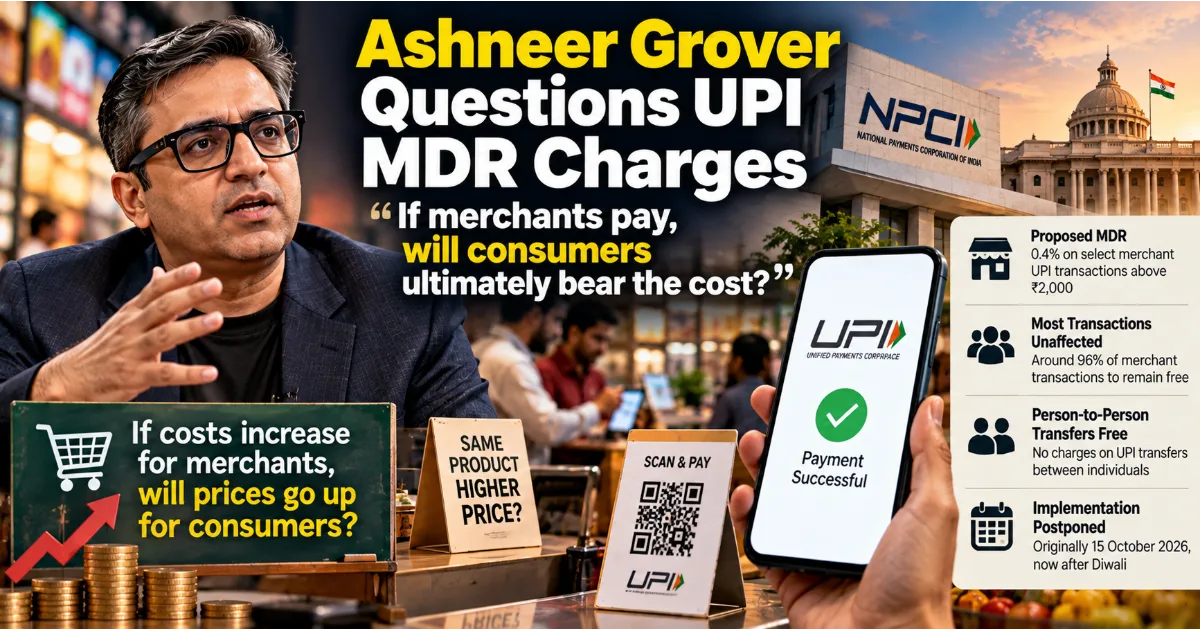
Former BharatPe co-founder Ashneer Grover has emerged as one of the prominent critics of the proposed charges. In September 2026, he argued that a fee officially imposed on merchants could eventually affect consumers because businesses may recover additional operating costs through higher prices. He also questioned why a charge should apply to selected merchant payments when person-to-person UPI transfers remain free.
The government and the National Payments Corporation of India, or NPCI, have presented a different argument. Their position is that the fee applies to specified merchant transactions, not to ordinary person-to-person transfers, and that most merchant transactions will remain unaffected. The government says the framework is intended to help support the financial sustainability of the payment ecosystem while protecting individuals and small merchants from additional charges.
The proposed framework was scheduled to begin on 15 October 2026. However, NPCI subsequently postponed its implementation until after Diwali, with a new date to be announced separately. As of 15 October, the revised implementation date had not been confirmed in the reports available.
This postponement has given the industry additional time to prepare, but it has not resolved the underlying debate. Merchants still want clarity about their costs, payment companies need a sustainable revenue model, and consumers want reassurance that using UPI will not become more expensive.
At the centre of the controversy is a fundamental economic question: even when a fee is formally charged to a business, who ultimately bears its cost?
The answer depends on how merchants respond, how much competition they face, the margins they earn and whether the fee changes their pricing decisions. Grover's warning raises a legitimate question about possible cost pass-through, but it does not establish that every merchant will increase prices or that every consumer will pay more.
To understand the controversy, it is necessary to examine what MDR means, which transactions are covered, why the fee is being introduced, what critics are arguing and how the decision could affect India's digital payments ecosystem.
What Is MDR, and How Does It Work?
Merchant Discount Rate, commonly called MDR, is a fee associated with processing a digital payment. In a typical arrangement, the merchant accepting the payment pays the fee to the payment ecosystem. The amount may be distributed among participating institutions and service providers, depending on the applicable framework.
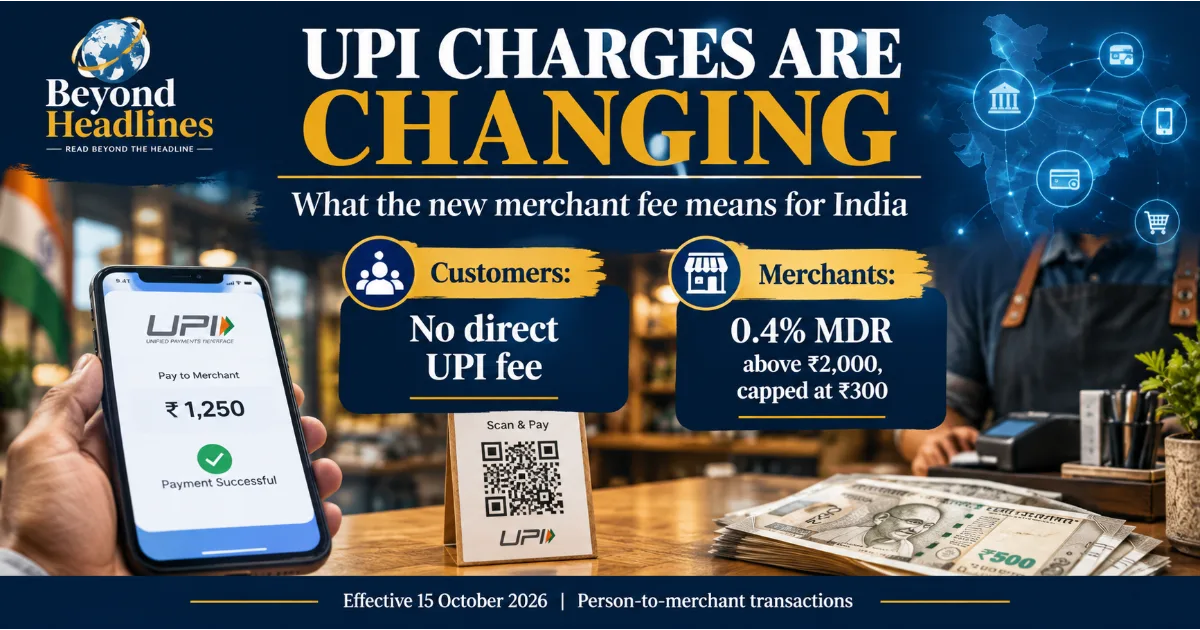
Consider a customer who buys a product worth ₹10,000 and pays through an eligible UPI transaction. Under the proposed general MDR rate of 0.4%, the merchant would face a fee of ₹40, subject to the rules and limits of the framework. The merchant would therefore receive ₹9,960 before accounting for other applicable costs. The customer would still initiate a payment of ₹10,000, rather than automatically paying an additional ₹40 as a separate UPI charge.
The distinction is important because the fee is imposed on the merchant, not directly added to the customer's payment by the UPI system. Whether the merchant later changes prices to recover that expense is a separate economic question.
MDR is not unique to UPI. Fees for processing digital payments exist in different forms across payment systems, although the structure and amount depend on the payment method, provider, transaction type and applicable regulations. The debate in India is particularly sensitive because UPI has become associated with low-friction, widely accessible payments, and the introduction of a merchant fee represents a change to that experience.
The proposed UPI framework is also not a universal charge on every digital transaction. It distinguishes between different types of payments and merchant categories. Person-to-person transfers are outside the new MDR framework, and specified merchant transactions remain exempt. The government's stated position is that approximately 96% of merchant transactions will remain unaffected.
Understanding these distinctions is essential. Headlines suggesting that every UPI payment will now attract a fee are misleading. At the same time, saying that customers can never be affected because the fee is technically paid by merchants would ignore how businesses make pricing decisions.
The real question is how the costs and benefits are distributed across the payment system.
Which UPI Transactions Are Expected to Attract the Fee?
The framework announced in September 2026 applies to specified person-to-merchant, or P2M, transactions above ₹2,000. These are payments made by customers to businesses, such as purchases from eligible retailers or payments to participating commercial service providers.
Under the reported general framework, the proposed MDR rate is 0.4% for eligible transactions, with a maximum fee of ₹300 per transaction. Certain categories, including specified railway, telecom, insurance and fuel payments, have been reported as subject to a different nominal fee structure. Capital-market transactions also have a separate reported rate. The precise treatment depends on the relevant category and transaction rules.
The framework distinguishes between a payment to a business and a transfer between individuals. Sending money to a friend or family member through a person-to-person UPI transfer remains free under the announced policy, irrespective of the amount transferred. The same principle applies to eligible merchant transactions that fall within the stated exemptions.
The government has also stated that small merchants covered by the zero-MDR framework will remain exempt. Reports on the proposal describe a threshold connected to monthly UPI receipts, with small merchants receiving up to ₹1 lakh per month through eligible arrangements exempt from the fee. Merchants should consult the final applicable rules and their payment provider for the exact classification and treatment of their accounts.
These exemptions are intended to protect ordinary low-value transactions and smaller businesses. That matters because UPI is heavily used for small purchases, where even a small processing cost can be significant relative to the merchant's profit margin.
However, thresholds can create complicated incentives. Two businesses selling identical products may face different costs if one qualifies for an exemption and the other does not. The precise effect will depend on how the rules are implemented, how merchants are classified and whether their payment patterns change.
For consumers, the practical takeaway is that the announcement does not mean every payment above ₹2,000 will automatically become more expensive at the checkout. The fee is a merchant-side charge under specified conditions, and most merchant transactions are expected to remain outside the framework.
The distinction between the formal rule and its possible commercial consequences is the central issue in Grover's criticism.
What Exactly Is Ashneer Grover Objecting To?
Grover's criticism focuses on the economic logic of charging merchants for certain UPI transactions while keeping person-to-person transfers free. In media interviews, he questioned whether the cost of operating the underlying payment infrastructure changes meaningfully simply because a transaction is a merchant payment above a particular amount. He argued that if the system has a cost, the justification for charging one category while exempting another needs to be explained.
He also challenged the language used to describe the charge, arguing that if the burden eventually reaches the consumer, it should not be presented as though the customer is entirely unaffected. His argument is that a business faced with an additional fee may respond by increasing prices, reducing discounts or adjusting its payment policies.
This is a familiar concern in economics. A fee may be legally payable by one party while its economic burden is shared with others. A retailer might absorb the expense, pass some of it on to customers, negotiate different terms with suppliers or attempt to shift transactions towards another payment method. The result is not predetermined.
Grover has also questioned why the payment ecosystem cannot be supported through other sources of funding, including the resources available to large financial institutions and public authorities. His position reflects a broader debate about whether digital payments should be treated primarily as a commercial service that needs to generate direct revenue or as public digital infrastructure whose wider economic benefits justify continued support.
These are arguments about policy design and the distribution of costs. They should be treated as Grover's views rather than as established proof that the fee is unnecessary or that every merchant will pass it on.
The response from the industry has also shown that there is no single consensus on how the payment ecosystem should be funded. BharatPe, the company Grover co-founded, supported the new MDR framework and clarified that his criticism represented his personal view rather than the company's position.
That distinction matters. A founder's past association with a company does not mean the company agrees with every public statement he makes. BharatPe's position highlights the perspective that a fee can help fund a stronger and more sustainable payments ecosystem.
Grover's central question remains relevant, however: if merchants bear the formal charge, what prevents some of the cost from eventually reaching customers?
Will Consumers Ultimately Pay More?
The possibility of cost pass-through is the strongest economic element of Grover's argument. Businesses do not operate in isolation. Their costs include rent, salaries, inventory, electricity, logistics, technology and payment processing. When one of these expenses increases, the business must decide whether to absorb it or adjust something else.
Imagine a retailer that accepts a large number of eligible UPI payments. If a new processing fee reduces its margin, the owner has several options. The retailer could absorb the cost, raise prices slightly, reduce promotional discounts, negotiate better terms with suppliers or encourage customers to use another payment method. Different businesses may choose different responses.
The effect on consumers therefore depends on market conditions.
A business facing strong competition may find it difficult to raise prices without losing customers. If several nearby stores sell the same product at similar prices, the merchant may decide that absorbing the fee is less damaging than risking a loss of sales. In this situation, the merchant's profit margin could fall, but the consumer might not notice a direct price increase.
A business with greater pricing power may have more room to recover the cost. If customers have few alternatives or value the convenience of a particular service, the merchant may be able to adjust prices without losing too much demand. The fee could then contribute to higher prices, although the size and timing of the increase would depend on other business conditions.
The impact may also vary by sector. A large retailer with substantial sales and multiple payment options may manage a new expense differently from a small service provider operating on thin margins. A business selling high-value products may process relatively few transactions but face larger fees on each eligible payment. Another business may have many low-value transactions that remain exempt.
There is also a difference between an explicit surcharge and a general price adjustment. If a merchant adds a separate fee for UPI, customers can see the connection between the payment method and the extra expense. If the merchant changes the price of the product for everyone, the connection becomes less obvious. The second approach may distribute the cost across customers who use cash, cards or other payment methods as well.
The government's stated position is that merchants should not pass the charge on to customers. However, a policy instruction and the economic incentives facing thousands of independent businesses are not the same thing. The effectiveness of such a restriction depends on clear rules, merchant awareness, monitoring and a practical mechanism for handling complaints.
It would be premature to conclude that consumers will definitely pay more. It would be equally premature to assume that consumers cannot be affected simply because they are not directly billed by the payment system.
The evidence to watch after implementation will include merchant pricing, checkout complaints, changes in payment preferences and the responses of different business categories. Those outcomes will provide a stronger basis for judging the impact than predictions alone.
Why the Government and NPCI Want a Merchant Fee
To understand the other side of the argument, it is necessary to examine the economics of UPI itself. A payment that appears effortless to a customer still depends on a complex network of institutions and technology.
Banks maintain accounts and process transactions. Payment service providers connect users to the system. UPI applications provide the interface through which people scan QR codes, authorise payments and check transaction histories. Infrastructure must be maintained, security risks addressed, fraud investigated and systems upgraded as transaction volumes grow.
These activities have costs. As digital payments become more widespread, the ecosystem needs sufficient resources to maintain reliability, improve security and support new services. A payment system that is inexpensive for the customer is not necessarily cost-free to operate.
The government's stated justification for the new framework is to support the long-term sustainability of UPI while preserving exemptions for individuals and small merchants. It has said that the fee will be distributed among participants in the payment ecosystem, rather than collected as a government tax.
This distinction is important because Grover's description of the charge as a tax is a criticism of its economic effect, not the official legal classification. The government has explicitly said the MDR is neither a tax nor a charge collected by the government or NPCI.
The underlying policy challenge is to fund the system without undermining the accessibility that helped it grow. If payment providers do not receive adequate revenue, they may have less incentive to invest in infrastructure, innovation and customer support. If charges are too high or poorly designed, merchants may resist digital payments or seek alternatives.
The policy therefore involves a trade-off. Keeping payments free can encourage adoption and produce broader economic benefits, but the costs of maintaining the system still need to be funded somehow. Charging merchants can create a source of revenue, but the structure must be designed carefully to avoid placing disproportionate pressure on smaller businesses or discouraging digital transactions.
There is also a public-policy question about whether the benefits of UPI justify continued government support. Digital payments can improve convenience, reduce dependence on cash handling and create a digital record of transactions. These benefits may support formalisation and economic activity, although the scale of those gains varies across businesses and users.
The debate is not simply about whether a fee is good or bad. It is about who should finance digital infrastructure, how that financing should be distributed and what safeguards are needed to preserve broad access.
BharatPe's Position and the Wider Fintech Debate
The disagreement between Grover and BharatPe illustrates how views about payment charges can differ even among people connected to the same industry. BharatPe publicly supported the MDR framework and said Grover's criticism did not represent the company's position.
For payment companies, a merchant fee may provide revenue that can help support operations and investment. For merchants, it represents an additional expense that must be considered alongside other business costs. For consumers, the central concern is whether digital payments remain convenient and whether the fee affects the prices they pay.
Different participants therefore have different incentives.
Payment providers may emphasise infrastructure costs and the need for a commercially sustainable model. Merchants may focus on profit margins, customer expectations and the possibility that shoppers will move to cash or another payment method. Consumer advocates may focus on transparency, affordability and whether businesses can recover the fee indirectly.
These interests are not necessarily incompatible, but they need to be balanced through a clear framework. A payment system can be financially sustainable without making every transaction expensive, provided the fee structure is proportionate, transparent and designed around the realities of different merchant categories.
The debate also raises a question about the future of digital public infrastructure in India. UPI's popularity has depended partly on making payments easy to use and broadly accessible. Changes to its pricing model could influence how businesses adopt it and how customers perceive it.
That does not mean any merchant fee will reverse the growth of digital payments. Consumer habits, network effects and convenience are powerful factors. But policymakers should monitor whether the new framework changes behaviour, particularly among smaller merchants and businesses with low margins.
The important lesson is that payment policy should be evaluated through evidence. Industry statements can explain the positions of different participants, but the actual effects will become clearer through transaction data, merchant experiences and consumer responses after implementation.
The October Postponement: What Happens Next?
The proposed MDR framework was originally scheduled to take effect on 15 October 2026. NPCI subsequently postponed the rollout until after Diwali, citing the need to avoid disruption during the busy festive spending period. The revised implementation date was to be announced separately.
The postponement is significant because the festive season is an important period for retailers, service providers and consumers. Businesses often experience higher sales volumes and increased competition for customers during this time. Introducing a new payment fee during a peak spending period could have added uncertainty while merchants were managing inventory, staffing and promotional offers.
However, postponement is not the same as cancellation. The available announcements indicate that the framework has been deferred, not permanently withdrawn. Merchants and payment providers therefore need to follow the official implementation notice rather than assume the proposed charges will never take effect.
The additional time also creates an opportunity to clarify important practical questions. Merchants need to know how eligibility will be determined, how the fee will appear in settlement statements, how exemptions will work and what recourse will be available if a charge is applied incorrectly.
Consumers need clear communication as well. Confusion about the difference between person-to-person transfers, merchant payments and exempt transactions can lead to rumours that every UPI payment will become chargeable. Accurate communication from banks, payment applications and merchants will be essential.
The industry should also examine how the framework affects businesses of different sizes. A policy designed to protect small merchants must be implemented in a way that makes the exemptions understandable and workable. If merchants struggle to determine whether they qualify, uncertainty itself can become a cost.
The postponement provides time for preparation, but the key test will be whether the final implementation is transparent and whether the promised protections are effective.
What Merchants and Consumers Should Watch
For merchants, the most important step is to understand the final applicable rules before changing prices or payment policies. Businesses should check their eligibility, review the fees communicated by their payment providers and keep accurate settlement records. They should not assume that every UPI transaction is chargeable, nor should they rely on unverified messages about new rates.
For consumers, the announcement does not mean they should expect an automatic surcharge on every UPI payment. The stated framework applies to specified merchant transactions, while person-to-person transfers and eligible exempt transactions remain outside the new fee structure. The implementation date and exact treatment should be checked against official announcements as they are released.
Customers should pay attention to any explicit additional charge shown at checkout and ask the merchant to explain it. A merchant's decision to change prices is not automatically proof that the MDR framework requires the customer to pay a separate fee. The difference between a payment-processing charge and the general price of a product should remain clear.
For policymakers and payment companies, the priorities should include monitoring merchant complaints, preventing misleading communication, ensuring correct application of exemptions and assessing whether the fee changes payment behaviour. If the goal is to fund infrastructure without harming adoption, these outcomes should be measured rather than assumed.
The most useful evidence will emerge after implementation. Data on transaction volumes, merchant participation, complaints and price changes can help determine whether the framework is meeting its stated objectives. Until then, both predictions of widespread consumer price increases and claims that the fee will have no indirect effect should be treated cautiously.
Conclusion: The Real Question Is Who Pays for Digital Convenience
Ashneer Grover's criticism of UPI MDR charges has brought an important economic question into the public conversation. When a payment fee is formally imposed on merchants, the final economic burden may depend on how businesses respond. Some may absorb the cost, some may adjust their prices, and others may change their payment policies.
The government and NPCI argue that the fee is necessary to support a sustainable payment ecosystem while protecting individuals and small merchants. Their framework preserves exemptions for person-to-person transfers and most merchant transactions. The planned 15 October rollout has been postponed until after Diwali, with a revised date yet to be announced in the latest reports.
Grover's warning should be understood as a concern about possible cost pass-through, not proof that all consumers will pay more. Equally, the official statement that merchants are responsible for the fee does not by itself settle the question of its wider economic impact.
India now faces the challenge of balancing three objectives: keeping digital payments accessible, ensuring that the payment ecosystem can finance its operations, and protecting merchants and consumers from unfair or opaque charges. Achieving all three requires transparent rules, effective exemptions, responsible pricing and evidence-based review.
UPI became an everyday habit because it made payments convenient. Its future will depend not only on transaction speed and technical reliability, but also on whether people continue to trust the system and understand the costs associated with using it.
The question raised by Grover therefore deserves attention beyond the personalities involved. It is a debate about the design of India's digital economy and the distribution of the costs that support it.
The ultimate test of the MDR framework will be whether it can help sustain digital payments without undermining the affordability, convenience and trust that made UPI so widely used.
#BeyondHeadlines #AshneerGrover #UPI #UPIMDR #MerchantDiscountRate #DigitalPayments #IndianEconomy #FintechIndia #NPCI #DigitalIndia #SmallBusinesses #ConsumerRights #PaymentSystems #BusinessNews #BeyondTheHeadline