Apple Wants to Make the Television More Intelligent
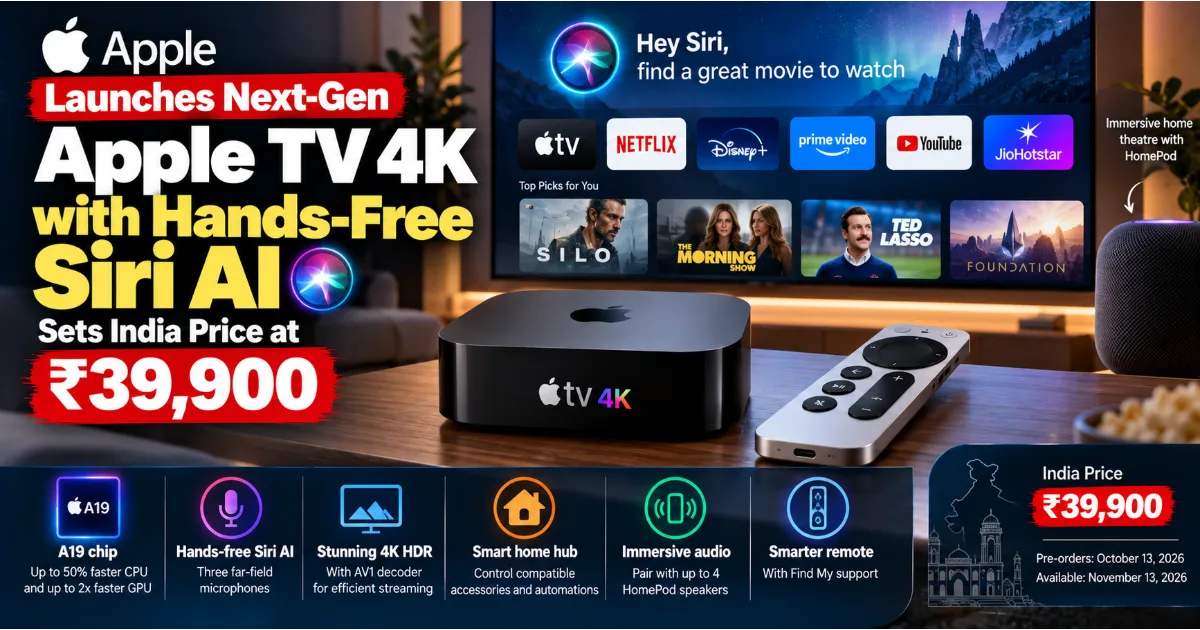
Apple is taking another step towards turning the living room into an intelligent, connected space with the launch of its next-generation Apple TV 4K. Announced on October 13, 2026, the new streaming device introduces a more conversational version of Siri AI, hands-free voice controls, faster processing and expanded smart home capabilities. Apple has priced the fourth-generation Apple TV 4K at ₹39,900 in India, placing it firmly in the premium segment of the streaming-device market.
The launch is significant because Apple is attempting to change how people interact with their televisions. Streaming devices have traditionally focused on bringing online video services, apps and games to the television screen. They have gradually added voice search, personalised recommendations and smart home integrations, but the basic experience has remained largely centred on browsing menus, selecting an app and choosing something to watch.
Apple's new approach places artificial intelligence closer to the centre of that experience. Instead of relying only on conventional voice commands, the upgraded Siri AI is designed to understand more natural questions, provide information about programmes and help viewers discover entertainment through a conversational, full-screen interface. Users can ask follow-up questions while watching a show, seek recommendations and, when the necessary Apple Intelligence features are configured, use personal context to locate content recommended by someone they know.
The hardware also receives meaningful upgrades. The new Apple TV 4K is powered by Apple's A19 chip, which the company says delivers up to 50 per cent faster CPU performance and up to twice the GPU performance of the previous generation. It also introduces three far-field microphones for hands-free Siri access, a dedicated AV1 decoder for more efficient streaming and an updated Siri Remote with Find My support.
Beyond entertainment, Apple is positioning the device as a central component of its connected-home ecosystem. It can control compatible smart home accessories, support automations and display notifications from compatible doorbells and security cameras. Apple also says that pairing the device with four compatible HomePod speakers can create a more immersive surround-sound arrangement than was previously possible in its Apple TV ecosystem.
For Indian consumers, however, the most immediate question may be whether these improvements justify a price of nearly ₹40,000. The answer will depend on how much value a household places on Apple's software ecosystem, the new Siri experience, home entertainment quality and smart home integration. Buyers who simply want to stream films and television programmes may find less expensive alternatives sufficient, while households already using several Apple products may see greater value in the additional features.
The new launch therefore represents more than a hardware refresh. It reflects Apple's broader attempt to bring its AI strategy into everyday household experiences, where voice interaction, entertainment and home automation can work together. Whether the device becomes a compelling purchase in India will depend not only on its technical specifications, but also on how well its promised intelligence works in real homes and whether consumers consider the premium price worthwhile.
Apple TV 4K: Price and Availability in India
Apple announced the fourth-generation Apple TV 4K on October 13, 2026. According to the company's official announcement, the new device is priced at ₹39,900 in India. Pre-orders opened on October 13, with availability beginning on November 13, 2026.
The price positions Apple TV 4K as a premium streaming product rather than an inexpensive accessory for an existing television. Buyers are paying for a combination of Apple hardware, its tvOS software platform, integration with other Apple products, support for smart home standards and the promise of a more capable Siri experience.
It is important to distinguish the device's purchase price from the cost of using it over time. Access to streaming libraries depends on the subscriptions and services a customer chooses. The Apple TV 4K hardware does not mean every film, television programme or third-party streaming service becomes available without additional payment. Users may need separate subscriptions for content offered by different providers.
The overall cost can therefore be higher than the price displayed on the product announcement, particularly for households that subscribe to several entertainment services or decide to add compatible HomePod speakers and smart home accessories. Consumers considering the purchase should evaluate the complete setup they intend to build rather than looking only at the streaming box.
Apple's positioning also means that the product is not aimed exclusively at people buying their first streaming device. It is likely to appeal most to users who value the Apple ecosystem, already use an iPhone or iPad, and want their television to work more closely with their other devices.
The November availability date gives prospective buyers time to compare the new model with existing Apple TV hardware and other streaming options. It also allows consumers to consider whether the new AI features are important enough to justify choosing the latest generation rather than purchasing an older device, where available.
Siri AI Becomes the Centre of the Entertainment Experience
The most important feature of the new Apple TV 4K is its integration of Siri AI. Apple describes this as a substantially more capable and conversational assistant powered by the next generation of Apple Intelligence. The system is designed to make finding and exploring entertainment more natural, reducing the need to navigate through multiple menus or search using only a few keywords.
Apple's announcement describes a full-screen Siri experience that presents programme artwork and relevant suggestions. Users can ask questions about awards, explore related genres and continue a conversation through follow-up questions. While watching a programme, they can ask for additional information without needing to leave the viewing experience entirely.
This approach could make content discovery more convenient, particularly for people who spend considerable time searching through large streaming catalogues. The difficulty with modern entertainment platforms is not always a lack of content. It is often the challenge of finding something suitable among hundreds of choices distributed across different applications.
A more capable assistant could help narrow those choices by interpreting what the viewer is asking for. If implemented well, the system could make the television feel less like a collection of separate apps and more like a single entertainment interface.
However, the usefulness of an AI assistant depends on the accuracy and relevance of its responses. A system that misunderstands a question, recommends unavailable content or fails to distinguish between similar titles can create frustration rather than convenience. It also needs to make clear which services provide the suggested content and whether accessing it requires a separate subscription.
Apple's announcement describes the intended experience, but actual performance will depend on the software, supported services, language settings and availability of individual features. Consumers should therefore distinguish between the capabilities Apple has announced and the experience they will receive in every application or region.
The significance of Siri AI is not that voice control itself is new. Voice assistants have been available on televisions and streaming devices for years. Apple's objective is to make voice interaction more contextual and conversational, allowing viewers to ask more complex questions and explore content through a continuing dialogue.
If that experience proves reliable, it could become one of the most important differences between the new Apple TV 4K and conventional streaming devices.
Hands-Free Voice Control Without Reaching for the Remote
One of the most practical hardware changes is the addition of three far-field microphones. These microphones allow users to interact with Siri without holding the remote or speaking directly into it. Apple says its echo-cancellation technology is designed to distinguish the user's voice from background audio, allowing voice recognition even while a programme is playing.
This changes the way the device can be used in an ordinary living room. A viewer sitting across the room could ask Siri to find a programme, pause playback or help discover something to watch without searching for the remote. The feature could also be useful when the remote is on a table, under a cushion or simply out of reach.
Hands-free interaction is particularly relevant in homes where several people share the television. Family members may want to search for different programmes, control playback or manage connected devices without interrupting what they are doing. A voice interface could make these actions easier, provided the system recognises commands accurately and responds in a predictable way.
The feature also creates questions about microphone privacy. A device designed to listen for a wake phrase must be able to detect that phrase while remaining ready for use. Consumers may want to understand how voice data is processed, what information is sent to remote servers and what controls are available for managing microphone access.
Apple says the new Apple TV 4K and its A19 chip include Secure Exclaves, which isolate microphone data processing from the rest of the system. The company also says Siri requests can be processed on the device or through Private Cloud Compute, with data handled by Private Cloud Compute neither stored nor made accessible to Apple.
These are important privacy commitments, particularly for a device intended to remain in a shared living space. However, privacy-conscious buyers should still review the relevant settings, supported features and terms of service. The way a particular request is handled can depend on the task and whether on-device or cloud processing is required.
Hands-free microphones are therefore more than a convenience feature. They are part of Apple's attempt to make the television a continuously available interface for entertainment and home control. The success of that approach will depend on balancing ease of use with clear privacy safeguards.
The A19 Chip Promises a Faster Experience
The new Apple TV 4K is powered by Apple's A19 chip, bringing a substantial performance upgrade over the previous generation. Apple says the processor delivers up to 50 per cent faster CPU performance and up to twice the GPU performance compared with the earlier model. It also includes a dedicated AV1 decoder to support more efficient, high-quality video streaming while using less bandwidth.
The CPU improvement is expected to support faster navigation, more responsive applications and smoother transitions through the interface. The GPU upgrade can help with graphics-heavy tasks, including games and visual effects. These changes may be especially noticeable when switching between applications, browsing content or using features that require more processing power.
The dedicated AV1 decoder is another relevant improvement because AV1 is a modern video codec designed to deliver good visual quality at comparatively efficient bitrates. Hardware decoding can reduce the processing burden on the device and potentially improve streaming efficiency when a service provides compatible AV1 content.
The actual benefit depends on several factors. Streaming services must offer content in supported formats, network conditions must be suitable and the television must support the relevant video capabilities. A more powerful chip cannot eliminate buffering caused by an unreliable internet connection, nor can it improve every video if the source material itself is limited.
Performance specifications should also be interpreted in context. A percentage improvement in CPU or GPU performance does not necessarily translate into an equally large improvement in everyday viewing. Most conventional streaming tasks do not require the same processing resources as demanding games or complex applications.
The A19 chip's value may become more apparent as Apple adds more advanced AI features, interactive interfaces and home automation functions. More processing capacity can give the software room to grow, although it does not guarantee that every future feature will be supported on every model.
For buyers upgrading from a much older streaming device, the new processor may provide a more responsive overall experience. For people who already own a recent Apple TV 4K and mainly watch films or television, the difference may be less dramatic in everyday use. The decision will depend on which new features matter most to the household.
A Smarter Siri Remote With Find My Support
Apple has retained the familiar overall design of the Siri Remote while adding Find My support. The feature is intended to make it easier to locate a misplaced remote, an everyday frustration in many homes. Depending on the supported device and region, users can use Precision Finding or play a sound to help locate the remote.
Although this may appear less significant than AI or processor improvements, it addresses a practical problem. Streaming devices are often used in shared spaces where remotes can be left in different rooms, buried under blankets or moved by other members of the household. A built-in way to locate the remote can save time and reduce the need to search manually.
Apple says Find My support is available on the Siri Remote from the second generation onward, while Precision Finding on the new remote has specific compatibility requirements involving supported iPhone models and software. Availability also varies by region.
This means that users should not assume every iPhone can provide the same locating experience. The exact functionality depends on compatible hardware, software and regional support. The remote's other controls remain important as well, since many users will continue to prefer physical buttons for playback, navigation and volume.
The remote upgrade reflects Apple's broader approach to product design. Rather than replacing every familiar interaction with voice commands, the company is combining physical controls with AI-powered assistance. Users can choose the method that suits the situation, whether they want to speak to Siri, browse menus or press a button.
That combination may be more useful than a purely voice-based system. Voice is convenient for discovery and open-ended requests, while physical controls can be faster and more reliable for precise actions such as pausing a programme or moving through a menu.
Apple Wants to Improve the Home Theatre Experience
The new Apple TV 4K is also designed to work more closely with Apple's HomePod speakers. Apple says users can pair the device with four compatible speakers, including HomePod mini 2 or the second-generation HomePod, to create a more immersive surround-sound setup.
For households that already own compatible speakers, this could make it easier to create a home theatre system without investing in a traditional receiver and a large collection of separate speakers. The system is designed to calibrate sound automatically, helping establish a more balanced listening experience in the room.
Sound quality, however, depends on more than the streaming box. Room dimensions, furniture placement, speaker positioning and the audio format of the content all influence the result. A well-configured speaker system can improve dialogue clarity and create a stronger sense of immersion, but the outcome will vary between homes.
Buyers should also consider the additional cost. The ₹39,900 Apple TV 4K price does not include the compatible HomePod speakers needed for a multi-speaker setup. A household starting from scratch would need to budget separately for audio equipment. For some buyers, a dedicated soundbar or an existing home theatre system may be a more cost-effective option.
The appeal of Apple's approach is integration. A household using Apple TV, HomePod, iPhone and other compatible products may find the setup more straightforward because the devices are designed to work within the same ecosystem. That convenience can be valuable, but it also encourages customers to buy additional products from the same brand.
For people who care deeply about sound quality, the new arrangement is worth watching. For casual viewers using television speakers, the extra capability may not be a major reason to upgrade. The value depends on how much the household prioritises cinema-style audio and whether it already owns compatible equipment.
Apple TV 4K Becomes a More Capable Smart Home Hub
Apple is positioning the new device as more than a streaming box. It can act as a home hub, allowing users to control compatible accessories, manage automations and interact with devices connected through Apple's smart home platform. Built-in Wi-Fi and Thread support help it connect with compatible accessories, while HomeKit Secure Video capabilities can bring camera-related functions into the television experience.
Imagine watching a film when a compatible smart doorbell detects a visitor. Instead of reaching for a separate phone immediately, the household can receive a notification on the television, view the visitor and, where the doorbell and connected accessories support it, communicate with the person at the door. Users may also be able to control other connected devices without leaving the viewing experience.
Apple also describes AI-generated camera activity descriptions and summarised notifications in the Home app. These features are intended to make security alerts easier to understand, rather than forcing users to review every event individually. Their availability depends on compatible cameras, devices, software and an eligible iCloud+ plan.
This could make the Apple TV 4K more useful throughout the day. The television may be used for entertainment in the evening, smart home control during the day and access to household notifications whenever the screen is active. The value comes from combining functions that would otherwise be spread across separate devices and applications.
However, smart home compatibility remains an important consideration. Not every connected device supports Apple's ecosystem, and some features require additional hardware or subscriptions. Consumers should check whether their existing cameras, lights, locks and other accessories work with the Apple Home platform before purchasing the device primarily for home automation.
Security is equally important. Smart home devices can provide useful convenience, but they also need strong access controls, secure software and responsible data handling. Apple's emphasis on secure local processing and encrypted HomeKit Secure Video is relevant, although the actual protection available depends on the specific configuration and compatible equipment.
The wider strategy is clear: Apple wants its products to work together as a connected household system. The Apple TV 4K can become one of the central interfaces for that system, bringing entertainment, voice assistance and home control into a single experience.
What Does the Launch Mean for Apple's AI Strategy?
The new Apple TV 4K arrives as Apple expands Siri AI across its software and devices. The company announced its next generation of Apple Intelligence and Siri AI earlier in 2026, describing a more conversational assistant with personal context understanding, broader knowledge and the ability to take additional actions across applications.
Bringing that experience to the television is a meaningful change because the living room has different requirements from a phone or computer. People often use a television while sitting at a distance, sharing the room with family members or focusing on another activity. An assistant must work through short spoken requests, present useful information clearly and avoid interrupting the main experience.
A full-screen interface can help users explore content, while a smaller overlay can answer follow-up questions without covering the entire programme. Personal context could also make discovery more relevant when the system has access to supported information from a compatible Apple device.
This approach could reduce the need to navigate multiple apps manually. Instead of opening a streaming service and searching within it, viewers may increasingly expect the television's assistant to help them find an appropriate title and direct them to the relevant service.
Yet Apple's success will depend on how well Siri AI performs in real-world situations. A sophisticated interface is useful only if the assistant understands requests, provides accurate information and handles ambiguity well. Users will also expect it to work consistently across supported applications and services.
The beta status of Siri AI is therefore important. Apple says the feature is available in beta and launches in English in India, among other supported markets. Some capabilities require a compatible Apple Intelligence-enabled iPhone or iPad, the latest software and appropriate language settings.
Consumers should not interpret the launch as a promise that every AI function will work in every language or with every device. The experience may evolve through software updates, and individual features can have different requirements. Apple's ability to improve the assistant over time will be an important factor in determining the long-term value of the hardware.
Is ₹39,900 Too Expensive for an Indian Consumer?
The Indian price is likely to be one of the biggest talking points surrounding the new Apple TV 4K. At ₹39,900, it is a significant purchase for a device whose primary role for many households may be streaming video on a television they already own.
For buyers who simply want access to popular streaming services, less expensive streaming devices may meet their needs. If the television already has a capable built-in operating system, the household may not need a separate streaming box at all. In those cases, the Apple TV 4K's additional processing power and AI features may not justify the cost.
The calculation changes for users who already own an iPhone, iPad, HomePod or other Apple devices. Integration can reduce friction between products and provide access to features that may not be available in the same form elsewhere. Those buyers may value the consistent interface, remote location feature, connected-home functions and the ability to interact with Siri AI from the television.
Another consideration is longevity. A more powerful chip and Apple's software ecosystem may help the device remain useful as applications and services evolve. However, no consumer should assume that a higher price guarantees a specific number of years of software support or that every future AI feature will be available on the device.
Potential buyers should consider their actual usage. Someone who watches films every evening, uses Apple devices throughout the home and wants to build a connected entertainment system may find the purchase easier to justify than someone who streams occasionally. The additional cost of subscriptions, speakers and smart home equipment should also be included in the budget.
The new model is best understood as a premium product for a particular audience, not necessarily the default choice for every television owner in India. Its price reflects a broader set of capabilities than basic streaming, but customers must decide whether those capabilities solve problems they actually have.
Privacy, Sustainability and the Questions Buyers Should Ask
As AI becomes more deeply integrated into household devices, privacy will be an important consideration for consumers. A television that listens for voice commands, processes personal requests and connects to cameras or smart locks handles information that can reveal details about daily life.
Apple says the new Apple TV 4K uses Secure Exclaves to isolate microphone data processing and supports on-device processing or Private Cloud Compute for Siri requests. The company states that data processed through Private Cloud Compute is neither stored nor made accessible to Apple. HomeKit Secure Video footage is end-to-end encrypted and not accessible to Apple.
These protections are an important part of Apple's stated approach, but buyers should still understand which features require cloud processing, which devices need to be linked and how permissions are configured. Households should also secure their Apple accounts and connected accessories, keep software updated and review access to cameras and other sensitive devices.
Sustainability is another part of the announcement. Apple says the new Apple TV 4K uses recycled materials, including recycled gold plating and tin solder in Apple-designed printed circuit boards, recycled rare earth elements in magnets, and recycled aluminium in the thermal module and Siri Remote enclosure. Its packaging is described as fibre-based and designed for recycling.
These material choices contribute to Apple's wider environmental objectives, although the overall environmental impact of a device also depends on manufacturing, transport, electricity use, repairability and how long consumers keep it. Extending the useful life of electronics and responsibly recycling old equipment remain important considerations for buyers.
Conclusion: More Than a Streaming Box, but Not for Everyone
Apple's fourth-generation Apple TV 4K brings together several changes that could make the living room more intelligent and connected. The ₹39,900 device introduces Siri AI with hands-free voice interaction, a more powerful A19 chip, an updated remote with Find My support, improved streaming efficiency and expanded smart home capabilities. Apple has announced availability beginning November 13, 2026, following pre-orders that opened on October 13.
The most important development is the move towards conversational television. If Siri AI can reliably understand what viewers want, help them discover content and answer questions without disrupting the programme, it could make entertainment easier to navigate. The ability to control compatible home accessories through the same device may further strengthen its appeal to households already invested in Apple's ecosystem.
At the same time, the product's value depends on how well these features work in practice. Siri AI remains in beta, language and hardware requirements apply, and certain smart home functions require compatible accessories or subscriptions. Buyers should evaluate the announced capabilities alongside their own needs rather than assuming every feature will work universally.
The price is another important factor. At ₹39,900, Apple TV 4K is a premium streaming product. Its strongest case is for consumers who want more than access to streaming apps and who value Apple's approach to software integration, privacy and connected-home control. For households that simply want to watch films and television programmes, cheaper alternatives may be perfectly adequate.
Ultimately, Apple is attempting to make the television a more active part of the connected home. Instead of being only a screen for watching content, it can become a place to ask questions, discover entertainment, manage household devices and interact with an AI assistant. Whether this vision becomes a mainstream expectation will depend on reliability, affordability and the everyday usefulness of the experience.
The real test for Apple's new Apple TV 4K is not how many AI features it offers, but whether those features make watching television and managing the home genuinely easier.
#BeyondHeadlines #Apple #AppleTV4K #SiriAI #AppleIntelligence #AppleIndia #TechnologyNews #SmartHome #StreamingDevices #HomeTheatre #ArtificialIntelligence #ConsumerTechnology #TechLaunch #GadgetsIndia #BeyondTheHeadline