
The Reality Behind a Disturbing Statistic
When people imagine sexual violence, one of the most common scenarios that comes to mind is an attack by a stranger in an isolated place. News reports about assaults in public spaces, frightening journeys home and crimes committed by unknown individuals have contributed to this perception. While such crimes are real and deserve serious attention, India's crime statistics point towards another reality that is equally important to understand: sexual violence frequently involves someone the survivor already knows.
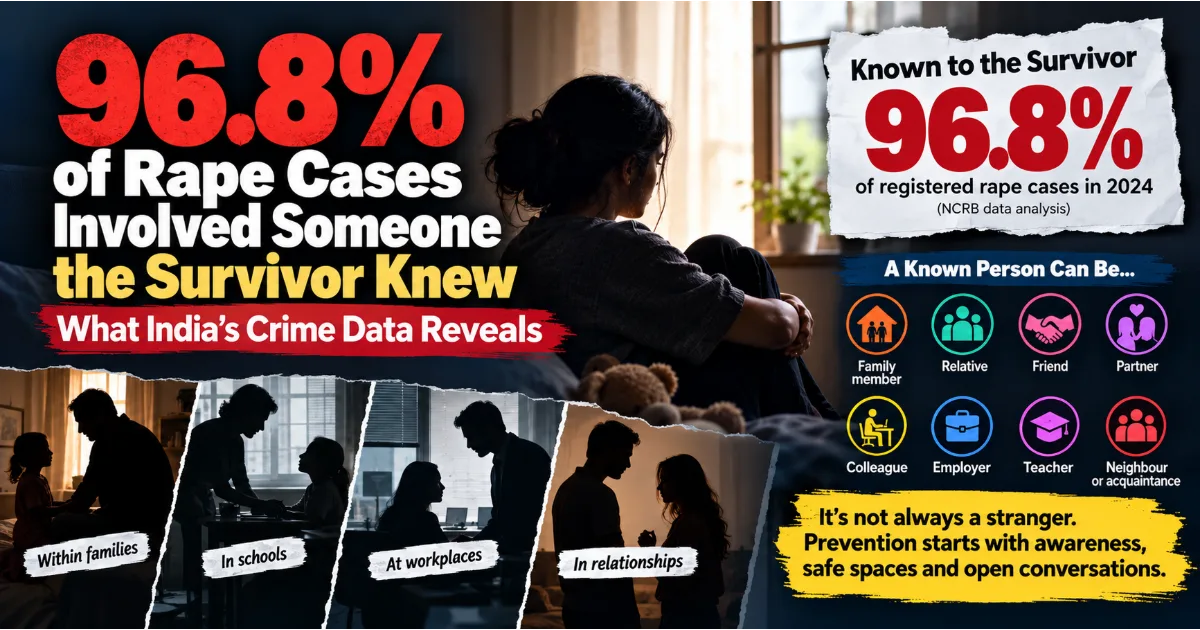
An analysis of India's 2024 crime statistics by the Centre for Economic Data and Analysis at Ashoka University reported that the accused was known to the survivor in 96.8% of registered rape cases. The findings have renewed attention to the relationships between survivors and accused persons, the circumstances in which sexual violence occurs and the limitations of public perceptions about personal safety.
The figure is alarming, but it must be interpreted accurately. It refers to the relationship between the survivor and the accused in registered cases. It does not mean that 96.8% of all sexual violence in India has been captured by official records, nor does it establish the outcome of every investigation or trial. It also does not mean that every accused person in the dataset has been convicted.
The distinction matters because crime statistics describe cases that come to the attention of the authorities and are recorded under particular legal categories. They cannot capture every incident that remains unreported, and they must not be used to treat an allegation as a final judicial finding.
Nevertheless, the statistic raises an urgent question. If the accused in most registered rape cases is someone the survivor knows, why does public discussion of sexual violence so often concentrate on strangers? The answer has implications for family safety, schools, workplaces, relationships, community awareness and the way society responds when someone reports abuse.
The issue is not simply about learning a percentage. It is about understanding how trust, familiarity, social pressure and unequal power can influence a person's safety, and why prevention must extend beyond the streets into places where people live, study, work and build relationships.
What Does the 96.8% Figure Actually Tell Us?
The reported figure comes from an analysis of the National Crime Records Bureau's 2024 crime data. It indicates that, among the registered rape cases covered by the analysis, the accused was known to the survivor in 96.8% of cases. The analysis also highlighted friends and intimate partners among the important categories of known accused persons.
The phrase "known to the survivor" covers a wide range of relationships. It can include a relative, neighbour, family friend, colleague, employer, teacher, acquaintance, friend or intimate partner. The exact relationship varies from case to case, and the headline percentage does not mean that all cases involved the same kind of relationship.
Knowing someone does not automatically make that person dangerous, just as being a stranger does not automatically make someone a threat. Most everyday relationships do not involve sexual violence. The significance of the statistic is that familiarity alone cannot be treated as a guarantee of safety.
It also does not follow that every case involving a known accused occurred inside a home or within a family. An incident may take place in a private residence, a workplace, an educational setting, a vehicle, a public place or another environment. The relationship category describes how the people involved knew one another, not necessarily where the alleged offence occurred.
Another important distinction concerns the meaning of "registered cases." Official statistics generally describe incidents that have been reported to the police and recorded under the relevant legal provisions. They do not provide a complete count of every incident of sexual violence that occurred during the year. Many survivors may never report what happened, for reasons that include fear, shame, financial dependence, threats, social pressure or a lack of confidence in the justice system.
The 96.8% figure should therefore be understood as a finding about recorded cases, not as a complete measurement of the prevalence of sexual violence throughout India. It is still a significant finding because it challenges the assumption that the main danger comes from unknown people encountered in public spaces.
Responsible interpretation also requires distinguishing an accused person from a convicted offender. Police registration, investigation, prosecution and conviction are different stages of the criminal justice process. The statistical finding describes the relationship recorded in the dataset. It should not be used to declare any individual guilty without the due process required by law.
These distinctions do not make the issue less serious. They help ensure that the public discussion remains accurate, fair and focused on prevention, accountability and support for survivors.
Why Familiarity Can Make Abuse More Difficult to Recognise
Trust is an important part of everyday life. People depend on relatives, friends, colleagues, teachers, neighbours and partners for emotional support, practical assistance and a sense of belonging. Children depend on adults to protect them, while adults often rely on people close to them during periods of illness, financial difficulty or personal stress.
That trust is essential for healthy relationships, but it can also make it harder to recognise or disclose abuse when someone violates another person's boundaries. A survivor may find it difficult to accept that a person they trusted could have harmed them. They may initially question their own understanding of the incident, particularly when the accused is someone they have known for years.
In some situations, the accused may have a position of authority or influence. A person may depend on a relative for housing, a partner for financial support, an employer for income or a teacher for educational opportunities. Such dependencies can make reporting feel risky, even when the survivor understands that what happened was wrong.
The relationship may also involve other people whose opinions matter to the survivor. If the accused is respected within a family or community, the survivor may fear that others will automatically defend that person. They may worry about being blamed, losing relationships or being forced to leave their home.
Children can face additional barriers because they may not have the vocabulary to describe what happened or the confidence to challenge an adult. A child may understand that an experience was frightening or uncomfortable without fully understanding its sexual nature. If the person involved is a trusted adult, the child may also have been taught to obey that person.
None of these circumstances means that every familiar relationship contains a hidden threat. Rather, they show why prevention cannot rely solely on warning people to avoid strangers. It must also help people recognise inappropriate behaviour, understand personal boundaries and seek support when someone violates those boundaries.
Familiarity should never be treated as proof that a person is safe in every circumstance. Trust is valuable, but it does not remove the need for respect, consent and accountability.
The Myth of the Stranger Danger Narrative
Public safety campaigns have often concentrated on unknown individuals, particularly when discussing children's safety and women's security. Advice about avoiding isolated areas, staying alert in unfamiliar surroundings and seeking help from trusted people can be useful in specific situations. However, if these warnings become the entire conversation about sexual violence, they may leave people unprepared to recognise abuse within familiar relationships.
The stranger danger narrative can create a false sense of security around people who are already part of a person's life. Parents may worry about an unknown individual approaching their child but feel less concerned about someone who regularly visits the home. A workplace may focus on security at the entrance while paying less attention to misconduct by a supervisor. A family may teach a young person to avoid strangers but never explain that relatives and acquaintances must also respect personal boundaries.
The answer is not to make people suspicious of everyone they know. Such an approach would damage trust without offering a practical solution. Instead, safety education needs to focus on behaviour, boundaries and the ability to seek help.
A child should understand that no adult is entitled to touch them in a way that makes them uncomfortable, demand secrecy about inappropriate conduct or threaten them for telling someone what happened. A teenager should understand that a relationship does not create an automatic right to another person's body, private information or decisions. An adult should know that consent must be freely given and can be withdrawn.
These principles apply regardless of whether the people involved are strangers, acquaintances, relatives or romantic partners. They also apply in situations where alcohol, social pressure, emotional dependence or a person's position of authority may make it difficult for someone to express their wishes.
Public awareness campaigns can help correct the imbalance by discussing both stranger-related risks and abuse involving known people. They should explain how to identify coercion, where to seek assistance and how to respond when someone discloses an experience of abuse.
The central message is straightforward: knowing a person does not make their behaviour automatically acceptable, and no relationship gives anyone permission to violate another person's boundaries.
Consent Is About Choice, Not the Relationship
Consent is one of the most important concepts in preventing sexual violence, yet public discussions sometimes treat it as a subject relevant only to strangers or casual encounters. In reality, consent matters in every relationship, including marriage, dating, long-term partnerships and relationships between people who have known each other for many years.
Consent means that a person freely agrees to a particular activity. It cannot be assumed from a person's clothing, past behaviour, relationship status or decision to spend time with someone. Agreeing to one activity does not mean agreeing to everything else, and consent can be withdrawn at any time.
A relationship does not create permanent permission. A person who has previously agreed to intimacy is not required to agree again. Marriage does not remove the importance of bodily autonomy, and an emotional relationship does not give either partner ownership over the other.
Coercion can also undermine meaningful choice. Threats, intimidation, manipulation and the exploitation of dependence can prevent a person from making a decision freely. Someone may appear to comply because they fear the consequences of refusing, not because they genuinely consent.
These distinctions are particularly important when the accused is a person the survivor knows. The familiarity of a relationship may lead outsiders to assume that an encounter was consensual or that the survivor should have been able to prevent the situation. Such assumptions can ignore the realities of pressure, fear and unequal power.
The responsibility for respecting consent belongs to every person involved. It is not the survivor's responsibility to anticipate or manage another person's decision to violate a boundary.
Consent education should begin with clear, age-appropriate explanations of bodily autonomy and respect. Children need to know that they can speak up when something feels wrong and that they should be listened to. Teenagers and adults need to understand that consent must be ongoing and voluntary, rather than inferred from a relationship or a previous encounter.
A society that takes consent seriously does not treat it as a slogan. It builds the principle into family conversations, school education, workplace policies and the way institutions respond when someone reports abuse.
Children and the People They Are Expected to Trust
The relationship between sexual violence and familiarity becomes especially important when children are involved. Children depend on adults for protection, guidance and access to basic needs. They may not have the independence or social authority to challenge an adult, particularly when that person is a relative, family friend, teacher, coach or another trusted figure.
Research and crime reporting have repeatedly drawn attention to sexual offences against children committed by people known to them. An India Today analysis of NCRB data for 2023 reported that 96.6% of registered rape cases involving children in the relevant reporting category involved a person known to the child. That finding relates to a particular year and dataset, and it should not be confused with the separate 96.8% figure reported in the analysis of 2024 rape cases.
The overlap in these findings makes child safeguarding a crucial part of the discussion. Children are not always able to recognise grooming, manipulation or inappropriate behaviour, especially when an adult gradually crosses boundaries while presenting the behaviour as affection, a game or a secret shared between them.
Grooming can involve building a child's trust, gaining access to them, isolating them from others or making them feel responsible for keeping inappropriate conduct secret. It may also involve gaining the confidence of parents or caregivers. Not every situation involving a trusted adult is suspicious, and behaviour should be assessed carefully, but children need protection systems that do not depend entirely on adults assuming that familiar people are safe.
Parents and caregivers can help by teaching children the names of body parts in an age-appropriate way, explaining personal boundaries and encouraging them to speak freely about uncomfortable experiences. Children should understand that they can say no to unwanted contact, seek help from a safe adult and disclose a concern without being punished for speaking up.
It is equally important to avoid placing the entire burden of prevention on children. A child may freeze, comply out of fear or struggle to explain what happened. Adults and institutions must create environments where concerns are taken seriously and children are not blamed for an adult's behaviour.
Schools, childcare centres, sports organisations and other institutions working with children need clear safeguarding procedures. These should include appropriate recruitment checks where applicable, supervision arrangements, accessible reporting channels, prompt responses to concerns and compliance with the law.
In India, the Protection of Children from Sexual Offences Act, commonly known as POCSO, provides a legal framework for addressing sexual offences against children. Its existence is important, but effective protection also requires awareness, trained personnel, child-sensitive procedures and coordination between families, schools, healthcare providers and law enforcement.
The objective is not to teach children to fear every adult. It is to help them understand their rights while ensuring that the adults and institutions responsible for their care take those responsibilities seriously.
Why Survivors May Not Report Sexual Violence
Official crime statistics cannot fully describe the scale of sexual violence because reporting depends on whether survivors feel able to approach the authorities. Some incidents are reported promptly, while others remain undisclosed for months or years. In some cases, a survivor may never report what happened.
Fear of social consequences can be a major barrier. A survivor may worry that relatives will blame them, that a partner will become violent, that neighbours will spread rumours or that their family will face social exclusion. These fears may be particularly intense when the accused is a relative or someone with influence in the community.
Financial dependence can make the decision more complicated. A person who relies on an accused individual for housing, education, employment or basic expenses may fear losing the resources needed to survive. A child may have no independent means of seeking help, while an adult in a controlling relationship may face threats if they attempt to leave.
There may also be concern about how institutions will respond. Survivors can fear being questioned in an insensitive manner, having their private information exposed or being forced to repeat traumatic details unnecessarily. Delays, complicated procedures and uncertainty about the legal process can add to those concerns.
In some cases, survivors may not immediately recognise an incident as sexual abuse. This can happen when coercion occurs within a relationship that the survivor has been taught to regard as normal, or when an incident involves manipulation rather than obvious physical force. Children may need time and support to understand what happened.
These barriers show why reporting cannot be improved through slogans alone. People need accessible reporting channels, trained responders, confidential handling of sensitive information within the limits of the law and practical protection against threats or retaliation.
Families and communities also have an important role. When a person discloses abuse, the first response should be to listen without blame, take the concern seriously and help them reach appropriate professional support. Demanding immediate proof, questioning why the person did not report earlier or pressuring them to protect the family's reputation can make disclosure more difficult.
A report is not the same as a final court judgment, and allegations must be investigated fairly. At the same time, fairness to the accused does not require humiliating or discrediting a survivor. A justice system can protect due process while treating people who report sexual violence with dignity.
Better reporting conditions can help authorities understand the problem more accurately. But an increase in registered cases should not automatically be interpreted as proof that sexual violence itself has increased. It may also reflect greater awareness, improved reporting or increased willingness to approach the police.
How Families and Communities Can Help Prevent Abuse
Prevention begins with the recognition that safety is not achieved simply by controlling where people go or whom they meet. It also requires clear expectations about behaviour and a willingness to intervene when those expectations are violated.
Within families, adults can make it easier for children and other relatives to speak about uncomfortable experiences. This means listening carefully, avoiding automatic loyalty to the person accused and refusing to dismiss concerns simply because the individual is respected or closely connected to the family.
Parents can discuss personal boundaries without making children feel ashamed of their bodies. Children should know that affection must be appropriate and that no one should threaten them or demand secrecy about conduct that makes them uncomfortable. They should also know that if one adult does not listen, they can approach another trusted adult or an appropriate support service.
Schools and colleges can reinforce these principles through age-appropriate education about consent, respect, digital safety and reporting. Educational programmes should explain how to seek help when someone uses threats, pressure or a position of authority to cross boundaries. They should also provide clear information about the people and services students can approach.
Workplaces need policies that address sexual harassment, abuse of authority and retaliation. Employees should have access to reporting mechanisms that are understandable and reasonably accessible. Managers must be trained to respond to concerns appropriately, and organisations should ensure that complaints are not dismissed because the person accused is senior, influential or well connected.
Community organisations can help challenge harmful attitudes that place responsibility on survivors to preserve family honour or avoid bringing shame to a group. Sexual violence is not made acceptable by a person's social position, religious standing, professional reputation or relationship to the survivor.
At the same time, prevention efforts must avoid turning into campaigns of suspicion against entire groups. A relative, teacher, neighbour or colleague should not be treated as dangerous merely because of their relationship to someone. The focus should remain on appropriate behaviour, safeguarding, accountability and the ability to seek help when boundaries are violated.
The goal is to create environments in which people can maintain healthy relationships without being expected to tolerate coercion or abuse. Trust should be strengthened through respect and accountability, not preserved by silencing people who raise concerns.
The Role of Police, Courts and the Justice System
Crime statistics can identify patterns, but the response to sexual violence depends on how effectively institutions investigate complaints, protect survivors and apply the law. When an accused person is known to the survivor, the investigation may involve complicated family relationships, shared living arrangements, financial dependencies or pressure from people who want the matter to remain private.
Police must be able to investigate complaints impartially, preserve relevant evidence and follow the applicable legal procedures. Survivors should receive clear information about the process and be treated with dignity. Where threats or intimidation are present, authorities must assess the need for appropriate protection and take action within their legal powers.
The justice system must also protect the rights of the accused. An allegation requires proper investigation, and criminal guilt must be determined through the applicable legal process. Recognising the seriousness of sexual violence and respecting due process are not competing objectives. Both are necessary for a credible system of justice.
Delays can create additional difficulties. Evidence may become harder to obtain, witnesses may become unavailable and survivors may experience prolonged uncertainty. Timely investigations and trials, appropriate support services and sensitive procedures can help reduce some of these burdens.
The legal process should not require survivors to face unnecessary humiliation. Personal information must be handled responsibly, and officials should avoid questions or practices that rely on stereotypes about how a survivor should behave. A person's emotional response, relationship with the accused or delay in reporting cannot, by itself, settle the facts of a case.
Public understanding of these principles matters because misinformation can undermine confidence in the justice system. Crime reports sometimes describe an arrest or a police complaint as if it were already a conviction. Responsible reporting should distinguish between allegations, charges, trial proceedings and final judgments.
There is also a need for better public access to reliable crime data. Statistics become more useful when the definitions, categories and limitations are clearly explained. Researchers, journalists and policymakers should be able to examine patterns without turning percentages into unsupported claims about every individual case.
The aim should be a system in which complaints are taken seriously, investigations are fair, survivors can access support and courts can reach decisions based on evidence and law.
How Media Coverage Shapes Public Understanding
News coverage plays a powerful role in determining how people understand sexual violence. When a case involves a stranger, the story may focus on public safety, surveillance cameras, transport arrangements or the danger of isolated locations. When the accused is a relative, partner or acquaintance, the story may involve family relationships, questions of trust and pressure to keep the matter private.
Both kinds of cases deserve careful reporting. The problem arises when coverage of dramatic stranger attacks dominates public attention while the wider patterns in crime data receive less discussion.
The 96.8% statistic offers an opportunity to broaden that conversation. It encourages audiences to consider the environments in which sexual violence can occur and to recognise that familiarity does not eliminate the need for boundaries and accountability.
However, the statistic should not be used merely to provoke fear. Headlines that imply that nearly everyone known to a survivor is a potential offender would be inaccurate and harmful. Most relationships are not abusive, and a broad relationship category cannot tell us that a particular individual poses a risk.
Journalists should also avoid identifying survivors or publishing details that could reveal their identities, particularly in sensitive cases involving children or vulnerable people. Privacy is not a minor consideration. Unnecessary exposure can increase distress, invite harassment and discourage others from seeking help.
Responsible reporting should explain what the data measures, identify the year and source, distinguish allegations from convictions and avoid unsupported conclusions about the motives of survivors or accused persons.
The same principles apply when statistics circulate through social media. A percentage shared without context can quickly become a misleading claim. Readers should check whether the figure refers to registered cases, a particular age group, a specific state or a national dataset.
The objective of journalism should be to inform the public and support a more accurate understanding of the issue. Sensationalism may attract attention, but clear reporting can help people recognise risks, understand their rights and consider practical ways to improve safety.
What the Statistic Means for India
The finding that the accused was known to the survivor in 96.8% of registered rape cases is a reminder that sexual violence cannot be addressed only through measures designed to protect people from strangers. Public safety remains important, but prevention must also consider relationships, institutions and situations in which familiarity or authority can make it difficult to recognise or report abuse.
For families, this means creating an environment where children and adults can speak about uncomfortable experiences without automatically being blamed. For schools and workplaces, it means having clear safeguarding policies and reporting procedures. For communities, it means challenging the idea that protecting a family's reputation is more important than protecting a person who reports harm.
For the government and law enforcement agencies, it means continuing to improve access to reporting, the quality of investigations, survivor support and public information. For the media, it means presenting crime statistics with accuracy and explaining their limitations rather than turning them into exaggerated claims.
It also means recognising that different groups face different barriers. Children may lack the ability to explain what happened or approach authorities independently. Adults who depend financially on an accused person may fear losing their livelihood or home. People living in isolated areas may have fewer support services nearby. Policies must account for these realities rather than assume that everyone can report abuse in the same way.
The data should not be used to create distrust in every personal relationship. Trust is necessary for families, friendships, workplaces and communities to function. What must change is the assumption that trust should prevent questions from being asked or concerns from being investigated.
A healthy relationship is one in which boundaries are respected and a person can say no without fear. A safe institution is one in which concerns are handled seriously, regardless of the accused person's status. A responsible community is one that supports people who speak up instead of pressuring them into silence.
Conclusion: Familiarity Should Never Replace Accountability
The reported finding that 96.8% of accused persons in registered rape cases were known to the survivor is one of the most important reasons to rethink how sexual violence is discussed in India. It challenges the narrow image of sexual assault as primarily a crime committed by a stranger and draws attention to the relationships in which many recorded cases occur.
The figure does not represent every incident of sexual violence, because official records cannot capture all unreported cases. Nor does it mean that every accused person has been convicted. It is a finding about registered cases and the relationships recorded in the data. Those limitations must remain clear whenever the statistic is quoted.
Even with those qualifications, the finding highlights a serious public concern. Prevention must include education about consent, personal boundaries and coercion. Children need effective safeguarding, workplaces need clear policies and survivors need accessible ways to seek help. Police and courts must investigate fairly, while families and communities must resist the pressure to silence people in order to protect reputations.
The larger lesson is that safety cannot be determined by familiarity alone. A person may be trusted, respected or closely connected to a family and still be responsible for unacceptable behaviour. Relationships should be built on respect, and concerns about abuse should be assessed seriously rather than dismissed because of who is involved.
India's response to sexual violence will depend not only on laws and enforcement but also on the everyday attitudes that influence whether people recognise abuse, report it and support those who disclose it. Meaningful change requires institutions that work, communities that listen and a culture in which consent and accountability apply to every relationship.
The most useful way to understand the 96.8% figure is not as a reason to fear everyone we know, but as a reason to look beyond the familiar narrative of stranger danger. Sexual violence must be addressed wherever it occurs, and no relationship should place anyone beyond accountability.
#BeyondHeadlines #IndiaCrimeNews #SexualViolence #RapeStatistics #NCRB #WomensSafety #ChildSafety #ConsentMatters #SexualAssaultAwareness #JusticeForSurvivors #POCSO #PublicSafety #GenderEquality #SurvivorSupport #CrimeData #SocialAwareness #ChildProtection #PersonalBoundaries #BeyondTheHeadline